
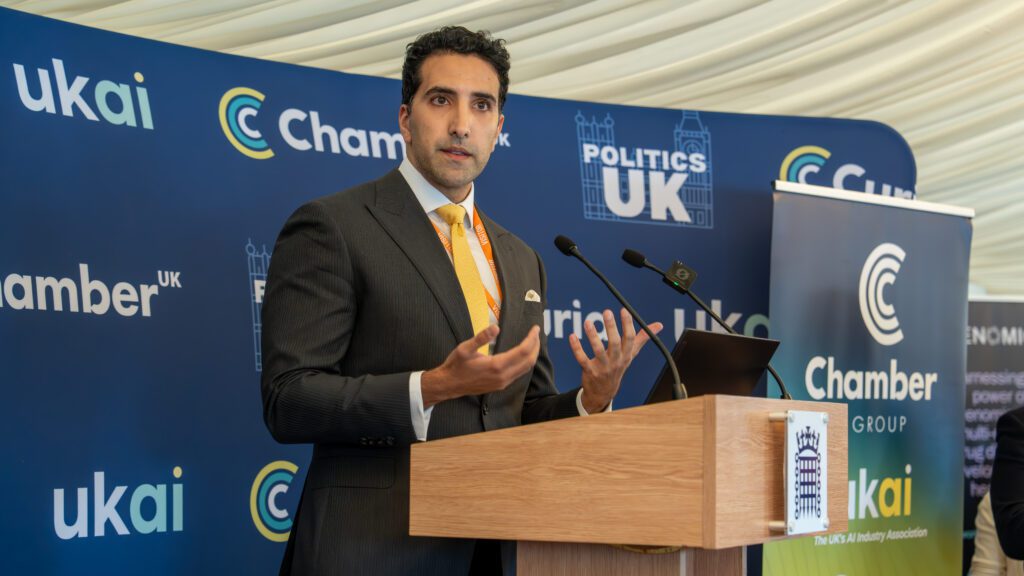

Dr Arrash Yassaee
Deputy Director for MedTech Innovation, NHS EnglandSpeaking at the UKAI and Curia Healthcare and Life Sciences Parliamentary Showcase, Dr Arrash Yassaee highlighted how the NHS 10 Year Health Plan, value based procurement, innovation adoption pathways and national assurance could help promising technologies reach patients faster.
Dr Arrash Yassaee, Deputy Director for MedTech Innovation at NHS England, used his remarks at the UKAI and Curia Healthcare and Life Sciences Parliamentary Showcase in Parliament to set out how the NHS can accelerate the adoption and scaling of promising health technologies, including artificial intelligence (AI).
Speaking during the afternoon session, Dr Yassaee framed the current moment as an important opportunity for innovation in healthcare. He argued that the NHS now has a clearer “north star” through the NHS 10 Year Health Plan, giving national policy a stronger sense of direction around why innovation matters and how it should support the transformation of care.
Innovation as an enabler of NHS transformation
A central theme of Dr Yassaee’s speech was that innovation should not be treated as an add on to NHS reform. Instead, he argued that it is one of the core enablers of modernisation.
He pointed to the major shifts set out in national policy, including the movement from analogue to digital, the shift of care into new settings and the ambition to intervene earlier in clinical pathways. These changes, he suggested, will be difficult to deliver without new technologies, new delivery models and a more systematic approach to adoption.
His remarks placed AI and MedTech within the wider reform agenda. The question is not simply whether individual tools are impressive, but whether they help the NHS deliver better care, improve workforce experience and support earlier intervention.

The UK as a place of world firsts
Dr Yassaee also challenged overly negative narratives about the NHS and innovation. He argued that the UK remains a place of “world firsts” in AI and healthcare, pointing to examples such as certified autonomous AI diagnostics, foundation models giving valuable insights to clinicians, and platforms using AI algorithms at scale across pathways and enterprise level.
This was an important reminder that the UK does not lack innovation. The issue is how to ensure the best technologies move through the system in a way that is safe, evidence based and scalable.
From regulation to market access
Dr Yassaee described innovation adoption as a lifecycle. Regulation is one part of the picture, but it is not the whole story. Products need to reach the market safely, but they also need the right commercial environment and adoption mechanisms to be used in practice.
He pointed to the work of the National Commission on the Regulation of AI in Healthcare and suggested that forthcoming findings could help shape the next stage of AI regulation and market access. He also highlighted the need to manage the tension between moving at pace and maintaining rigour, with proportionality sitting at the centre of that balance.
Rethinking procurement and reimbursement
One of the most practical parts of Dr Yassaee’s contribution focused on procurement and reimbursement. He welcomed work emerging through the NHS 10 Year Health Plan around value based procurement, arguing that the health service should not simply default to the cheapest option, but should consider which technologies deliver the best value for providers and the wider system.
He also highlighted the National Health Access Pathway as an example of creating greater parity between medicines and health technologies. Notably, he said that the first two products going through the pathway included at least one AI product. This matters because it points towards a more structured route for promising health tech to be evaluated, reimbursed and adopted.

Scaling what works
Dr Yassaee was clear that adoption cannot stop at regulation, market access or first deployment. The hardest challenge is sustained scale.
He emphasised the role of Health Innovation Networks as implementation partners, supporting adoption, evidence generation and learning across local environments. He also discussed the need to strike the right balance between national, regional and local action, depending on the type of technology and pathway involved.
A particularly important example was the Innovator Passport, which Dr Yassaee described as a way to reduce duplication and divergence in assurance checks. For innovators navigating the NHS, repeated local assurance processes can slow adoption. The Innovative Passport offers a way to get innovations into the hands of patients more quickly, while still maintaining appropriate standards.
A clearer route for responsible adoption
Dr Yassaee’s message was ultimately one of cautious optimism. The NHS has world leading examples of AI and health technology, a clearer national policy direction and a growing focus on adoption pathways. But real transformation will depend on whether regulation, procurement, reimbursement, assurance and implementation are aligned.
His remarks reinforced one of the central themes of the showcase: the UK does not just need more innovation. It needs a system that can identify what works, support responsible adoption and scale technologies that make a measurable difference to patients, staff and services.