

The Times reports today that Treasury officials are considering raising billions of pounds of debt, within the existing UK fiscal rules, to fund the new Government’s spending priorities. New Chancellor John Healey told the newspaper “”scope for more and more rapid investment.”
He is due to deliver his first budget on the 28th October.
UK Fiscal Rules
The UK has never defaulted on it’s debt, though it has come close when recovering from debt after the World Wars, in the 1930s, the gold standard was abandoned and the value of debt was eroded by inflation and similarly in the 1970s the UK needed help from the IMF and again struggled with inflation.
Since 1997 UK Governments have voluntarily bound themselves with fiscal rules in order to reassure bond markets that they will not borrow more than they can repay. Incoming Chancellor Gordon Brown, famously made “prudence” his watchword. He instituted a “golden rule” that allowed borrowing for investment but required day to day spending to be funded from taxation over the economic cycle.
In 2010, the incoming coalition Government set up the Office for Budget Responsibility (OBR) which produces independent reports on the impact of UK budgets on the fiscal position.
At the same time, Chancellor George Osbourne added an additional target. The Government would now target falling Public Sector Net Debt as a share of GDP. This additional rule depressed investment spending during the subsequent Conservative-led administrations. Some argue that this lack of investment also reduced GDP growth.
In 2024, incoming Chancellor Rachel Reeves amended the fiscal rules again by changing the target from Public Sector Net Debt to Public Sector Net Financial Liabilities. This change ensured that Government financial assets such as funded government pension schemes, the student loan book and Bank of England lending facilities. Changing the target allowed the Government more ‘fiscal headroom’ for borrowing.
Why Fiscal Rules?
As Liz Truss learned (or failed to learn) during her short tenure at Number 10, Governments must signal their direction, responsibility and competence to markets to ensure that asset prices remain stable.
Since the pandemic the cost of the UK borrowing has increased significantly. Currently the Government spends around £110 billion per year on debt interest. Approximately half the price of the NHS or almost double the defence budget. So even small changes in the interest rate the Government pays for debt can have disastrous consequences for Government spending decisions.
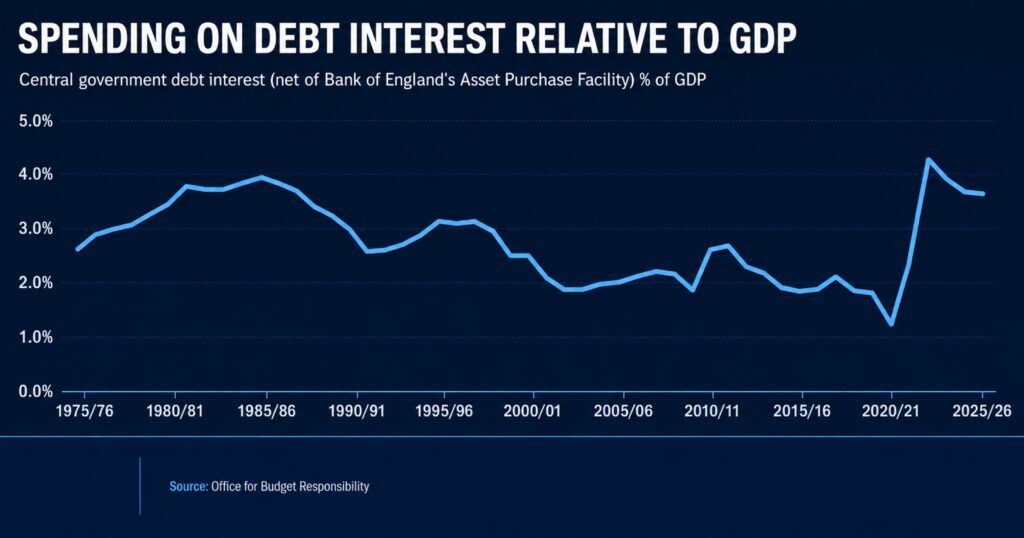
So expect to hear more about fiscal rules and Governments of all stripes try to signal that the UK is still a good investment.
Final Thought
Government spending for investment is a driver, perhaps a missing driver of economic growth. Would the UK economy produce more if we had faster trains, better roads, more data centres, energy security and better technical education? Probably. But how much more? Would that growth come in time to reward bondholders? Is it guaranteed with an ageing population and unstable climate?
Are there better places to invest? Is the UK still the most stable place to store money or are there other economies and Governments that have better prospects?
These are the questions that loom over the debate about UK fiscal rules and Government spending. They none of them come with easy, simple or fast answers. Good luck John Healey!

You can still get a copy of our new edition of ChamberUK. Our parliamentary journal.