
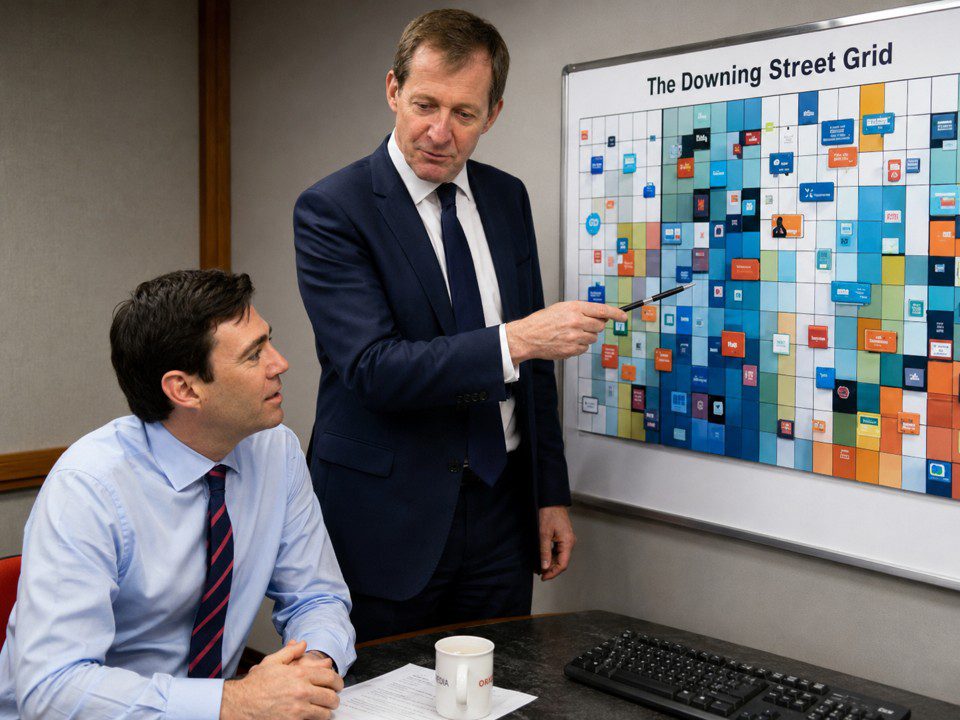
Does Andy Burnham’s Government feel different from Keir Starmer’s? Have you noticed more action? More announcements? More photos of the PM visiting places?
What you’re seeing is the resurrection of an old Blairite tool of politics. The Grid.
The Grid
The Grid, sometimes called the Downing Street Grid but not to be confused with the National Grid, is a tool used by the Government to more easily manage sequences, timings of events and external communications. It operates across all branches of government to ensure a consistent narrative and synchronised cross-department media strategy. It means that on any given day everyone in Government knows what they need to be talking about.
The use of the GRID protects the Prime Minister by burying negative news stories, avoiding clashes and maintaining a consistent narrative across their Government. Most importantly, it feeds the media, giving them something to report every day rather than unhelpfully looking for something the Government may prefer went unreported.
The history of the GRID dates back to 1997, under Tony Blair’s Ministry. It was introduced by Alastair Campbell, with the aim of creating a centralised strategic communications plan to keep the Government’s agenda running smoothly.
According to InHouse London, it is one of the most influential and important government functions. If announcements are not gridded, then they cannot proceed any further, symbolic of the Grid’s significance as the sole operation of communication for all departments.
On the Grid…
Over the years, the Grid has adapted to fit changing economic objectives. In 2025, under Keir Starmer, it was organised by colour to reflect the specific priorities at the time: Economy, Leadership, Crime, Health and Ukraine. The subsections of the grid indicate the main aims of the government, acting as a signal for departments to streamline their actions into these categories to give them precedence.
The Grid does not focus solely on political events, but takes into account a vast array of cultural, social and economic events as well. Extracts from the 2004 Grid show an inclusion of the Belgian Grand Prix and Notting Hill Carnival. It also did not solely encompass UK or EU events but included international happenings such as talks between China and Korea (August 2004).
Each day may be divided under different subheadings, including headings on sport, politics, world news and show business. Campbell aimed to utilise each and every event to portray the Government in the best possible light, mitigating disaster through unprecedented knowledge.
…Off the Record
However, the Grid sparked controversy when pictures revealed Government knowledge of events prior to their occurrence. An example can be found during a week in 2003 which the newspaper, the Sun, ran a series of striking reports on asylum seekers coming to the UK, which readers may have thought to be a shock to the Government. However, Downing Street was already aware of this campaign, seen through a listing on the Grid titled “Sun asylum week”, indicative of the pre-existing relationship between Government and media that was supposedly holding them to account. Even today, this raises serious concerns as to the integrity of political news in the UK, and questions how much we can and do blindly trust.
To make matters even worse, the peace agreement between the two had been decided before the conflict even began. A Grid listing titled “Blunket asylum interview in Sun” was marked for Thursday of the week following the scandal. On Monday, a Sun reporter released a statement calling for “scroungers and criminals to be stopped”, and, then unsurprisingly, the then Home Secretary responded to these statements exactly three days later.
Hardly press independence.
Final thoughts
Andy Burnham appears to have utilised the Grid fair more effectively than Keir Starmer. Where Starmer focused on long-term, cautious goals, Burnham places much more emphasis on immediate strategies and policies that can be quickly and visibly brought into effect, such as cutting VAT on household electricity and capping bus fares at £2.
However, these aren’t labelled “sugar-rush” policies for no reason, and critics wonder whether these changes are simply shallow attempts for a new PM to win over a frustrated nation. Concerns, questions and eyebrows are all being raised as to whether this fast-paced management can truly sustain long-term public trust.
You can still get a copy of our new edition of ChamberUK. Our parliamentary journal.
Photo Credit: Andy Burnham and Alastair Campbell altered by ChatGPT