

British quantum businesses are receiving a share of £50 million to develop technologies that could improve railway maintenance, bring diagnostic scans closer to patients and strengthen national security. Alongside investment in communication networks and apprenticeships, the announcement aims to help UK companies turn scientific breakthroughs into practical products.
Turning Quantum Research into Practical Solutions
The Government has announced £50 million for businesses developing quantum technologies, supporting projects intended to improve healthcare, transport, environmental monitoring and national security.
Announced on 13 October, the funding will be delivered through UK Research and Innovation’s (UKRI) Sensing and Positioning, Navigation and Timing competition. It will help companies build on early testing and develop products for practical use.
Quantum technologies exploit the behaviour of particles, including atoms, to enable highly precise measurements. These capabilities could help address challenges ranging from locating railway faults to providing more accessible medical scans.
Science, Innovation and Investment Minister, Chris McDonald said:
“Quantum has long been an exciting technology, but now real world applications are within our grasp.”
The announcement places particular emphasis on translating research into products, with potential benefits for public services alongside opportunities for business growth and skilled employment.
Bringing Eye and Brain Scans Closer to Patients
Two supported companies are developing diagnostic technologies with potential applications in NHS care.
Siloton Ltd, based in London and Bristol, is developing a handheld eye scanner designed to make advanced diagnostics available beyond specialist hospitals. Smaller, more accessible devices could support screening in community settings and help reduce pressure on hospital services and waiting lists.
Making scans available closer to patients could improve access and support more convenient diagnostic pathways.
In Nottingham, Cerca Magnetics Ltd is working to bring a wearable brain scanner into clinical use, particularly for assessments before surgery for epilepsy.
Professor Michael Lewis, Scientific Director for Innovation at the National Institute for Health and Care Research (NIHR), said:
“Research into Quantum enabled technologies are at the tipping point of being able to enter care. Early investment by NIHR and UKRI into promising UK innovations is now starting to bear fruit”
His comments highlight the growing opportunity to translate quantum research into clinical tools. For patients and NHS services, the next step will be demonstrating how these technologies can improve diagnosis and access to care.
Both projects illustrate how quantum sensing could contribute to healthcare delivery. Their eventual impact on waiting lists and patient outcomes will depend on clinical validation, adoption and integration into services.
Representing the health innovators sector, Chief Executive of UK Healthcare and Life Sciences Innovation (UKHLSI), Jo Bekis told Politics UK:
“This is much welcomed news. This funding highlights the potential of quantum innovation to transform diagnostic imaging, bringing world-class scanning technologies closer to the patients who need them most, it also provides innovation companies real opportunity to transform and scale with the right support.”
Finding Railway Faults and Strengthening Navigation
West Midlands-based MoniRail Ltd is developing high-accuracy positioning technology for trains.
Its quantum monitoring system could help identify the precise location of faults in railway tracks and signalling equipment, including where GPS cannot reach. More accurate location information could enable maintenance teams to find and address problems faster, potentially reducing disruption for passengers. The project also aims to support applications in railway signalling infrastructure.
In Oxford, Quantum Fabrix Ltd is developing a next-generation satellite clock for navigation, defence and communications infrastructure.
Accurate timing underpins many systems that people and organisations rely on. The project demonstrates the role quantum technology could play in strengthening the infrastructure supporting transport, connectivity and security.
Supporting Defence, Emergency Response and Environmental Monitoring
Oxfordshire-based ColdQuanta UK Ltd is receiving support to develop a compact, mobile quantum radio system capable of locating signals with high accuracy.
Potential applications include military operational intelligence, protection of critical infrastructure such as airports, and search and rescue. Emergency responders could use the technology to help locate distress signals.
Meanwhile, Wales-based QLM Technology Ltd is developing a camera that can detect and measure greenhouse gases across energy, water and waste infrastructure.
Its project highlights the potential for quantum sensing to support environmental monitoring, helping operators identify emissions and understand where action is needed.
Together, these projects show the breadth of applications being pursued across the UK, from clinical services to infrastructure resilience.

Building British Quantum Supply Chains
Alongside the sensing and positioning funding, UKRI is investing £20 million in UK businesses to develop domestic capability in quantum communication networks.
Through its Enabling Commercial Quantum Networking competition, it will support companies including Sheffield-based Aegiq to develop specialist components, such as lasers and photonic chips.
The investment aims to strengthen UK supply chains and build capability in the components needed to commercialise quantum systems.
Professor Charlotte Deane, UKRI’s Senior Responsible Owner for IS8 Quantum, said the funding would help businesses develop their technologies while retaining essential supply-chain capabilities in the UK. She also highlighted potential benefits for military and emergency services when conventional navigation and communications systems cannot be relied upon.
UKAI Calls for Investment to Match Britain’s Quantum Ambition
Welcoming the announcement, Tim Flagg, Chief Executive of UKAI, called for sustained investment to help Britain retain the economic and strategic benefits of its scientific expertise.
“The UK has spent decades building its quantum advantage, and we welcome the Government’s continued investment in this critical technology. The challenge now is ensuring the scale and pace of investment matches our ambition, as international competition for technology and talent accelerates. We have seen too often how British scientific breakthroughs create industries that scale elsewhere.
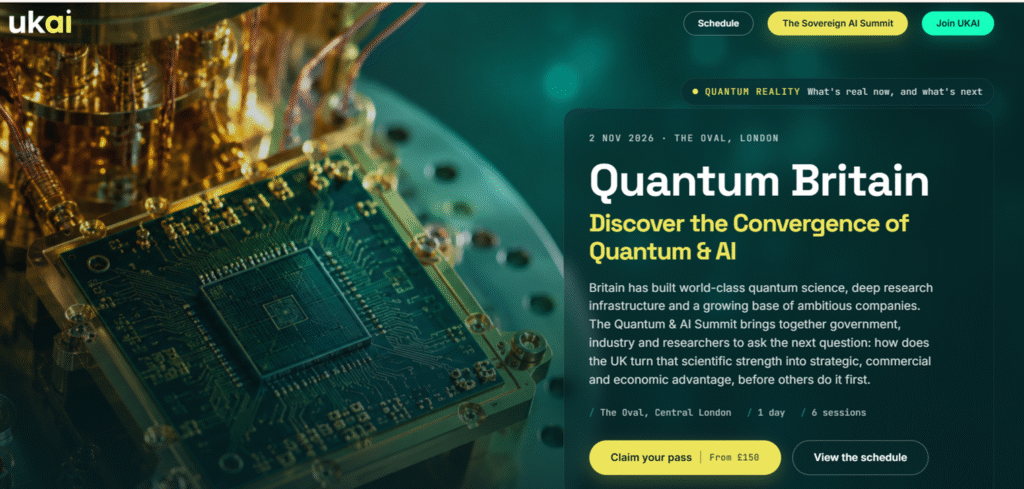
“At the intersection of quantum computing and AI, the UK has an opportunity to write a different story, building sovereign capabilities and world-leading businesses. At Quantum Britain on 2 November, we look forward to exploring how we turn this opportunity into lasting economic and strategic advantage.”
His comments underline the commercial challenge behind the announcement: ensuring that support for research translates into companies that can grow in the UK, retain specialist talent and compete internationally.

Developing the Workforce to Deliver Growth
An £8 million expansion of UKRI’s QuEST Apprentices Programme will support training for engineering technicians and specialist quantum technicians.
By 2030, the programme aims to equip 150 apprentices studying engineering subjects with skills to support the growing quantum workforce.
The announcement also coincides with the relaunch of Quantum City, an Engineering and Physical Sciences Research Council-funded public engagement initiative, with updated resources highlighting training opportunities and career pathways.
The wider policy ambition is to make the UK a world leader in quantum sensing by 2030, supported by up to £2 billion of investment announced earlier this year.
For public services and industry, the next challenge is delivery: demonstrating that these technologies work reliably, can be manufactured at scale and offer measurable improvements. The funding provides an opportunity to connect Britain’s research strengths with the practical needs of patients, passengers, employers and frontline services.
Find out more
To find out more about UKAI and its work on quantum, please click here.