


Miles Bennington
Editor – Chamber UKAndy Burnham is the seventh Prime Minister in a decade. He is the second Labour Prime Minister since the election. He has not won an election as leader of the Labour Party. He has no personal mandate. There is no cash to splash around. Labour are at 25% in the polls. If they scored that at a general election, it would be their worst showing since 1918.
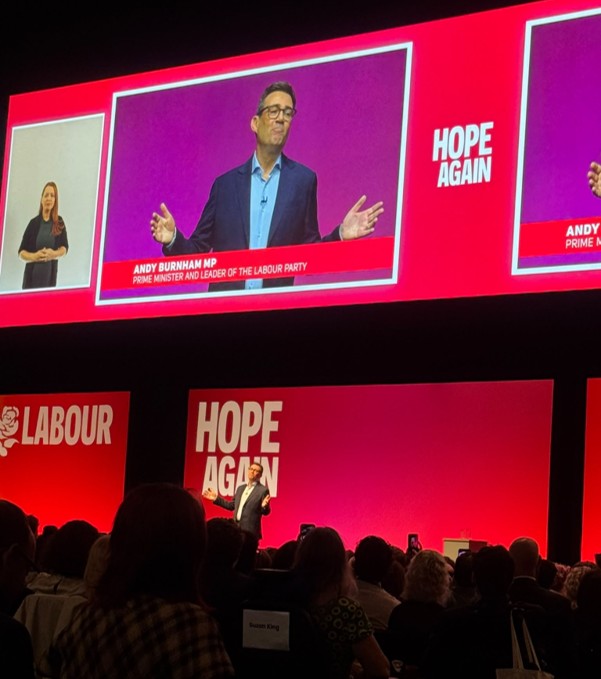
None of this is slowing down Andy Burnham. He has massive ambition and confidence. Today he delivered a speech to Labour conference in Liverpool worthy of a proven election winner, with the confidence of a man who has his party and country in lockstep behind him.
Better, the substance was there. In both policy and rhetorical terms, Burnham broke new ground in British politics. If his premiership is successful, this speech will be held up, along with Tony Blair’s Clause 4 speech and “the lady’s not for turning”, in the annals of important conference speeches.
Burnham’s Diagnosis
Britain is prone to declinist malaises, but since the financial crisis, then Brexit, then the pandemic, then the mini-budget, the mood in the country has been pretty bleak. In today’s speech, Burnham did not gesture broadly at a formless feeling of decline; he identified specific decisions as mistakes and charted a course to correct them. It was bracing; and for seasoned (worn down?) politics watchers, it was a breath of fresh air.
Ideology is back. In Burnham’s telling, Britain has been on the wrong path for forty years, since the Government of Margaret Thatcher. During that Government, Britain gave away the public ownership, and therefore public control, of essential services, leaving the state unable to respond to the everyday problems of voters.
This lack of control has left the country demoralised, with some voters turning to the far right.
“But something is different these days. That sense of the powers-that-be pulling against the people not with them. If there’s one thing I want to put right, it’s that.”
Andy Burnham
With the exception of Jeremy Corbyn, this speech marks the first Labour leader to truly set their sights on the neoliberal consensus and suggest a replacement. Again and again, Burnham identified examples of where the state had stepped back and a lack of “public control” had resulted in failure.
He hammered home the phrase “paying for failure”, partly as critique of a safety net under strain due to upstream problems, but also as a mantra to explain why cutting services has not balanced the budget.
Public Control
The solution to these mistakes is “public control”, including public ownership. Gone is the squeamish taboo against the state intervening in markets.
If the pre-Tony Blair Labour was committed to the public ownership of the means of production, and post-Blair’s Clause 4 moment they were committed to not rolling back Thatcher’s privatisations, then we are now in a new era. Call it the Burnham Corollary to Tony Blair’s rewriting of Clause 4.
While Labour is still not committed to ownership of the means of production, it is no longer committed to leaving “essentials” in private hands. It is no longer squeamish about state interventions in markets essential to the Government’s mission.
Council houses, private houses of negligent landlords, water companies and a new “Great British Grid”. Throughout his speech, Burnham suggested targets for public ownership. He wielded this policy not as a superior ideological endpoint but more as a solution of last resort for industries holding Britain back.
Theory of Growth
He set out a clear theory of growth.
Public control of essentials that make places work (or fail to). Devolution of power to those places so they can decide their own destiny. Support for people so they are ready for business to employ.
I’m paraphrasing, but not by much. This is the clearest explication of “Manchesterism” that Burnham has come up with so far.
Ambition
Finally, the sheer ambition of this speech and Burnham’s programme of Government must again be noted. With a nod to Beveridge, he reiterated pledges for a National Care Service, an end to rough sleeping, parity for technical education, leasehold reform and for Britain to lead the world on AI safety.
“We led the world’s first industrial revolution from the Midlands and the North of England. So why can’t we lead the next?”
Andy Burnham
He has learned from the populists that people want to be promised solutions, and in this he has delivered in spades.
Unlike the populists, however, he did not shy away from some of the thorniest political issues. He confidently announced that after the next election the triple lock on pensions would be broken, at the next UK-EU summit he would present options for our long-term relationship with the EU and seek a consensus position, and he again signalled to a Labour audience his “pragmatism” in the North Sea (read: he will approve extraction from the Rosebank and Jackdaw oil and gas fields).
Delivery
So overall, this was a very impressive speech. Delivered confidently, without a podium. When discussing his late father and the opportunities the country afforded him, Burnham was visibly emotional, inspiring a hall of Labour activists in a way that would be unimaginable for Keir Starmer. In communication terms, Burnham is such a step up that he overcomes the powerful headwinds that Labour currently face.
His direct assault on the right’s language of “control”, of “take back control” fame, is effective. If he can convince the electorate that “public control” will give them agency and improve their lives, then he will have given the Labour Party direction while robbing Reform of theirs.
In toto, this speech amounts to a thrilling call for a British Deliverism. Burnham is convinced that if the state is effectively wielded against the problems of the British people, then they will notice and turn away from the empty promises of the far right.
It’s an inspiring idea, and he has now bet his premiership on it. All Together Now!
.
.
.
.
.
If you are pumped up by Andy Burnham’s speech and want to preserve that feeling, it’s probably best to stop reading now.
.
.
.
.
.
.
.
.
.
.
.
.
.
.
.
.
.
.
.
.
.
.
.
.
.
.
Not too late to turn back…
.
.
.
.
.
.
.
.
.
.
.
.
.
.
.
.
.
.
.
Fine!
.
.
.
.
The Sinking Feeling
Of course, those of us who have kept an eye on developments across the pond have seen much of this before. Deliverism was the strategy of Joe Biden. His election also felt like a relieving return to a familiar world. A restoration of competence and sanity that the country so desperately needed.
Burnham’s diagnosis is clear and well argued. It may also be wrong.
Perhaps voters that are drifting towards the far right are not frustrated by the poor delivery of previous British governments. Perhaps they are not motivated by a sense of loss felt in “left-behind areas”.
If the new rising of the far right and the disintegration of the centre right are in fact born of new phenomena such as the rise of social media, attention-seeking algorithms and the smartphone-enabled immersion of our attention into the conspiracy theories and racial animus these forces drive us to, then Burnham’s proposed solutions won’t work.
The Uninspiring Alternative
If the above diagnosis is closer to the truth of Britain’s problems, then different medicine is required.
Burnham should attack the power bases of the far right: social media algorithms, party funding, private ownership of the media and the information ecosystem more widely.
He should Reform-proof the system, distributing power away from the executive, empowering institutions and beefing up the Electoral Commission.
His move towards electoral reform was good, but dependent on Labour winning the next election, a dicey prospect at best.
Conference Speeches
As a speech, Andy Burnham’s conference speech was brilliant. Strong substance and stronger delivery. If he is successful, it will be remembered for years to come. If he fails, however, Ed Davey’s “Fight Of Our Lives” speech may prove a more prescient message.
You can still get a copy of our new edition of ChamberUK. Our parliamentary journal.