
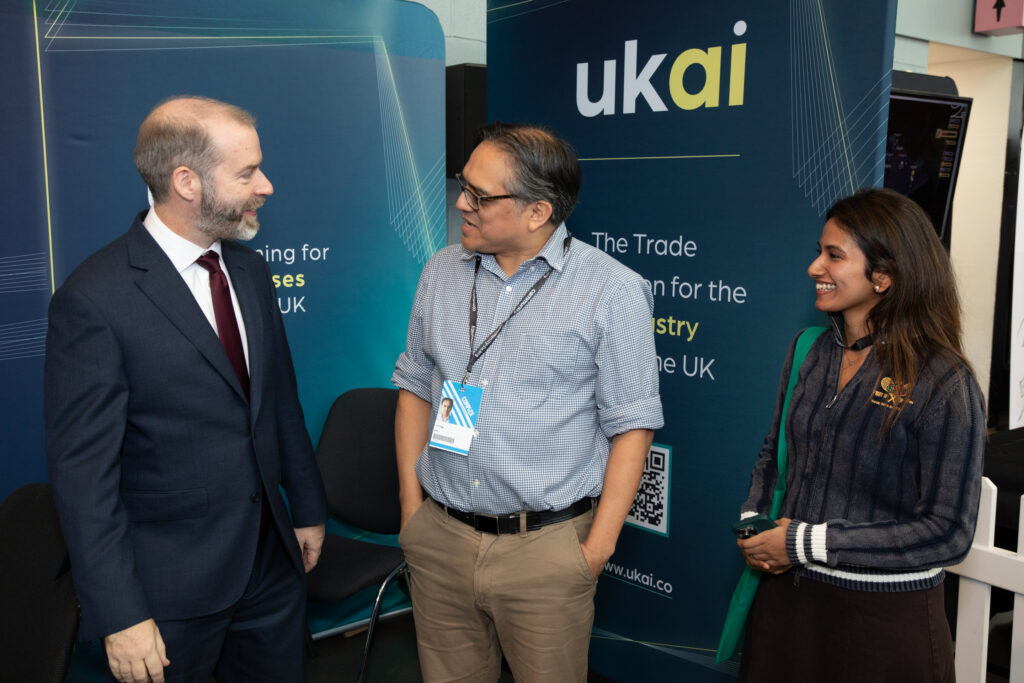
Launched at Labour Party Conference, UKAI’s new report argues that planning reform alone will not provide the power, water, connectivity, skills, and investment needed to build the UK’s AI infrastructure. It calls for a national Green AI mission, a cross-government delivery unit and properly resourced regional plans to turn infrastructure ambitions into projects that support British firms, communities, and the wider economy. (Photo: Chief Executive of UKAI, Tim Flagg and Founders Associate, Mariya Radiowala speak to Secretary of State for Business, Innovation, Science and Trade about the report at Labour Party Conference. Credit: UKAI)
The UK’s ability to compete in artificial intelligence will depend on more than research, investment, and new technology. It will also depend on whether the country can build the infrastructure AI needs: data centres and advanced computing, secure electricity, timely grid connections, water, resilient digital networks, and a skilled workforce.
At Labour Party Conference, UKAI launched Connected Regions, Competitive Britain: A Devolved Delivery Model for Green AI. The report sets out how the UK can coordinate these needs and turn its AI ambitions into regional investment, stronger domestic capability, and economic growth.
The Government has made progress. The revised National Planning Policy Framework (NPPF) gives greater weight to AI Growth Zones, data centres, and related energy infrastructure. Nationally significant data centres can now enter the Nationally Significant Infrastructure Project (NSIP) regime, while Ofgem, and the National Energy System Operator (NESO) are working on reforms to the electricity connections process.

But UKAI argues that these initiatives remain fragmented. The AI Energy Council and the joint Ofgem–NESO connections programme each address parts of the challenge, but no single body is responsible for bringing together planning, energy, water, connectivity, skills, and regional delivery.
The scale of the connections challenge is growing. Ofgem figures cited by UKAI show grid demand applications rising from 41GW to 125GW in less than a year, with data centres accounting for at least 70GW of the queue. Planning consent, the report argues, does not guarantee an electricity connection, affordable power, adequate water, reliable fibre or trained workers. Nor does it ensure that a new facility will support local industries, jobs or AI adoption by businesses, and public services.

From national ambition to regional delivery
The report’s main argument is that AI infrastructure should be treated as connected economic infrastructure, rather than as a series of individual property developments. Decisions about where computing capacity is built need to reflect where energy is available, the strengths of regional industries and the infrastructure that can be shared.
Data centres and advanced computing can support sectors beyond digital technology, including life sciences, advanced manufacturing, defence, financial and professional services. Regional plans could connect these needs with local universities, businesses, skills provision and infrastructure, while helping British firms win contracts and scale their capabilities.
UKAI proposes a clearer division of responsibilities. Central government should set a national Green AI mission, establish environmental and security standards, coordinate national infrastructure, and provide access to strategic finance. Mayoral authorities should turn national priorities into regional programmes by assessing demand and infrastructure, identifying suitable sites, aligning skills provision, and building investable project pipelines.
Devolution, the report cautions, must come with the expertise, funding and influence needed to deliver. Giving regions planning responsibilities without the resources to coordinate energy, water, connectivity and investment risks shifting fragmentation from Whitehall to local government.

Five priorities for government
The report sets out 18 recommendations and five immediate priorities:
- adopt Green AI as a national mission;
- establish a cross-government AI Infrastructure Delivery Unit;
- publish a dedicated National Policy Statement for data centres;
- require mayoral strategic authorities to prepare regional AI infrastructure plans;
- introduce common Green AI performance standards for major projects.
The proposed delivery unit would bring together government departments, regulators and delivery bodies to resolve barriers that fall between areas of responsibility. UKAI is urging the Government to use the Autumn Budget on 28 October to establish the unit and give mayors the technical teams and long-term finance needed to deliver infrastructure in their regions.
The National Policy Statement would provide a joined-up framework covering energy, water, connectivity, security, environmental performance and community benefit. Regional plans would assess credible demand for computing capacity alongside suitable land, grid and water capacity, renewable generation, storage, connectivity, workforce needs and opportunities to reuse heat.
To finance delivery, UKAI recommends enabling regions to establish investment vehicles that bring together devolved revenues, public finance and private investment. These could support shared substations, storage, water systems, fibre routes and heat networks serving multiple projects and nearby communities. The report also proposes regional delivery teams to provide developers and investors with a single point of contact.
Making growth work for places and the energy system
The report argues that infrastructure projects should be assessed not only by the electricity they consume, but also by their contribution to the energy system and the communities where they are built. Facilities located near surplus renewable generation could help make better use of clean power. Flexible computing workloads, storage, and local balancing could also help manage demand and network constraints while protecting consumer affordability.
UKAI says stronger environmental standards are needed. Data centre developers are not currently required to report consistently on power usage effectiveness, water usage effectiveness or carbon intensity. The report calls for common measures for major projects, including energy and water efficiency, carbon intensity, clean-energy use, grid flexibility and waste-heat reuse.
It also recommends a community-benefit framework covering local employment, apprenticeships, connectivity, environmental improvements, public infrastructure and community investment. Early, open engagement matters: communities hosting new infrastructure need to understand its effects and see a tangible benefit. Trust, the report argues, is a condition for securing the local support needed to deliver projects on time.
The report was developed with UKAI’s Infrastructure Working Group, chaired by Lorraine Mackin, Deloitte’s Vice Chair for Sustainability and Infrastructure, with input from Energy Minister Michael Shanks MP.

Measuring progress by delivery
The main tests for UKAI in measuring success are whether projects secure grid connections, attract investment, enter construction, and create demonstrable regional value. That value should include jobs and skills, efficient use of energy and water, support for the electricity system, stronger local industries, and improve public confidence.
UKAI argues that the UK does not need to compete by pursuing the greatest possible volume of computing capacity. It can build an advantage by deploying AI infrastructure efficiently and responsibly, connecting it to clean energy and regional economic strengths, and supporting British firms to develop sovereign AI capabilities.
The UK has research expertise, renewable generation, engineering capability, and globally important financial markets. The challenge is to coordinate them – something successive governments have failed to deliver effectively. A national mission, accountable cross-government leadership, and regions equipped to plan and finance delivery could make Green AI a source of lasting industrial capacity and economic growth.
The report’s conclusion is that national strategy and devolution need to work together. A coherent national direction, matched with well-resourced regional delivery, can help the UK build the infrastructure its AI economy needs.
Find out more about UKAI
To find out more about becoming a member of UKAI, please click here.