

Prime Minister Andy Burnham has unveiled plans to give English mayors a share of income tax revenues for the first time, alongside greater retention of locally generated business rates.
The Government described the package as the biggest transfer of power, funding and responsibility from Westminster in a generation. Mayors will gain greater control over transport, housing, planning, skills, employment support, and public services. Areas without mayors will be supported to establish strategic authorities.
Details will be published at the Budget. From next spring, mayors will begin keeping more business rates, with the longer-term aim of replacing Whitehall grants with funding that rewards local growth.
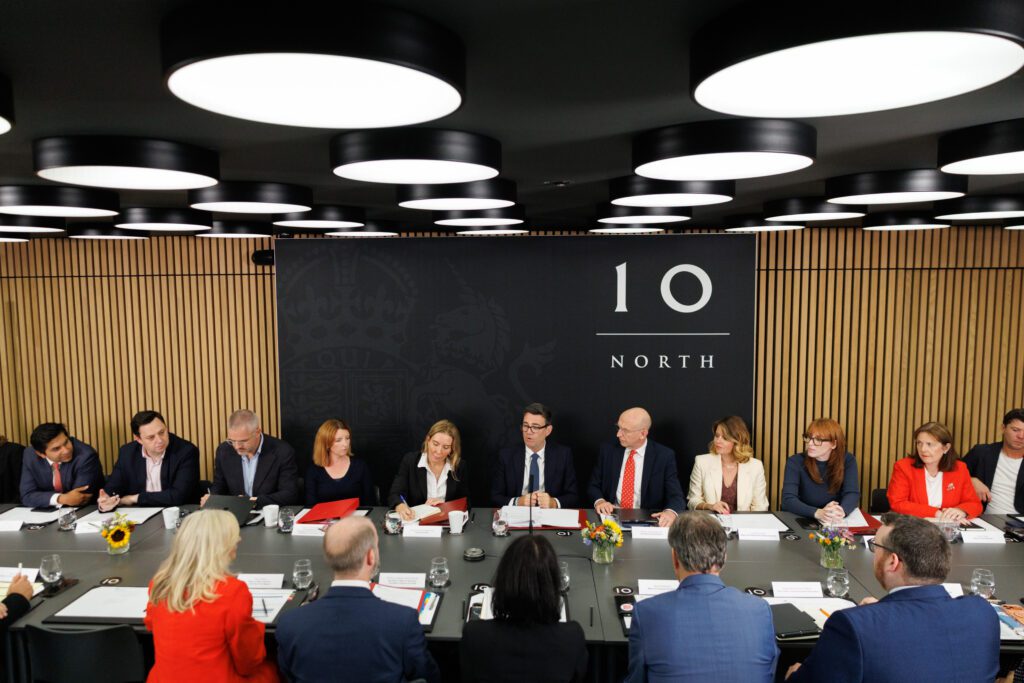
A new “local first” principle will require ministers to justify why powers should remain in Whitehall, while No. 10 North will work with mayors to remove barriers to growth.
‘Bring Power Home’
The announcement is intended to establish devolution as the defining theme of Burnham’s early premiership. By allowing mayors to retain a share of locally generated tax revenues, the Government is seeking to give regional leaders both a stronger incentive to pursue growth and greater freedom over how its benefits are spent.
The policy also reflects Burnham’s experience as Mayor of Greater Manchester, where he regularly argued that local leaders understood their economies better than Whitehall departments and should not have to compete repeatedly for short-term grants.
Burnham said:
“I said we’d take power out of Westminster and carry it into every postcode in the country. Today, we make good on that promise.
“Under our plans, more of the taxes raised in a community will stay in that community. Soon, every local leader will have the power and resources to improve public transport, build homes and create jobs.
“I know what it’s like to be ignored by politicians in Westminster. I’m not going to make that same mistake now I’m PM.
“The whole of government will now pull together behind the people and places that desperately need our support. This is how we’ll bring back hope and bring power home to you.”
The central change is not that mayors will be able to alter income-tax rates, but that part of the revenue generated by local employment and earnings will be assigned to their regions. That creates a more direct connection between decisions on skills, transport, housing and business investment and the resources available to fund local priorities.
However, the scale of the benefit will depend on the formula announced at the Budget, including how much tax revenue mayors retain, which Whitehall grants are replaced and how areas with weaker economies are protected.
Chancellor John Healey said:
“The people who best understand what skills employers want, what transport an area needs and where investment can make the biggest difference are those who live there.
“For the first time we’re giving Mayors a share of income tax, so communities directly benefit when their economy grows – passing power out of Westminster and driving growth in every postcode.
“This is the way we start to build new hope and advance the working people of this country.”
‘Rewire This Country’
The package goes beyond fiscal reform. Under the Government’s proposed “local first” principle, Whitehall departments will be expected to explain why powers should remain at the centre rather than being transferred to regional or local leaders.
This reverses the traditional assumption that councils and mayors must make the case for additional responsibilities. In theory, it could speed up decisions on transport, regeneration, employment support and public-service reform while reducing the number of separate funding agreements negotiated with government departments.
Housing, Communities and Local Government Secretary Angela Rayner said:
“This is the first step in our plan to rewire this country and build a better future, where power is no longer hoarded in Westminster but is put back in the hands of local people – where it belongs.
“Our devolution revolution is about bringing an end to the begging-bowl culture of the past, and instead making sure our local leaders have the tools they need to drive the change that communities have been crying out for.
“We need every region to be firing on all cylinders if we want good growth in every postcode, and we will do everything in our power to make that a reality.”
The Government has said that resources will follow newly devolved responsibilities, while the Civil Service will become smaller and more focused on functions that are best exercised nationally.
That commitment will be closely scrutinised. Previous devolution programmes have often transferred responsibility without providing sufficient long-term funding or flexibility. The success of Burnham’s reforms will therefore depend on whether mayors receive genuine control over budgets and delivery, rather than simply greater accountability for services still constrained by Whitehall.
What Could It Mean for Health?
The announcement does not transfer NHS budgets or hospitals to mayors. However, greater regional control over housing, skills, employment and public services could increase mayoral influence over population health and the pressures facing the NHS.
The wider direction of health devolution will also be closely watched. In March, Greater Manchester and South Yorkshire were selected to test a model under which each area’s integrated care board chair would also serve as the mayor’s health commissioner, reporting jointly to NHS leaders and the elected mayor. The commissioners are intended to bring together the NHS, councils and mayoral authorities around prevention, health inequalities and more integrated local services, while supporting the shifts from hospital to community, treatment to prevention and analogue to digital care.
Burnham described the arrangement as an opportunity to make Greater Manchester a national blueprint for prevention and to replace costly crisis intervention with earlier support. Now that he is Prime Minister, a key question will be whether he extends this approach to other mayoral regions and gives regional leaders a more formal role in shaping health and care, while stopping short of transferring direct control of hospitals or NHS commissioning.
The Rt Hon Andrew Stephenson CBE, former Health Minister and Chair of Curia’s Health, Care and Life Sciences Research Group, said:
“Health cannot be improved by the NHS acting alone. Housing, employment, transport, skills and economic opportunity all shape people’s health and their ability to access care.
“Greater regional powers could help mayors bring those services together with NHS leaders, universities and industry. This is an opportunity to create places where proven healthcare and life sciences innovations can be adopted more quickly, improve outcomes and generate skilled jobs and investment.
“Devolution must now be matched by clear accountability and strong partnership with the NHS.”

The Test Will Be Delivery
The scale of the announcement is significant, but its success will depend on the detail. The Budget will need to explain how much revenue mayors can retain, which Whitehall grants will be replaced and how areas with smaller tax bases will be protected.
For Burnham, the political test is whether people can see tangible improvements in transport, housing, skills, health, and employment – not simply a rearrangement of responsibilities between institutions. If regional leaders are given meaningful funding, freedom and accountability, the reforms could change how England is governed. If the powers arrive without sufficient resources, the promise of bringing power home may prove harder to deliver.
Photo: Picture by Lauren Hurley/No 10 Downing Street.