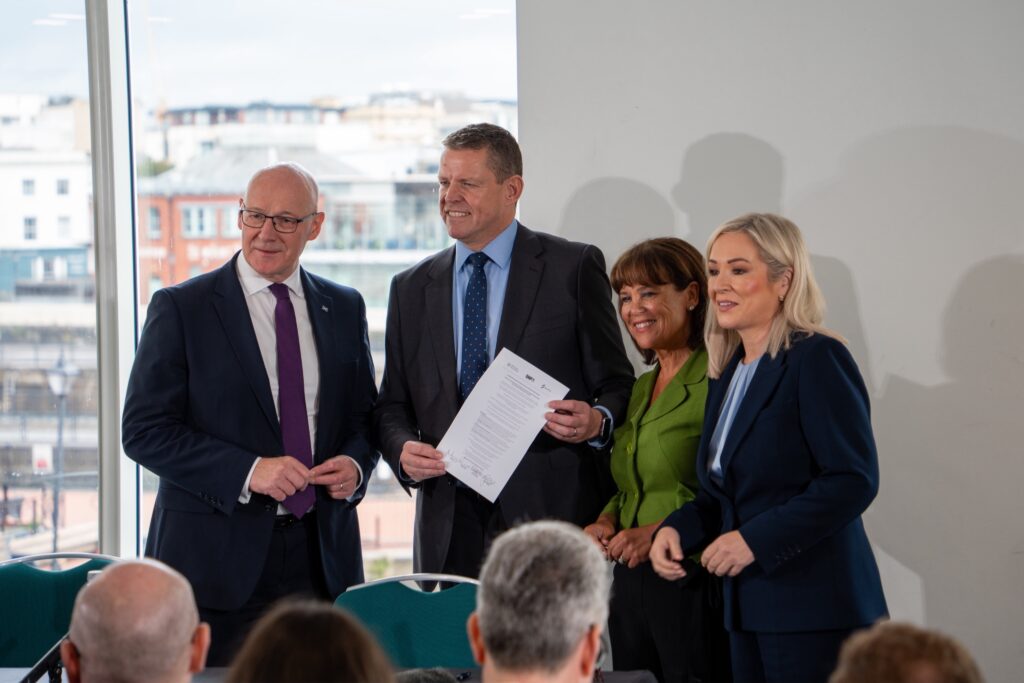

In an historic meeting, the nationalist First Ministers of Wales, Scotland, and Northern Ireland have issued a joint challenge to Westminster, declaring that the UK Government must prepare for constitutional change and insisting that no Prime Minister should be able to block demands for national referendums. (Photo: First Minister, Scotland)
The First Ministers of Wales, Scotland, and Northern Ireland have declared that “Westminster’s time is coming to an end” after nationalist leaders signed a new agreement asserting the right of their nations to determine their own constitutional futures.
Welsh First Minister and Plaid Cymru leader Rhun ap Iorwerth, Scotland’s First Minister and SNP leader John Swinney, and Northern Ireland First Minister Michelle O’Neill met in Cardiff alongside Sinn Féin President Mary Lou McDonald.
For the first time since devolution began, all three devolved nations now have First Ministers whose parties support leaving the United Kingdom.
The memorandum signed by the nationalist leaders states that “no Westminster government has the right to block democracy” and says each nation should determine its future “in its own way and in its own time”.
The intervention creates a significant constitutional challenge for Prime Minister Andy Burnham, who is due to meet the devolved leaders next month.
Swinney calls Burnham the ‘last prime minister of the United Kingdom’
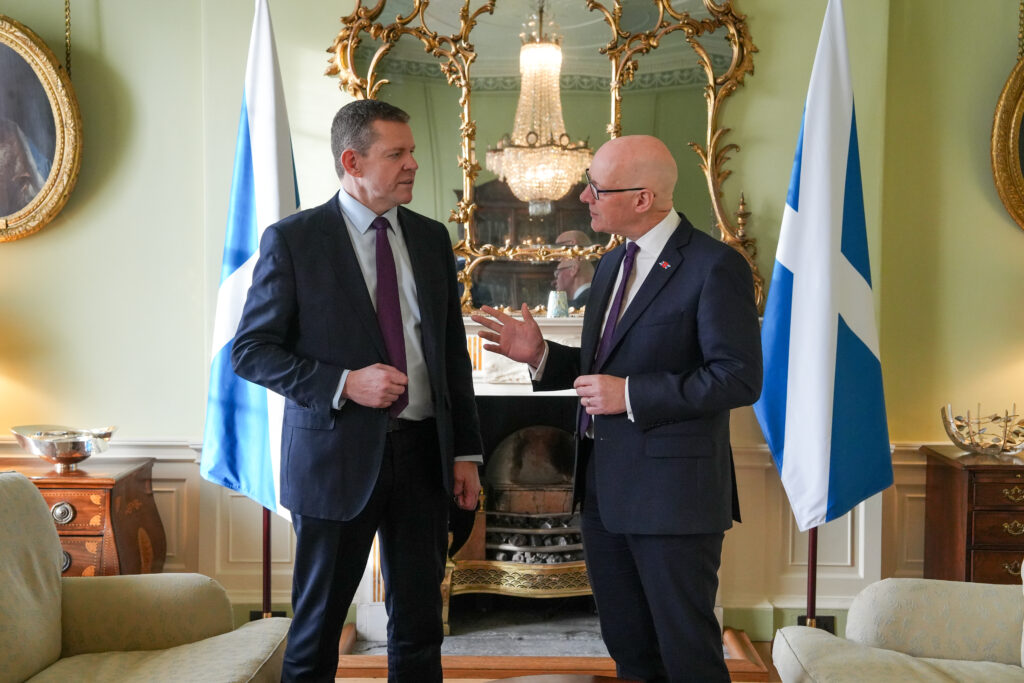
John Swinney went furthest in his assessment of the political consequences, describing Burnham as the “last Prime Minister of the United Kingdom”.
The Scottish First Minister argued that, if Scotland was given another independence referendum, voters would choose to leave the Union.
His remarks follow an exchange at Prime Minister’s Questions in which Burnham appeared to open the door to considering another Scottish referendum if there was clear and sustained public support.
Burnham compared the question with the provisions governing a border poll in Northern Ireland, arguing that a vote must be considered where public opinion has shifted sufficiently. However, after Swinney welcomed the apparent change in tone, the Prime Minister subsequently clarified that another Scottish independence referendum remained “off limits”.
That leaves the Government facing a difficult question: what level of democratic support, if any, would be sufficient for Westminster to reconsider its opposition to another referendum?
Wales pushes for greater constitutional powers
The immediate situation in Wales is different.
Ap Iorwerth has ruled out pursuing an independence referendum before the next Senedd election in 2030. His government instead intends to establish a national commission designed to lay the foundations for a possible future move towards independence.
However, the Welsh First Minister is seeking further devolution from Westminster, including powers over policing and youth justice, while also arguing that the power to hold an independence referendum should ultimately be devolved to Wales.
Ap Iorwerth has also challenged Burnham’s approach to the nations and regions, arguing that the Prime Minister has “a lot to learn” about the distinction between national devolution and English regional devolution.
Despite the criticism, he said he wanted a positive relationship with the Prime Minister.
Northern Ireland divisions exposed
The meeting has also highlighted the very different constitutional arrangements governing Northern Ireland.
Michelle O’Neill argued that, while Wales, Scotland and Northern Ireland have distinct political circumstances, they share a belief that Westminster does not adequately serve their interests.
However, DUP Deputy First Minister Emma Little-Pengelly criticised O’Neill’s involvement in the talks, accusing her of attempting to “weaponise the role of first minister”.
Unlike Scotland and Wales, the route towards a referendum in Northern Ireland is specifically provided for under the Good Friday Agreement, with the Secretary of State able to call a border poll where it appears likely that a majority would support Irish reunification.
Labour, Conservatives and Reform attack Plaid
The declaration has prompted criticism from unionist parties in Wales.
Welsh Labour leader Ken Skates accused Plaid Cymru of wanting to “use power to break up Britain”, while Welsh Conservative Senedd leader Darren Millar argued that the First Minister should concentrate on pressures facing the Welsh NHS and schools rather than independence.
Reform UK’s Welsh leader Dan Thomas similarly accused the First Minister of prioritising the break-up of the UK over NHS waiting lists and education.
The UK Government, meanwhile, said Burnham remained committed to delivering change across all four nations and “believes strongly in the union”.

Burnham faces an increasingly difficult Union question from nationalist leaders
The significance of the Cardiff declaration extends beyond whether another independence referendum is imminent.
The emergence of nationalist-led governments in all three devolved nations creates a fundamentally different political relationship between Downing Street and the governments in Cardiff, Edinburgh, and Belfast.
Funding is likely to become another source of tension. Welsh ministers have long argued that the Barnett formula disadvantages Wales, while Scotland is generally regarded as benefiting from the existing system. Burnham previously argued for reform before becoming Prime Minister but has since played down the prospect of significant changes.
When the Prime Minister meets the devolved leaders next month, the discussion will therefore stretch well beyond independence.
Burnham will have to balance his stated commitment to the Union with demands for greater devolution, arguments over funding and increasingly coordinated pressure from nationalist governments claiming that Westminster should not have the final say over their constitutional futures.
For a Prime Minister who has long championed transferring power away from Westminster, the question is becoming increasingly difficult: how far should that principle extend when devolved governments want the power not simply to govern differently, but potentially to leave the United Kingdom altogether?