
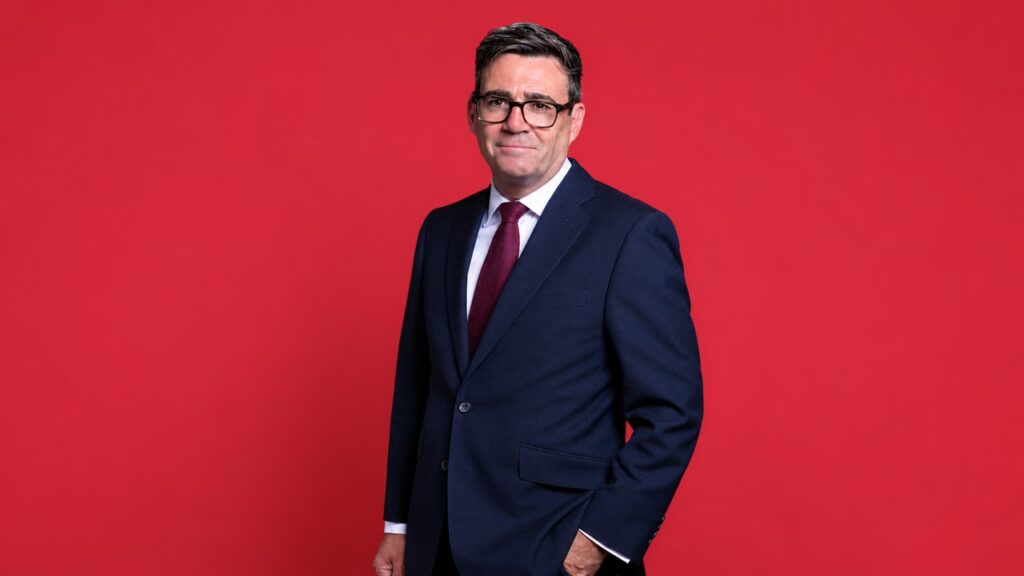
Andy Burnham used his first speech as the new leader of the Labour party to promise a return to “the Labour they once knew”, devoting efforts to rebuild trust in politics, devolve power away from Westminster, and to unite a party he believes have often been too divided by internal battles.
Addressing party members after winning the leadership contest, Burnham said Labour had a “last chance to change” and has promised to put the party’s renewed unity “at the service of people and places who have been waiting too long for politics to let them hope again.”
“We’re going to give them hope back,” he said. “We will be that version of Labour again.”
The former Greater Manchester mayor used the speech to outline five commitments that he said would define his leadership moving forward.
First Speech: Building “One Labour Team”
Burnham’s first pledge was to create what he described as a culture of “one Labour team”, arguing that factionalism had damaged the party’s ability to govern.
“We won’t beat Britain’s new right if we are consumed by infighting and pulling in different directions,” he said.
He promised to move away from what he described as an “insidious briefing culture” and said he wouldn’t seek to “suspend or punish members who have principled views that may be different from mine.”
Instead, he pledged to build unity by “respecting all shades of opinion” and said his team intends to “reflect all parts of our party, all communities.”
New Labour Leader, “New Politics” and a New Direction
His second commitment was to build what he called “a new politics”, arguing that voters had become frustrated with political point-scoring while living standards have continued to fall.
“We might enjoy the point scoring against others. The public don’t,” Burnham said.
Calling Labour’s current position a “last chance to change”, he urged politicians to focus on solving problems rather than merely attacking opponents.
Burnham’s third pledge focused on Labour’s political identity. He said the party would not attempt to imitate its rivals.
“We won’t try to out-green the Greens or out-reform Reform,” he said. “We win by being us. Boldly, confidently, authentically us. Labour.”
The new leader also made the argument that Britain had taken “a series of wrong turns in the 1980s”, blaming neoliberalism and pointing to the centralisation of political power and the privatisation of key industries as factors behind regional inequality as well as declining communities.
Andy Burnham : Power Back to Communities
Burnham’s fourth and fifth commitments centred on geography and devolution.
Declaring that he would be “a leader for the North, the South, the East and the West, for Scotland, Wales and Northern Ireland”, and rejected suggestions that his leadership would focus solely on northern England.
“I love every part of this country,” he said. “But I also know they can all be more than they are.”
His final promise was to “take power back from Westminster and Whitehall and give it to the place where you live.”
Among the areas he highlighted were transport, housing and skills policy, arguing that local communities should have greater control over decisions affecting their economies.
“We want to give your area more power to build the council and social homes that you desperately need,” he said, while also promising support for local businesses and a greater emphasis on technical education and apprenticeships.
Burnham closed his speech with a call for Labour to become once again “the party that puts more power in people’s hands, drives good growth in every postcode and puts hope in every heart.”
“Labour are for us,” he said. “I want that to just fall off people’s tongues.”
The speech marked Burnham’s first opportunity to define his leadership and offered the clearest indication yet of the themes likely to shape his approach, including party unity, devolution and what he repeatedly described as his mission to “bring back hope.”
You can still get a copy of our new edition of ChamberUK. Our parliamentary journal.
Photo Credit: House of Commons, background added by ChatGPT