

This article is describing the findings of the new StatsandData Global Quarterly Weighted Assessment (QWA) for 2026 Q1. It demonstrates the difference between Andy Burnham opinion poll projections and Keir Starmer ones. This is an analysis of a model based on publicly released polling.
The newly released StatsandData Global Quarterly Weighted Assessment for 2026 Q1 shows Britain’s party map is more fragmented than it has been in decades, with Reform UK leading on a projected 209 seats of the 631 up for grabs. This analysis paints a picture of five sizable parties, razor-thin margins in many seats, and small flank parties that could tip results beyond their national vote share.
National Picture And Headline Numbers
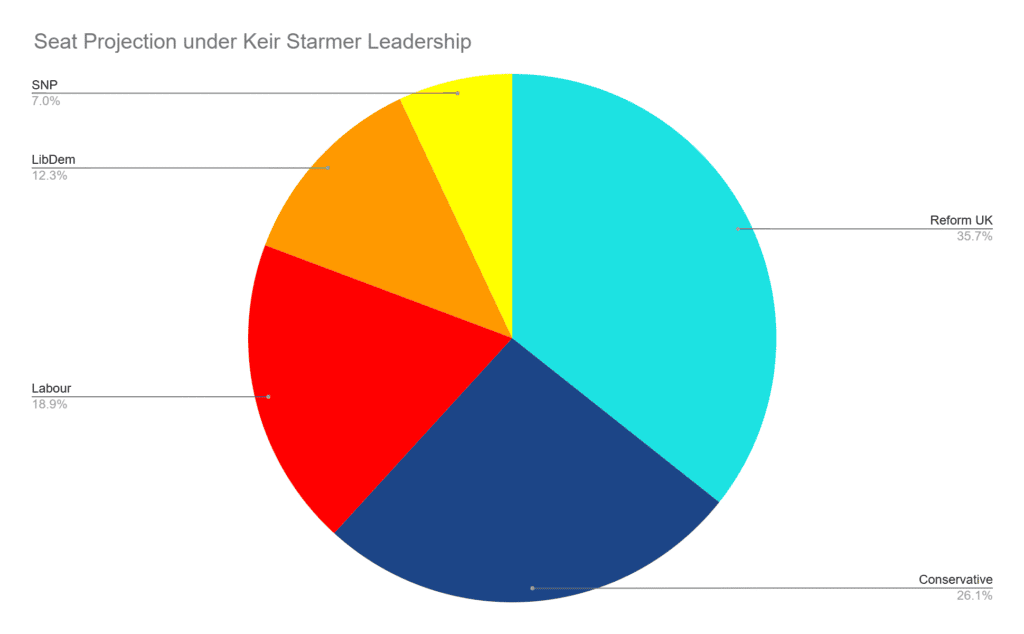
The QWA’s top-line national numbers show a remarkably even party spread, with Reform UK holding 25.5% of the vote and 209 seats, the Conservatives holding 21.9% and 153 seats, Labour holding 19.9% and 111 seats, the Greens holding 13.1% and 36 seats, and the Liberal Democrats holding 11.5% and 72 seats. Restore Britain registers just 3.3% nationally but is currently modelled to win a seat.
This analysis gives significantly more insight than a simple vote share projection because first‑past‑the‑post makes local splits quite decisive. The largest party currently commands barely a quarter of the vote, and roughly one third of MPs would be elected on under 30% of their constituency vote.
Burnham Opinion Poll Scenarios
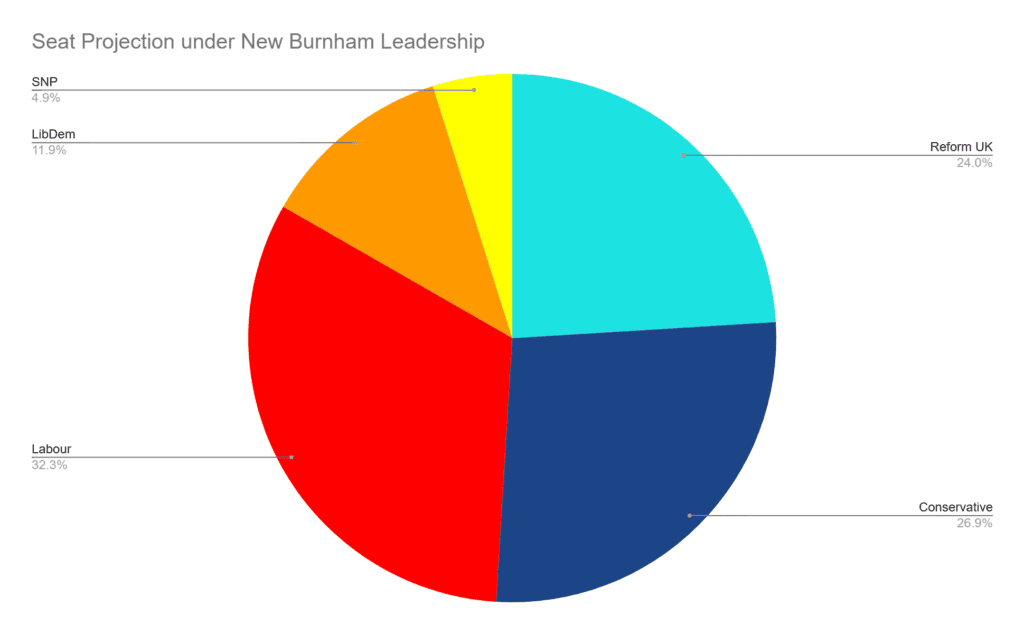
The QWA models three Labour leadership scenarios, allowing comparison between Keir Starmer at the helm, a Wes Streeting leadership, and and the incoming Andy Burnham premiership. The differences between the three are significant. Labour’s projected seat total ranges from about 90 under Streeting to 199 under Burnham, with the Keir Starmer at 111. In other words, it seems that Labour has made the electorally advantageous decision by choosing Burnham.
Geography also plays a significant role. Under the Burnham scenario, Labour recovers strongly in the industrial North West, gaining 26 in that region alone, while gains in the North East are smaller. Scotland also swings, with Burnham modelled to win seats from the SNP that do not move under the Streeting scenario. Even in the best-case Burnham projection, parliament remains finely balanced. The left‑of‑centre bloc reaches roughly 315 seats against a Reform-plus‑Conservative bloc of about 314.
Restore Britain
Perhaps the most striking finding is that Restore Britain’s outsized effect. At 3.3% nationally, Restore is currently modelled to cost Reform UK at least 72 seats, but as many as 84 under maximum‑damage assumptions, by peeling decisive votes in seats decided by smaller margins. Without Restore’s presence, Reform would be projected to win roughly 293 seats, within reach of a GB majority; with Restore standing, Reform drops to 209 seats.
Most of that loss benefits the Conservatives, and the QWA estimates about seven in ten of Restore’s toll on Reform accrues to Conservative candidates, implying that much of the Conservative recovery is borrowed rather than newly earned. Restore does win one seat outright in the model, though Great Yarmouth, where Rupert Lowe polls 38%, shows how concentrated support locally can produce a seat just from a small national share.
Seats To Watch And Next Steps
The QWA highlights several constituencies where outcomes vary depending on the scenario or local dynamics. Currently, Great Yarmouth (Restore’s beachhead), Hitchin (an actual three‑way tie), Makerfield (a recent by‑election test of candidate effect), Bermondsey & Old Southwark (centrist leakage to the Liberal Democrats), and a handful of Welsh and Midlands seats that the model has flagged as vulnerable.
Stats and Data plans follow‑up releases, including a deep dive on the Restore–Reform arithmetic, a first‑past‑the‑post whitepaper which explores proportional alternatives, and full constituency‑level tables.
Final Thought
This analysis underlines two plain realities. Britain’s vote is fragmented across multiple parties, and small shifts or the presence of minor parties can make significant changes to parliamentary outcomes far beyond headline national percentages. Even the same party under a different leader can have wildly different results based on relatively small vote share changes.
It’s all to play for in the second half of this Parliament!
You can still get a copy of our new edition of ChamberUK. Our parliamentary journal.
Photo Credit: Number 10