
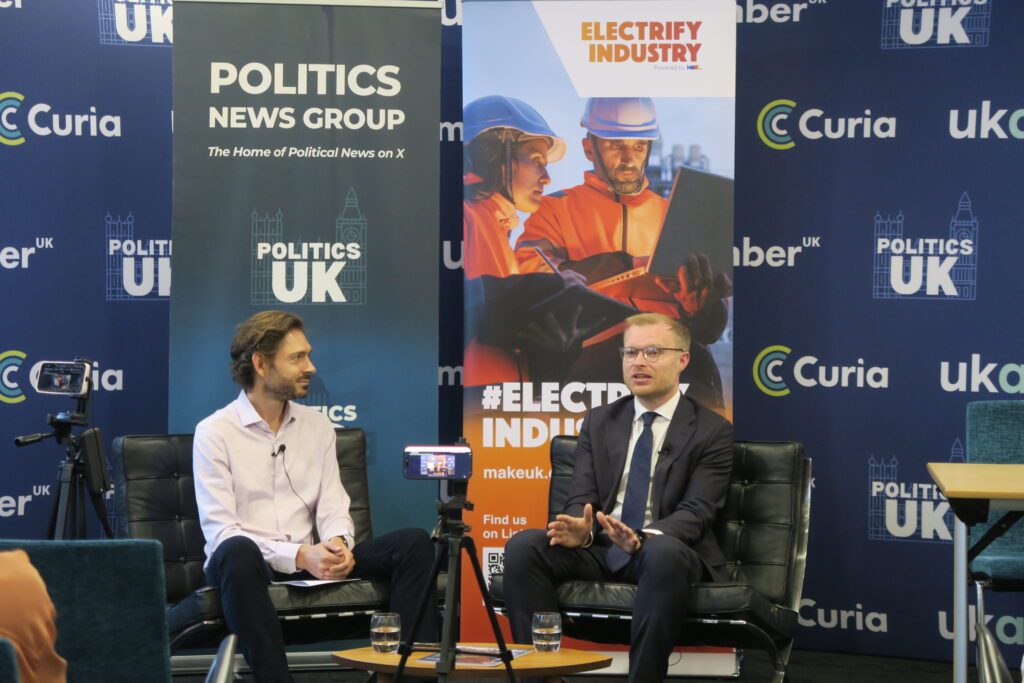
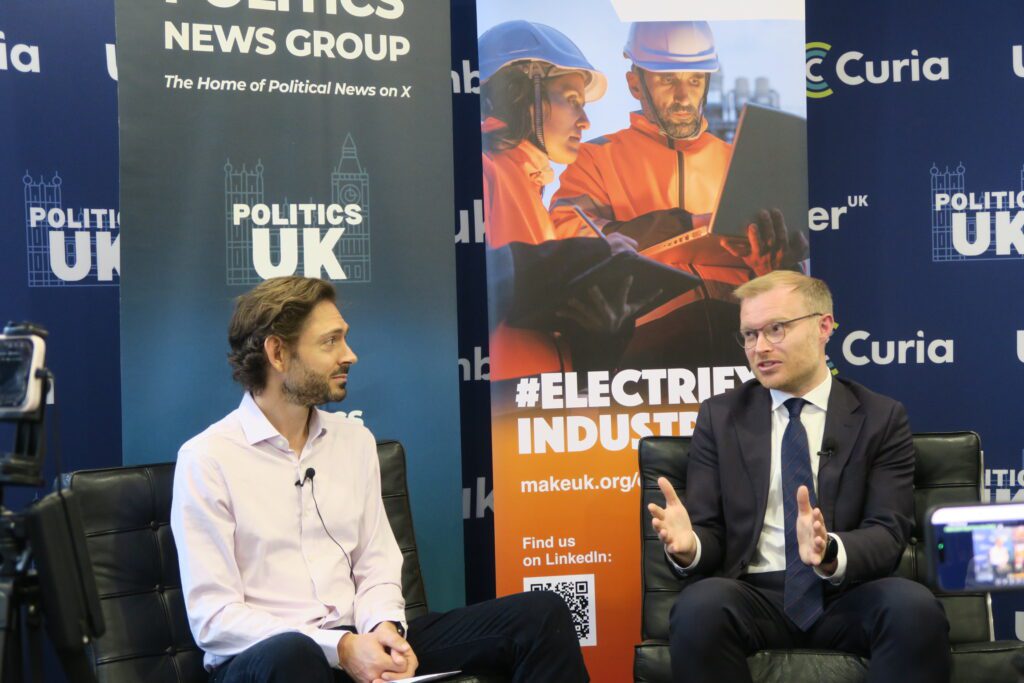
Speaking in conversation with Simon Evans, Deputy Editor and Senior Policy Editor at Carbon Brief, Michael Shanks, Member of Parliament for Rutherglen, set out his views regarding the future of Britain’s energy system, arguing that moving away from fossil fuels is not only essential for tackling climate change, but also for protecting households and businesses from volatile energy prices.
Incoming Burnham Administration
While questions inevitably turned to speculation surrounding Andy Burnham’s expected arrival in Downing Street, Shanks declined to engage in discussions about cabinet appointments or internal politics.
“Everything before then is just absolute speculation,” he said. “It will fill some column inches but it doesn’t really move the conversation forward.”
Instead, Shanks focused on what he sees as the defining principle of the government’s energy strategy, which is linking energy policy with industrial policy.
Industrial Policy
“We’re an energy department, but we’re also an industrial policy department,” he said, arguing that Britain had spent too long focusing efforts on building major infrastructure projects without securing the jobs and manufacturing opportunities that should accompany them.
The Government’s Clean Power Mission, he argued, is intended not only to decarbonise electricity generation but to ensure communities benefit directly from investment.
“Every pound of public spending that is spent on building energy infrastructure should result in investment in communities, jobs, apprenticeships and opportunities.”
Much of the discussion centred around energy prices and incoming criticism that the Government’s net-zero ambitions risk pushing bills higher.
Shanks rejected that argument outright.
Energy Independence
“We are exposed to fossil fuels,” he said, pointing to both the Russian invasion of Ukraine and recent instability in the Middle East as examples of how global events quickly feed through into British energy bills.
“We spent tens of billions of pounds as a country subsidising energy bills because of our exposure to fossil fuels. Less than five years later, here we are with another fossil fuel crisis not of our own making and bills have gone up again.”
For Shanks, the choice facing Britain is straightforward: continue investing in gas infrastructure and remain exposed to international price shocks, or accelerate investment in renewables, nuclear power and storage technologies.
“Half of the recessions we have faced as a country since the 1970s have been caused by fossil fuel shocks,” he argued. “The answer is to get off that as quickly as possible.”
Affordability, however, remains the government’s central political challenge. Shanks acknowledged concerns from manufacturers facing some of the highest industrial electricity prices in the developed world and said ministers were open to considering proposals to move some policy costs away from energy bills and into general taxation.
Blackouts
Questions over recent reports of near misses in the electricity system also featured prominently.
The issue was brought into the political spotlight after former Energy Secretary Claire Coutinho claimed she had been contacted by whistleblowers within the National Energy System Operator (NESO), who alleged that the grid was “not being run securely” and that a particularly serious incident had occurred on 23 June. In a post on X, Coutinho said the whistleblowers believed operational concerns were being hidden from the public, and called for an independent investigation into the events surrounding the day in question.
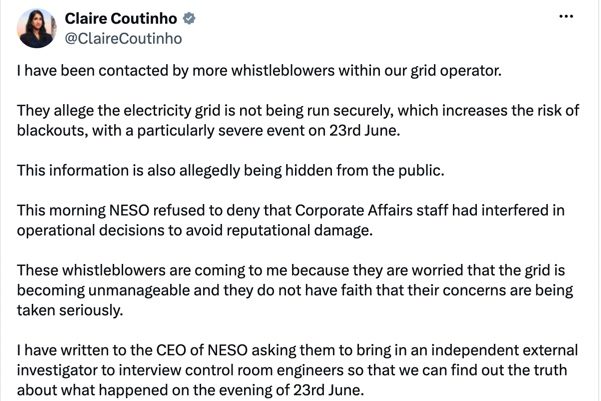
While supporting an independent investigation into concerns raised by whistleblowers, Shanks criticised what he described as “unfounded claims about impending blackouts”.
“The control centre made a lot more decisions to balance the grid than they normally would have,” he said, referring to recent periods of extreme weather, “but they balanced the grid and the lights did not go out.”
On the future of the North Sea, Shanks sought to reassure workers concerned about the transition away from oil and gas, particularly in Aberdeen and north-east Scotland.
“We’re not turning off the taps,” he said, emphasising that existing production would continue for decades and that domestic energy production remained important for jobs and tax revenues.
Michael Shanks Final Thoughts on Britain’s Long Term Future
However, he argued that Britain’s long-term future lies elsewhere, particularly in offshore wind, carbon capture, hydrogen and decommissioning.
“The government has a responsibility to support workers through that transition,” he said, arguing that new industries must provide “good, sustainable, well-paid” jobs for those currently employed in oil and gas.
When asked what success would look like by the next election, Shanks’ answer was clear.
“Without a doubt, it has to be around affordability,” he said.
“Until we get to a point where a letter drops through the letterbox and people aren’t absolutely terrified that it’s a bill they just can’t afford, we won’t have really tackled the affordability crisis.”

You can still get a copy of our new edition of ChamberUK. Our parliamentary journal.