
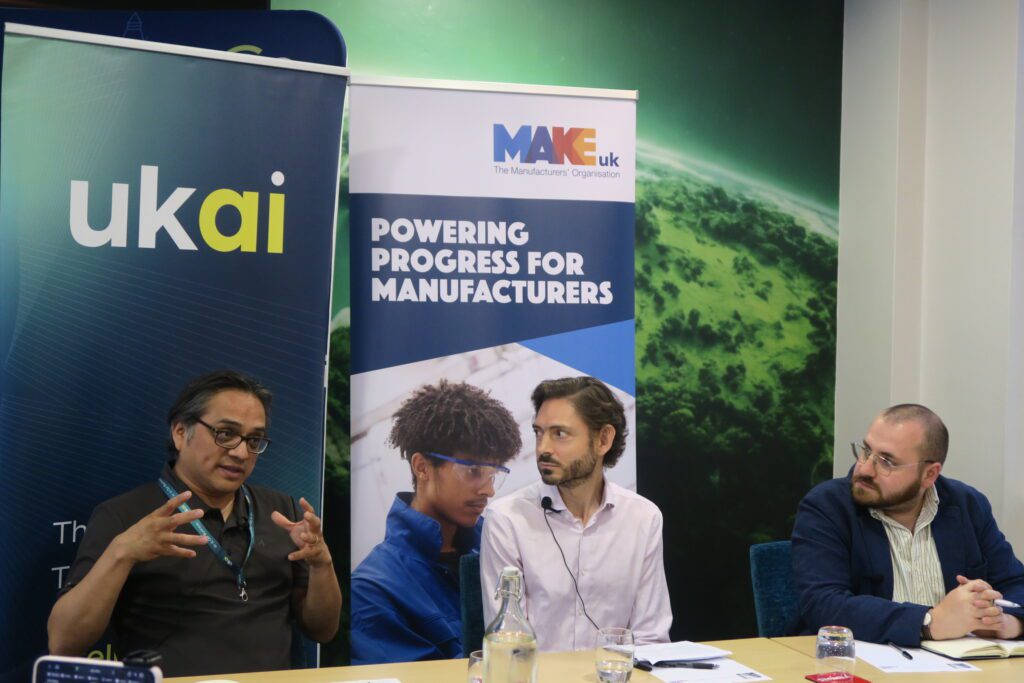
Speaking in conversation with Simon Evans, Deputy Editor and Senior Policy Editor at Carbon Brief, Tim Flagg, CEO and Co-founder of UKAI, and Patrick Matthewson-Clark, Senior Policy Manager for Energy and Net Zero at Make UK, discussed whether Britain’s ambitions to become both an AI superpower and a clean energy leader can be pursued simultaneously.
Flagg has been a prominent advocate for positioning Britain as a “green AI superpower”, arguing that the UK’s strengths in efficient data centres, AI infrastructure and clean energy innovation can reinforce one another rather than compete. Matthewson-Clark leads Make UK’s work on industrial energy costs, electrification and manufacturing decarbonisation, focusing on ensuring the transition to net zero strengthens rather than undermines British industry. The discussion followed an earlier roundtable and interview with Michael Shanks MP, the current Energy Minister. It focused on artificial intelligence, industrial policy, and energy affordability.
AI and Clean Power
For Flagg, the challenge facing policymakers is bringing together two of the Government’s defining missions: delivering clean power and establishing Britain as a global leader in artificial intelligence.
“On the surface, those two might seem incompatible,” he said. “But actually, we can bring those two things together.”
Flagg argued that British data centres are already among the most energy and water efficient, creating an opportunity for the UK to export those technologies internationally.
“UK data centres are some of the most energy efficient, water efficient in the world,” he said.
AI itself, he argued, also has the potential to improve efficiency across the wider economy through smarter electricity grids and optimisation technologies.
The UK’s AI Opportunity
The panel challenged assumptions surrounding Britain’s role in the global AI race.
While the largest language models are often trained in energy-rich locations such as Texas or the Middle East, Flagg argued that the UK’s opportunity lies in “inference” computing, which is the local data centre activity that supports everyday interactions with services like ChatGPT.
Flagg also suggested Britain could carve out a competitive advantage through smaller, more efficient models and open-source technologies rather than competing directly to build the largest models.
“What we’re seeing is the emergence of what we call the second paradigm,” he said, describing a future built around smaller models operating across distributed networks.
Industrial Energy Costs
As in the earlier discussion with Michael Shanks MP, energy affordability quickly moved to the centre of the conversation.
For manufacturers and data centre operators alike, electricity costs remain a major concern for future investment. “If the energy price is too high here, then they’re going to look in other jurisdictions,” Flagg warned.
Both panellists argued that one immediate solution would be removing policy levies from electricity bills, which they said currently penalises businesses seeking to electrify operations. “You’re placing costs onto electricity whilst wanting industry to electrify,” Flagg argued.
Matthewson-Clark warned that high industrial energy prices continue to threaten Britain’s manufacturing base and risk undermining the Government’s wider growth ambitions. “We feel that industry is at the real risk of deindustrialisation and that is generally driven by high energy costs,” he said.
According to figures cited during the discussion, 13 percent of manufacturers believe another major energy price shock could threaten their viability, while 90 percent report that energy bills have continued to rise since the energy crisis triggered by Russia’s invasion of Ukraine.
Electrification
Despite those challenges, both speakers argued that the industry remains committed to decarbonisation if the economics can be made to work.
Matthewson-Clark noted that 63 percent of manufacturers have already invested in electrification technology, and 87 percent would invest further if the so-called “spark gap” between gas and electricity prices was narrowed.
“There is an appetite here,” he said. “Industry is ready to make a move, but at the moment the investment conditions aren’t right.”
The pair also welcomed growing international interest in electrification targets and action plans, pointing to developments in the European Union and preparations for COP discussions.

You can still get a copy of our new edition of ChamberUK. Our parliamentary journal.