
The Prime Minister has today released the long-delayed Defence Investment Plan (DIP) which was originally slated for release 10 months ago. This follows months of wrangling between the Ministry of Defence (MOD) and the Treasury over exactly how many commitments could be funded.
The Road to Defence
The road to releasing this plan has been rocky to say the least. Originally planned for release in Autumn 2025, it is widely understood to be drafted in conjunction with the Strategic Defence Review (SDR) that was published in June 2025.
That review was almost immediacy called into question when, later that month, at the annual NATO summit, US President Donald Trump demanded massive defence spending increases from other NATO members.
Defence spending targets are usually expressed as a percentage of GDP. For example, the previous NATO defence budget target was 2% of GDP, meaning that for every one hundred pounds, dollars or euros spent in a NATO country, two of those should be on defence.
Trump’s demands prompted the Government to increase it’s defence spending target from the 2.5% promised in the 2024 Labour Manifesto to the 3.5%. This change has resulted in conflict about just how much and by when the defence budget will increase.
Since then the publish date for the DIP has been pushed back causing interventions first by Lord George Robertson, former Secretary General of NATO, former Labour Defence Secretary and author if the SDR in April 2026 when he said “UK’s security is “in peril” and Sir Keir Starmer’s government has shown “corrosive complacency” towards defence.
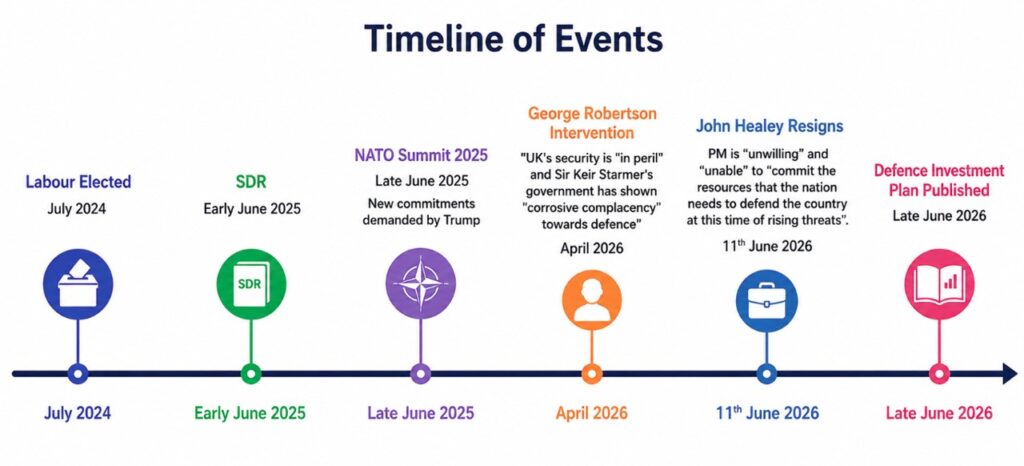
Earlier this month, then Defence Secretary John Healey stepped down saying Sir Keir Starmer is “unwilling” and “unable” to “commit the resources that the nation needs to defend the country at this time of rising threats”.
Numbers
Now that the report is published we can compare the numbers promised with those planned for. The defence budget is usually
The headline change from current Government plans announced today seems to show a modest rise from 2.6% of GDP in 2027 to 2.7% in 2030. Though analysis of the full plan continues.
| 2025 | 2026 | 2027 | 2030 | 2035 | As soon as resources allow | In the next Parliamnt (starting 2029) | Source | |
| Actual | 2.3% | BBC News | ||||||
| Institute for Fiscal Studies says current plans imply | 2.6% | 2.6% | IFS | |||||
| Government Position | 2.5% | 3% | BBC | |||||
| BBC Reports plan presented to Healey | 2.68% | BBC | ||||||
| Healey | 3% | 3.5% | BBC | |||||
| Labour Manifesto | 2.5% | Labour Manifesto | ||||||
| NATO Summit 2025 Defence Spending | 3.5% | NATO | ||||||
| NATO Summit 2025 Defence Spending in civil defence | 5% | NATO | ||||||
| DIP | 2.7% | DIP |
Details
Today’s announcements includes several notable funding changes:
- £8bn over four years for the Global Combat Air Programme (GCAP), developing a next generation stealth fighter with Japan and Italy.
- £63bn over four years for the UK’s nuclear deterrent, including Dreadnought and SSN-AUKUS submarines, a new warhead, and the purchase of 12 F-35A aircraft for NATO’s nuclear mission.
- Over £5bn over four years to transform military drone capabilities, including £650m for expendable autonomous systems such as drones and uncrewed ground vehicles for the Army, Royal Marines and Special Forces.
- £26bn over 10 years for Project Royal Oak, the largest naval base upgrade in over 45 years, including major investment in Faslane, Portsmouth and Devonport.
Defence Investment Plan: Final Thought
There has been much squabbling over abstract numbers in defence spending but far less discussion of what we expect our defence spending to achieve. Looming over this squabble is two big changes that have occurred since 2022.
Vladimir Putin’s Russia has become increasingly bellicose and risk tolerant since their full scale invasion of Ukraine and the election of Donald Trump in the USA has destabilised the main source of security for Europe. Trump speaks irresponsibly, often implying that the US commitment under NATO article 5 is conditional and even threatening NATO members with military force.
Together this means that Europe, including the UK must secure a credible deterrent against Russia. Particularly against limited incursions such as skirmishes in the Baltic or sabotage in the North Sea.
Europe’s economy is ten times the size of Russia’s and it already massively outspends Putin’s regime on defence. Any change in the UK’s defence budget will be unlikely to tip the strategic balance in a long conflict. The question is whether spending can convince Russia that any limited intervention is a losing proposition.

You can still get a copy of our new edition of ChamberUK. Our parliamentary journal.
Photo Credit: Alan Wilson timeline by ChatGPT