
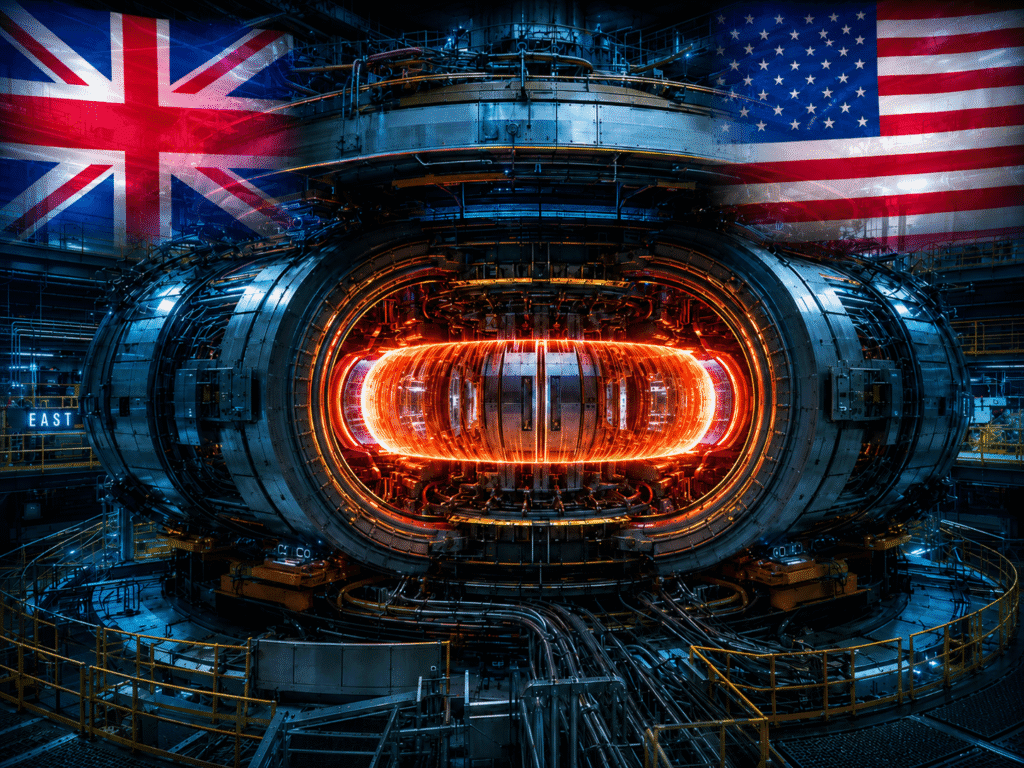
The United Kingdom and United States have strengthened cooperation on fusion energy through a new agreement between two of the world’s leading fusion research institutions.
The Memorandum of Understanding (MoU), signed between the US Department of Energy’s Princeton Plasma Physics Laboratory (PPPL) and the UK Atomic Energy Authority (UKAEA), will deepen collaboration across plasma science, workforce exchange, advanced computing and fusion technology.
The agreement follows The King’s Address to a Joint Meeting of Congress in Washington DC, where he highlighted new partnerships between the UK and United States on fusion energy, and said British and American ingenuity should continue to lead the world.
While fusion has long been presented as a future clean energy breakthrough, the significance of this agreement is broader than a single research partnership. It places fusion firmly within the wider UK-US relationship on science, trade, industrial strategy and energy security at a time when governments are seeking to reduce exposure to volatile global energy markets and build advantage in strategic technologies.

From the Lab to the Grid
Fusion energy aims to replicate the process that powers the sun, offering the possibility of abundant low carbon energy with no long-lived radioactive waste and no greenhouse gas emissions from power generation. The scientific promise is considerable, but the engineering challenge remains among the most complex in the world.
That is why partnerships between national laboratories matter. The route from experimental success to commercial power plants will require not only scientific discovery, but major advances in materials, magnets, plasma control, tritium handling, diagnostics, computing and plant design. No single country is likely to solve these challenges alone.
Under the new agreement, PPPL and UKAEA will expand scientific, academic and educational cooperation across fusion science and technology. The partnership includes reciprocal staff exchanges, access to major research facilities, joint projects, the exchange of academic information, collaboration on ITER diagnostics, advanced computing and wider information sharing over the coming years.
Fusion is not a field where progress happens through one breakthrough moment. It advances through accumulated knowledge, shared facilities, improved modelling, better diagnostics, highly specialised skills, and the ability to test ideas across different machines and research environments.
Why This Matters for the UK
For the UK, the agreement reinforces its ambition to remain one of the world’s leading fusion nations.
UKAEA operates at the centre of Britain’s fusion ecosystem and has decades of experience running major experimental facilities, including the Mega Amp Spherical Tokamak Upgrade (MAST Upgrade) at Culham. The UK is also pursuing the Spherical Tokamak for Energy Production (STEP) programme, which aims to develop a prototype fusion power plant in Nottinghamshire.
The partnership with PPPL supports that wider national strategy. It strengthens links between researchers, gives UK scientists access to expertise and infrastructure in the United States, and helps align the UK with one of the most advanced fusion research communities in the world.
But the opportunity is not only scientific. Fusion could become a major industrial sector, with supply chains spanning advanced manufacturing, robotics, materials, cryogenics, digital engineering, artificial intelligence, high performance computing and precision instrumentation. For the UK, the challenge is to ensure that research leadership translates into industrial capability, jobs, investment and export potential.
The workforce element of the agreement is therefore important. Fusion will require a specialist talent pipeline across physics, engineering, computer science, construction, regulation and plant operation. Staff exchanges and educational cooperation can help build the skills base needed for a future commercial sector.
A Strategic Signal from Washington and London
The fact that the agreement builds on The King’s Address to Congress gives it diplomatic weight. It signals that fusion is not just a long-term scientific pursuit, but as part of the next phase of UK-US strategic cooperation.
Energy security has moved to the centre of geopolitical thinking. The war in Ukraine, supply chain shocks, and the volatility of fossil fuel markets, have all reinforced the need for resilient domestic energy systems. At the same time, the race for leadership in clean technologies has become more competitive.
Fusion sits at the intersection of these priorities. It is a climate technology, an energy security technology and a high value industrial technology. Countries that lead in fusion will not only shape future electricity generation; they may also control parts of a major new global supply chain.
For the UK, alignment with the United States offers scale and strategic depth. For the United States, the UK brings a long-established fusion research base, specialist expertise and a serious commitment to developing commercial fusion pathways. The partnership gives both countries a stronger platform from which to influence the future direction of the technology.
Executive Director of Plasma Science and Fusion Operations at UKAEA, Fulvio Militello said the organisation’s mission is to use its expertise through international partnerships to help deliver sustainable fusion energy.
“UKAEA has decades of expertise operating world leading fusion facilities and solving complex fusion challenges,” he said.
“This agreement with PPPL confirms the positive working relationship between the US and UK fusion communities. We look forward to combining our expertise to help solve some of fusion’s toughest challenges.”
Associate Laboratory Director for Strategy and Partnerships and Deputy Chief Research Officer at PPPL, Laura Berzak Hopkins said the agreement would help both institutions accelerate their shared mission.
“PPPL and UKAEA have each led groundbreaking, flagship fusion experiments,” she said.
“This strategic partnership allows us to unite our capabilities and deliver on our shared mission of bringing fusion from the lab to the grid. It is through global partnerships like this that PPPL amplifies its impact and pushes the boundaries of fusion science.”
Collaboration Will Decide the Pace of Progress
The agreement comes at an important point for fusion. Private investment has grown, national programmes have expanded and governments are increasingly looking at fusion as part of long-term energy planning. Yet the sector still faces hard questions about cost, timescales, regulation and commercial viability.
That makes international collaboration essential. The next phase of fusion development will depend on whether leading laboratories can share knowledge quickly, train enough skilled people and connect scientific progress with engineering delivery.
The PPPL UKAEA agreement should therefore be seen as more than a symbolic partnership. It is part of the infrastructure needed to turn fusion from a scientific aspiration into a practical energy technology.
If the UK and America can combine their research strengths, industrial capacity and political commitment, they will be better placed to shape the future of fusion power.
The prize is not only cleaner energy, but leadership in one of the defining technologies of the next century.