

Faced with severe staff shortages, waiting lists exceeding 7.1 million, and demand which all too often surpasses capacity, the NHS is looking to artificial intelligence (AI) through the Healthcare AI Solutions Framework to improve efficiency and deliver better patient outcomes.
As AI technologies continue to develop at pace, healthcare leaders are exploring how cutting-edge innovations such as predictive analytics, diagnostic imaging, and workflow automation could help address some of the most pressing challenges facing the NHS today. From supporting earlier intervention to improving operational efficiency, AI is expected to play a key role in executing the goals set out by the Government’s 10 Year Health Plan for England.
However, the successful integration of AI into the NHS will depend on more than innovation alone; it requires clear governance structures, effective procurement pathways, and strong infrastructure to deploy new technology safely across the country’s healthcare system.
To further this ambition, NHS Shared Business Services (NHS SBS) recently published the Healthcare AI Solutions Framework Agreement in May 2026. That is, a new nationally available contract designed to simplify the procurement of pre-approved, and legally compliant AI technologies across public health services.
A Shift ‘from Analogue to Digital’
In a speech delivered at the launch of the 10 Year Health Plan in July 2025, Sir Keir Starmer defined AI as central to the NHS’s transition from “analogue to digital“. According to the Prime Minister, AI “means a future where we have better GP access, no more 8am scrambles, more dental care for your children, better care on your doorstep and Neighbourhood Health Centres like this in our coastal towns, in rural counties, in every community across the country”.
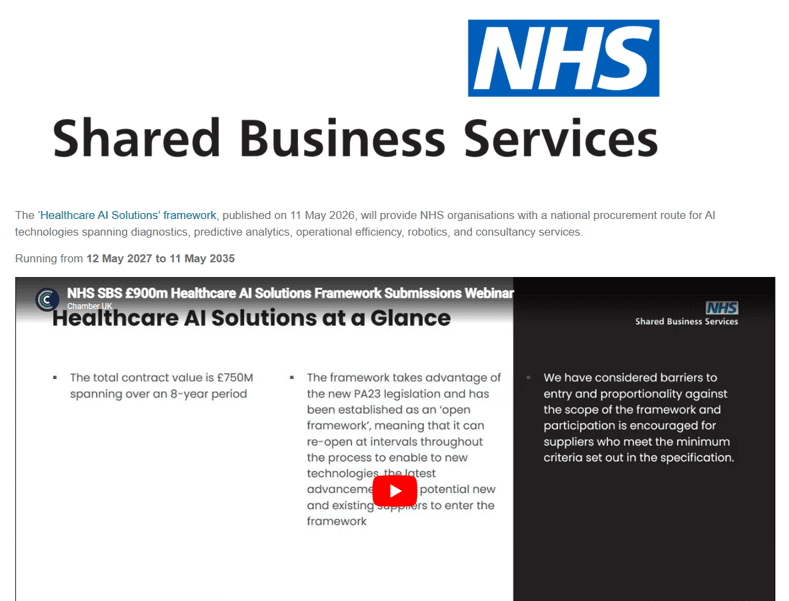
The new Healthcare AI Solutions Framework is valued at up to £750m, and £900m including VAT. As with all framework agreements, it represents a buying option, not a spending commitment, but as NHS SBS Senior Category Manager, Kelly Bevington, sais: “AI has the potential to transform NHS patient care, speeding up diagnosis and treatment times by ensuring that expert clinical resource is targeted where it has the greatest impact for the patient.”
She added: “Our new framework agreement will focus on the application of AI in different specialties by providing new, efficient ways to prevent, diagnose, treat illness, and optimise clinical workflow”.
The framework has been divided into eight specialist lots covering a broad range of healthcare applications. These include: radiology and diagnostic imaging; pathology and preventative healthcare; virtual and robotic health; predictive analytics; research and development; operational efficiency; specialist advisory services; and integrated AI solutions.
Importantly, the framework will remain open to new technologies, which will be periodically integrated as the AI market continues to evolve.
UKHLSI’s Specialist Webinar on New Healthcare AI Solutions Framework

Given the magnitude of this technological change, there is work to be done in bringing industry stakeholders, such as AI technology companies and digital health suppliers, up to speed.
To support this process, UK Healthcare and Life Sciences Innovation (UKHLSI), a healthcare innovation network, hosted a webinar in partnership with NHS SBS and UKAI (the trade association for the UK’s AI industry) on 17 June to provide specialist guidance on procurement. Chaired by UKHLSI Chief Executive Joanne Bekis, the session featured contributions from UK AI’s Tim Flagg, alongside NHS SBS representatives Paddy Howlin, Procurement Solutions Director, and James Gee, Head of Category for Digital and IT.
The webinar offered practical insight into how industry stakeholders can best engage with the framework, covering topics including bidding requirements, accreditation standards, consortium arrangements, and future opportunities for market participation. It also provided suppliers with an opportunity to raise questions directly with NHS SBS officials and seek clarification on key aspects of the procurement process.
During the discussion, panellists outlined the rationale behind the framework, emphasising the need to balance innovation with patient safety throughout the technological overhaul of the NHS. Moreover, they argued that the framework would help reduce duplication and streamline procurement processes, enabling NHS organisations to access AI technologies more quickly. As Howlin explained, the new system would tackle “fragmented procedure routes and lengthy procurement cycles’”
Is the NHS Digitally Fit to Deploy the New Healthcare AI Solutions Framework?
While many healthcare professionals recognise the potential of AI in healthcare, concerns remain about whether the NHS has the capacity to seamlessly implement these technologies. According to a recent report by the Royal College of Physicians (RCP), 70% of physicians support the wider adoption of AI tools within the NHS, while 68% believe that the healthcare system lacks the necessary infrastructure to deploy them.
Despite this, the Healthcare AI Solutions Framework marks an important milestone in the NHS’s transition to a more digitally enabled healthcare system. It reflects a growing recognition that the pressures facing the health service will require new solutions and additional resources. Given this, the United Kingdom is especially well-placed to lead the technological transformation, consistently ranking among the top countries in the world for AI innovation and investment.
NHS Shared Business Services recognise this challenge and have structured the Healthcare AI Solutions Framework under PA23 to allow for a re-opening of the Framework at appropriate intervals during its 8-year lifespan. This will enable new (and existing) suppliers to refresh their offers, provide access to previously maturing AI solutions and support the NHS in adapting AI into its ecosystem.
To find out more about the webinar and the UKAI Healthcare and Life Sciences Working Group and UKHLSI’s AI Working Group, please contact Partnerships Director, Ben McDermott at bmcdermott@ukhlsi.co.uk