

Umang Patel
Chief Clinical Information Officer – MicrosoftThis article sets out how technology, when embedded within the right system design, can move the NHS from pilots to delivery by creating capacity, improving productivity, and enabling the ambitions of the NHS Plan to be realised at national scale.
There are roughly five barbers or hairdressers for every NHS surgeon today. With waiting lists at historic highs, a far-fetched solution might be to borrow from medieval Britain and see whether any high street snippers are available for minor procedures.
That is, after all, where surgery began. Barbers were the first surgeons. They had sharp tools, steady hands, proximity to the public, and a willingness to help. What followed was not simply better instruments, but the creation of training, standards, sterile technique, governance, and dedicated environments for care. Systems, not tools alone, made surgery safe, trusted, and scalable.
That lesson matters now. In healthcare, new capability delivers impact only when embedded in the right operating model. Today, we have powerful digital and AI tools, but we are still too often treating them as pilots rather than infrastructure.
From Policy Direction to Market Creation
Over the past decade, national policy has established that digital health works. We have commissioned pilots, evaluations, and frameworks. This has been necessary. It has also reached its limit.
The centre of gravity must now shift from setting direction to creating markets.
Market creation means defining what good looks like nationally, validating it once, and scaling it many times. It means using national levers such as procurement, standards, assurance, and payment to ensure suppliers build for NHS realities, and that trusts are not forced to repeat the same evaluation hundreds of times.
In practical terms, when a redesigned digital pathway for a high-volume service is clinically assured, shown to be safe, and demonstrated to release capacity, it should become a reusable national building block rather than a bespoke local experiment. This is the difference between approving a product and commissioning a pathway. Approving a product confirms that a tool is safe and effective. Commissioning a pathway confirms that care can be delivered differently, at scale, and with technology embedded as infrastructure rather than added on at the margins. A market is created through pathway commissioning and orchestration.
The ambitions set out in the 10 Year Health Plan for England – moving care from hospital to community, from analogue to digital, and from sickness to prevention – are not abstract goals. They are delivery challenges. Technology is the lever. Market creation is the mechanism.
NHS Productivity: The Scale of the Opportunity
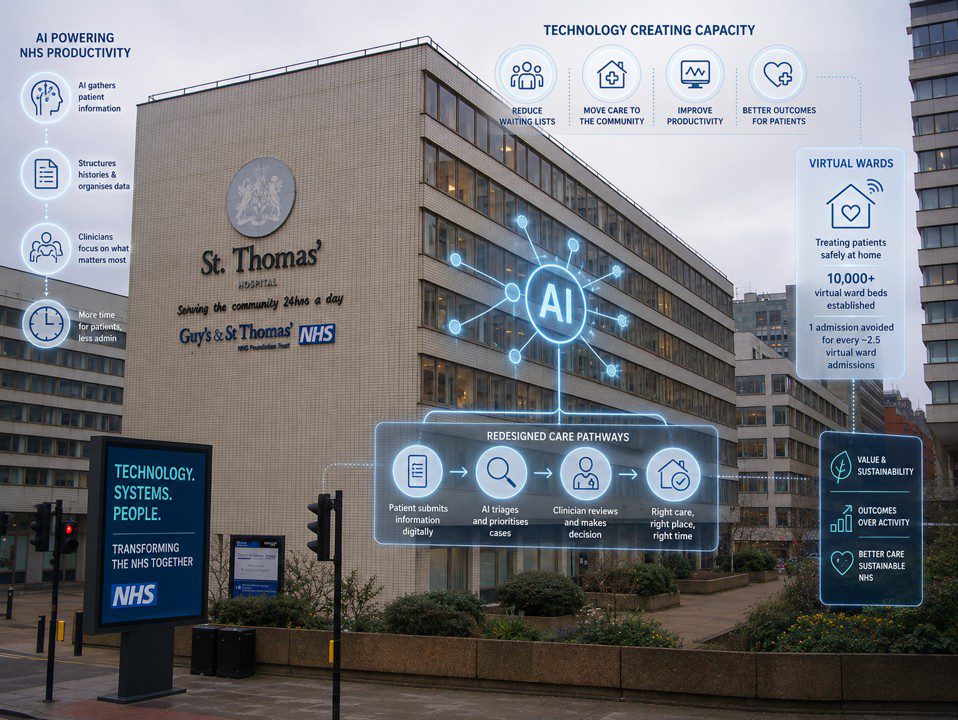
A simple worked example illustrates the difference. In a standard dermatology pathway, patients are referred, wait for an outpatient appointment, attend face to face clinics and are then reassured, treated or referred on. In redesigned digital first pathways, structured history and images are submitted upfront and triaged asynchronously, and only a minority require in-person review. Early deployments show that more than half of referrals can be resolved without a clinic appointment, reducing waiting times and freeing specialist capacity.
The scale of the prize is significant. In 2024 and 2025, there were 146.1 million outpatient appointments in England, with 8.1 million recorded as did not attends. Even small percentage improvements in pathway design would release capacity equivalent to entire hospital departments.
Virtual wards demonstrate what this kind of redesign can achieve. By late 2023, more than 240,000 patients had been treated at home, with over 10,000 virtual ward beds established, with evaluation suggesting one non-elective admission avoided for roughly every 2.5 virtual ward admissions on average.
AI as a Productivity Multiplier
AI adoption is not optional if we are serious about delivery. It is central to the economic case for reform, as productivity growth in healthcare is now essential to maintaining fiscal sustainability while demand continues to rise.
At the same time, AI has clear limitations that must be acknowledged explicitly. AI systems can hallucinate, can lack clinical judgment, and cannot be relied upon to diagnose or make final clinical decisions. Treating them as digital clinicians would be unsafe and would undermine public trust.
The opportunity lies elsewhere. AI can be used to perform structured administrative and preparatory work that is currently consuming scarce clinical time. For example, AI can guide patients through clinically relevant questions, collect structured histories, prompt the submission of relevant images or observations and organise this information for clinician review. In this model, the clinical content remains human, while the administrative burden is automated.
This approach aligns capability with accountability. Clinicians retain decision-making responsibility, while AI operates as a force multiplier that improves information quality, reduces friction and allows expertise to be applied where it adds the most value.
A recent national pilot reported average time savings of 43 minutes per person per day from AI co-piloting tools. At NHS scale, this equates to millions of hours returned to care.
This matters because productivity remains below pre-pandemic levels while fiscal constraints tighten. Without sustained productivity improvement, healthcare spending growth will increasingly crowd out other public priorities, limiting both service quality and wider economic resilience.
AI is not about replacing clinicians. It is about multiplying them, allowing scarce expertise to be applied where it adds the greatest value and reducing time lost to low-value administrative work.
National Infrastructure, Not Shadow IT
Public trust is critical. AI must operate under clear human oversight, with auditability, clinical accountability, and equity guardrails designed in from the outset. Market creation should reinforce these principles, ensuring that innovation strengthens trust rather than eroding it, and that benefits are distributed fairly across populations.
The UK is unusually well-positioned to lead. We have national evidence standards, assurance frameworks, statutory clinical safety requirements, and increasing regulatory coordination. Few health systems combine this scale, public trust, and institutional capability.
Market creation should make the safe option the easy option. Validate once, reuse assurance, align payment with redesigned pathways and scale what works.
This approach reduces risk, lowers transaction costs and accelerates adoption. It also creates operating models that are replicable nationally and credible internationally.
Payment, Productivity, and Value
Current payment mechanisms still largely reward activity rather than outcomes. AI enables outcomes to be measured at scale through remote monitoring, pathway analytics, patient-reported outcomes, and equity tracking.
These capabilities provide the foundation for genuine value-based care. Blended payment models can support redesigned pathways rather than historic clinic templates, making productivity gains structural rather than episodic, while reducing unwarranted variation and protecting safety.
From Local Delivery to National Scale and Export
Delivery must begin locally, focusing on a single high-volume pathway, with assurance applied upfront and clear measures such as reduced waiting times, avoided appointments, and staff time released.
Those successes then become national reference points. Specifications, safety requirements, and procurement routes can be standardised and reused, with operating models that are credible internationally and exportable beyond the UK.
Show. Do. Scale.
The tools are no longer the constraint. The question is whether we are willing to design the systems, including procurement, assurance, payment, and accountability, that allow them to be deployed safely and at pace.
If we do, we will not only improve care for patients in the UK. We will demonstrate that large-scale healthcare transformation is possible, affordable, and repeatable.
History shows that when capability is matched with system design, transformation follows. The opportunity is clear: move from intent to execution, and from planning constrained by workforce and physical capacity to deliberately designing in digital capacity.

This article features in the new edition of ChamberUK. Our parliamentary journal.
Photo Credit: St Thomas Hospital altered with ChatGPT.