
Until Sunday, 12 April, Viktor Orbán (Hungary’s strongman prime minister) was the EU’s longest-serving leader and one of the most durable political figures of the modern era. He was riding the wave of right-wing populism long before Donald Trump entered the White House; his success became a model for nationalist leaders across the world, demonstrating how effectively politics built on division and fear could be used to maintain power.
But after 16 years in office, Orbán’s rule has come to an end. In a result few would have thought possible, Péter Magyar, a rising star in Hungarian politics, and his Tisza party defeated Fidesz in Hungary’s general election, toppling the most deeply entrenched political machine in the European Union. Orbán conceded defeat on election night, while Tisza secured 138 of the 199 seats in parliament: enough for a two-thirds supermajority.
The scale of the result makes it more than a routine change of government. For years, Hungary had been a symbol of democratic backsliding in Europe: a country where elections still took place, but where the playing field had been so thoroughly tilted in favour of the ruling party that removing it through the ballot box seemed increasingly remote. That is why this election is being read not simply as a defeat for Fidesz, but as the collapse of a political order that had come to look immovable.
A Test for the Global Right
Viktor Orbán’s influence stretches far beyond the borders of a small central European state. Steve Bannon, Donald Trump’s former adviser, once described him as “Trump before Trump”. He has been embraced by figures across the nationalist and populist right, from Matteo Salvini and Marine Le Pen to Trump himself. Just last week, US Vice-President J.D. Vance travelled to Budapest on the eve of the election, praising Orbán as an extraordinary leader and expressing confidence in his victory.
Before becoming the European Union’s longest-serving head of government and a self-styled defender of Christian conservative values, Orbán was a young anti-communist liberal. He first rose to prominence in the late 1980s after the fall of communism, presenting himself as a champion of democracy, national sovereignty, and Hungary’s western future.
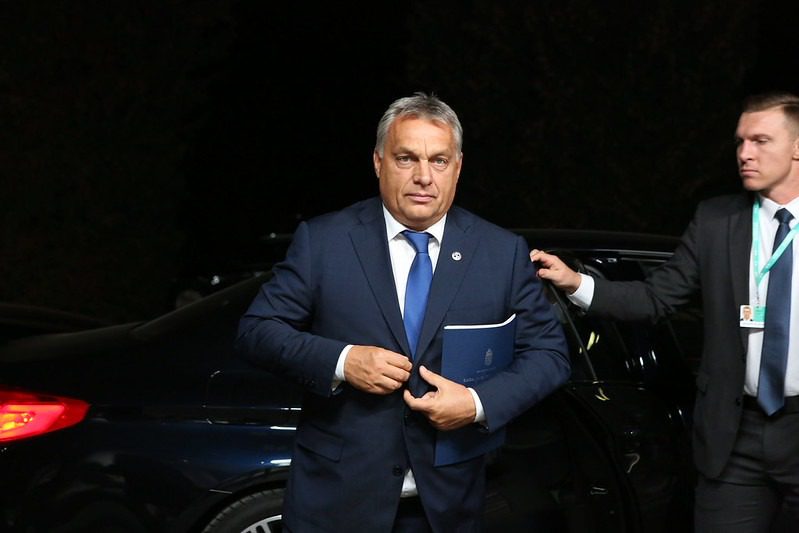
Image: Former Hungarian Prime Minister Viktor Orban – EU2017EE / Annika Haas
Since then, both Orbán and his party have moved steadily to the right, with the decisive turning point coming after Fidesz won a constitutional supermajority in 2010. Drawing on the politics of fear and using the refugee crisis to sharpen his message, Orbán built a powerful “us-versus-them” narrative in which he cast himself as the guarantor of order and security in an increasingly hostile world.
Repeated landslide victories gave him the power to rewrite the constitution, reshape state institutions, and pass laws that tightened his grip on power while squeezing independent media, civil society, and democratic checks. Ever since, Orbán has used his dominance of the political system to present himself as the nation’s protector against an ever-changing list of enemies: migrants, Brussels, LGBTQ+ groups, George Soros and, more recently, Ukraine.
Why the Change?
One might ask: with a system so deeply rooted and influential, how was change even possible? Previous challengers were either outmanoeuvred or swiftly crushed by the government’s propaganda machine, which proved highly effective at discrediting opponents before they could gain real momentum.
For years, despite a lack of transparency and widespread allegations of corruption, much of the Hungarian public was kept onside by a potent mix of fear-based messaging and targeted economic support. The government coupled campaigns against perceived enemies with tangible benefits for key groups, including tax breaks for families and the restoration of the 13th-month pension.
After Russia’s invasion of Ukraine in 2022, Fidesz also managed to present itself as the guarantor of peace, portraying the opposition as reckless figures who would drag Hungary into a war that was not its own. This year, Orbán returned to that familiar populist script. He framed the election as a choice between peace and war, telling voters they could keep Hungary as an “island of peace and security” by re-electing him, or risk chaos by backing Magyar, whom he depicts as a proxy for Brussels and Kyiv.
But fear of the war began to fade as a dominant political force after 2024, and the government’s message has become harder to sustain against the realities of daily life. A combination of poor economic management and a succession of damaging scandals left Fidesz looking less invincible. Voters appeared more focused on domestic concerns, particularly the economy and public services. Growth has stalled and healthcare remains under strain; food prices have climbed to near-EU average levels, even though Hungarian wages remain among the lowest in the bloc.

Image: Prime Minister Peter Magyar via Flickr – Norbert Banhalmi
That shift created an opening for Péter Magyar, a 45-year-old former Fidesz insider, to emerge as the first genuinely credible challenger to Orbán’s rule. A lawyer and former diplomat, he spent years inside Orbán’s circle and (through his marriage to former Justice Minister Judit Varga) was close to the heart of the system itself.
He burst into national politics in early 2024 after Varga was forced out over a scandal surrounding a presidential pardon in a child sexual abuse case, a moment that badly shook the government’s moral authority. Magyar seized that opening, breaking publicly with Fidesz and presenting himself as a disillusioned insider willing to say aloud what many Hungarians already suspected: that Orbán’s system had become defined by cronyism and the concentration of power.
He moved quickly to turn that outrage into a political vehicle, building his party, Tisza, as a broad anti-establishment force. Tisza’s strong second-place finish in the 2024 European elections transformed Magyar from a media phenomenon into a serious political contender. He has since built his appeal around promises to restore ties with the EU, tackle high-level corruption, and revive public services.
When the Unstoppable Force Met the Immovable Object
Before Sunday’s election, more than 100,000 people gathered in Budapest for a massive anti-government concert described as a “system-breaking” event. The crowd was overwhelmingly young, and the atmosphere felt less like a campaign event than a final release of collective energy.
Even though most polls had shown Tisza with a clear advantage, 16 years of unshakable power left many feeling that victory was “too good to be true”. Reuters had reported that Tisza was ahead in independent polling (in some cases by as much as 13 points) but Hungary’s electoral system still favoured Fidesz, meaning a lead in vote share was never guaranteed to translate into power.
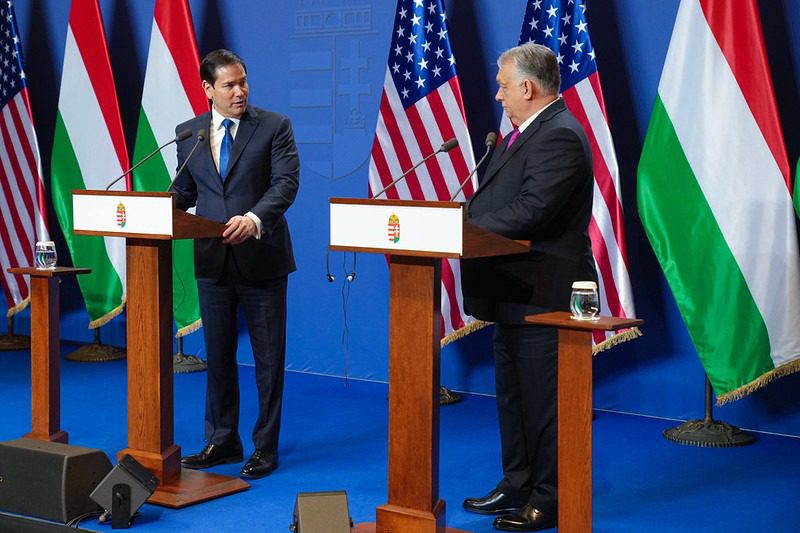
Image: Secretary Rubio Holds Joint Press Availability with Hungarian Prime Minister – State Department / Freddie Everett
Once the polls opened, participation reached unprecedented levels. By the afternoon, turnout had already surpassed the previous overall record, eventually peaking at a record 80%. As the country waited, Tisza’s gathering by the Danube drew a huge crowd. When the first results showed a clear lead for Magyar, the mood turned from nervous hope to celebration. By the end of the night, Budapest had become what Reuters described as a “party zone”.
The campaign also exposed a clear social and generational divide. Among older voters, particularly those over 65, Fidesz retained much of its strength. However, among younger and more educated Hungarians, the picture was sharply different. Reuters reported that Fidesz won only 8% support among voters aged 18 to 29, underlining how decisively youth turnout drove Tisza’s victory.
Orbán No Longer: What Is Next for Hungary?
Four consecutive parliamentary supermajorities gave Fidesz the freedom to entrench itself across almost every part of Hungarian public life: the media, the judiciary, state institutions, and universities. That is what made Viktor Orbán’s defeat so significant, but it is also why defeating him is not the same thing as dismantling the system he leaves behind.
For years, it was assumed that even if a challenger beat Orbán, they would struggle to govern without a two-thirds majority to undo the deeper legal architecture of the Orbán era. What even the boldest pollsters hesitated to predict was that this is exactly what Tisza secured: a parliamentary supermajority of its own.
With this mandate, the party now has the strength to restore democratic checks, strengthen judicial independence, and join the European Public Prosecutor’s Office to unlock billions in frozen EU funds.
But with great power comes great responsibility. A supermajority removes excuses. Tisza can no longer argue that its ambitions are blocked by parliamentary arithmetic. If it fails to deliver visible democratic renewal, it will be much harder to blame the structure it inherited. The task will not be straightforward, as Orbán-era loyalists remain embedded throughout the state. Orbán may be gone, but the system he built is not.
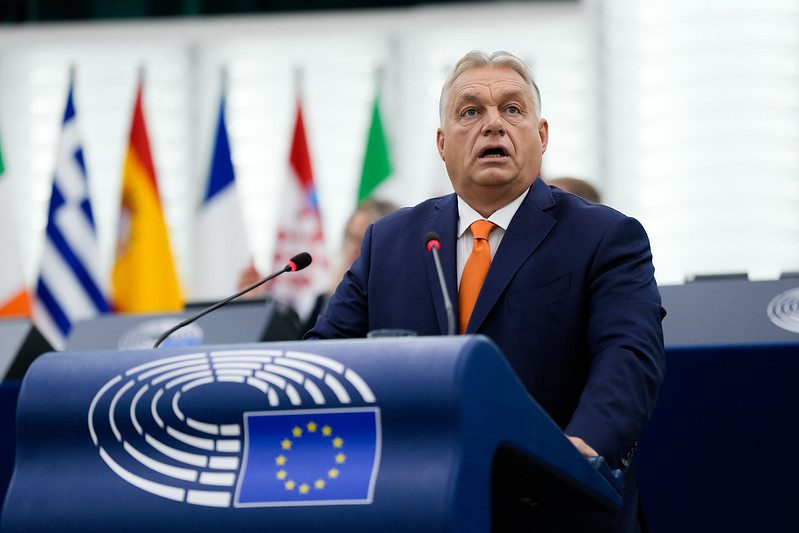
Featured Image via European Union