



Ben Howlett
Chief Executive, Chamber UKAndy Burnham has found a message that may delight Labour members, but the country cannot be rebuilt on the romance of state control and cheaper bus fares.
Are we seriously being asked to believe that Britain’s national renewal begins at the bus stop?
Andy Burnham’s Times essay, written as a response to Sir Tony Blair, was really a leadership prospectus. It was aimed at a Labour Party exhausted by managerial Starmerism and desperate for someone who can sound northern, national, radical, and respectable all at once.
Burnham’s argument is simple. Blair was right to talk about growth, wrong to trust markets, and blind to falling living standards. Britain, he argues, has been damaged by “neoliberalism”, privatisation, deregulation, weak regional economies, and the collapse of local power. His answer is stronger public control, more devolution, local procurement, technical education, public investment and, as his proof point, Greater Manchester’s buses…
“Good Growth”…
“strong public control”…
“reverse…bus deregulation”…
A leadership pitch dressed up as policy.
This may be enough to win him the Labour leadership. It should not be mistaken for a serious plan to fix Britain.
Why Labour members will love it
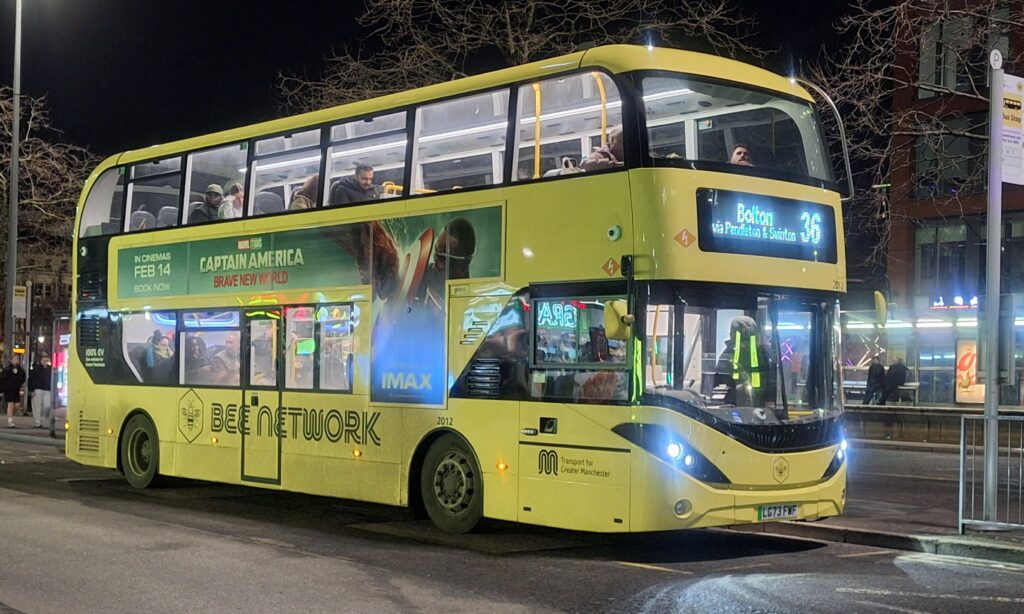
Burnham understands something Labour often forgets: politics is emotional before it is technical. The Bee Network works as a story because it is visible. People can see a yellow bus. They can understand a £2 fare. They can grasp the idea that local leaders, not distant markets, are in charge.
Labour members like examples of the state doing things. They like attacks on Blairite economics. They like the language of place and public purpose. They like the idea that the party lost its soul somewhere between Thatcherism and globalisation, and that Burnham can give it back.
Burnham also offers Labour a way to blame decline on one grand theory: neoliberalism.
That word turns the failures of planning, welfare, productivity, housing, migration, health reform, and public sector efficiency into one ideological crime scene. It gives Labour activists a villain.
But governing is not therapy.
The bus is not the economy.
The problem with Burnham’s essay is not that buses do not matter. They do. Transport can connect people to jobs, colleges, town centres, and hospitals. A better local bus network is a good thing.
The problem is scale. Britain is not a failing bus route. It is a low productivity, high tax, low investment economy with a planning system that blocks homes and infrastructure, an NHS that consumes ever more money while too often resisting reform, an energy system that punishes industry, a skills system that underserves employers, and a state that is simultaneously expensive and ineffective.
Bringing buses under local public control does not answer any of that…
It does not build enough houses. It does not make the NHS productive. It does not secure cheap energy. It does not restore discipline to public finances. It does not explain how Britain competes in artificial intelligence, advanced manufacturing, life sciences or defence.
Burnham wants to argue that public control is the missing ingredient. But Britain’s problem is not simply that the wrong people own things. It is that too many institutions, public and private, are miserably poor at execution.
A leadership slogan, not a national strategy
This is why Burnham’s message is dangerous for Labour. It may win the internal contest because it tells the party what it wants to hear. It says Labour did not go far enough. It says the answer is more state, more control, more local power and more repudiation of the past.
But general elections are not won by impressing Labour members. They are won by persuading voters that you understand the country as it is, not as your movement wishes it had been.
A voter waiting months for treatment does not need a lecture on Thatcherism. A family priced out of a home does not need a sermon on bus deregulation. A small business facing high energy bills and weak demand does not need a mayoral case study from Stockport. They need competence, growth, discipline, and delivery.
It also ignores the hard economics of the moment.
A bigger state is not free, and in today’s Britain it would not be funded in a world of cheap money. With gilt yields already high and markets acutely sensitive to any hint of unfunded spending, more public control means more borrowing, more debt interest, more pressure on the pound and less room for the very investment Labour says it wants to protect. Burnham’s politics may sound reassuring to activists, but bond markets do not price nostalgia. They price risk.
The old argument in new packaging
Burnham is right that Britain needs a new economic settlement. He is right that places beyond London need power, investment and respect. He is right that technical education has been treated as second class for too long. But he is wrong if he thinks the central dividing line in British politics should be public control versus markets.
The real dividing line is competent delivery versus decline.
The danger for Labour
Burnham’s essay sounds radical but feels strangely old. It reminds me of the splits in government when Burnham was last in Cabinet, between the Brownites and the Blairites. It reaches back to the battles Labour knows how to have, rather than forward to the problems Britain must solve.
The country does not need a tribute act to municipal socialism with better branding. It needs a government capable of making hard choices on planning, welfare, NHS productivity, energy costs, immigration control, industrial strategy and public sector reform.
Burnham may be the man Labour members want because he speaks their language.
But that is precisely the danger. If Labour responds to national disillusionment by retreating into the comfort of state control, it will not rebuild trust. It will confirm the fear that the party has mistaken a popular mayoral brand for a governing programme.
Britain cannot be fixed by yellow buses. Labour cannot be saved by reheated anti-Blairism. And a country this serious cannot afford a politics this small.
(Photo: Lauren Hurley/No 10 Downing Street)