
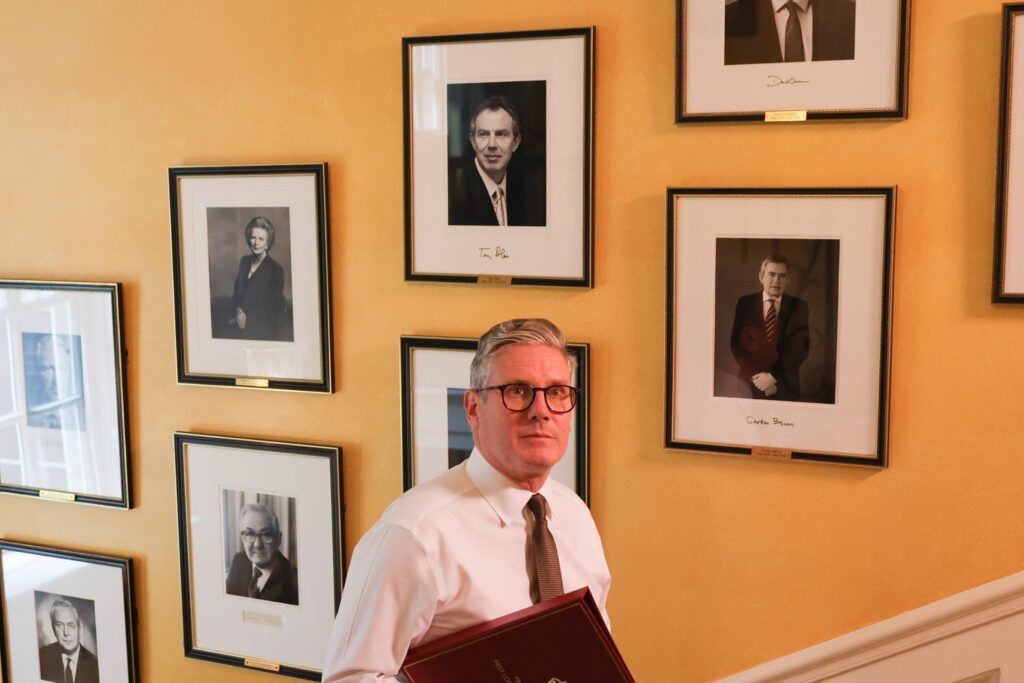
In a major essay and subsequent Times Radio interview, the former Prime Minister argues that Labour must rediscover the discipline of policy, purpose and reform if it is to avoid being squeezed by both left and right. (Picture: Simon Dawson/No 10 Downing Street)
Much to the frustration of successive inhabitants of Number 10, Sir Tony Blair has never been a passive observer of the Labour Party’s direction. But his latest intervention goes further than a routine warning from a former Prime Minister. In his 5,000-word essay, The Labour Party Is Playing With Fire Over Its Future and the Future of the Country, Blair argues that Labour is in danger not simply because of poor polling, internal nervousness, or questions over Keir Starmer’s leadership, but because it lacks a sufficiently clear governing project for a radically changed world.
His argument is blunt: Labour cannot solve its problem by changing leader, shifting tone or finding a more persuasive communications strategy. The deeper issue, he says, is that the party has not properly answered the question of what Britain needs now. In his view, leadership speculation is secondary. Policy must come first.
That matters because Tony Blair’s intervention arrives at a moment when Labour is facing pressure on multiple fronts. Reform UK is attempting to define the argument on immigration, national identity, and political insurgency. The Greens are pressing from the left on climate, public spending and redistribution. The Conservatives remain damaged but are searching for space on tax, welfare and security. Labour, Blair argues, risks being left as “Just Labour” – a party in office, but without a sufficiently distinctive project for national renewal.
The core warning: Labour needs a project
The most important part of Tony Blair’s argument is not any single policy recommendation. It is his claim that successful governments begin with an idea of the country they want to build. He argues that Labour’s current problem is not primarily one of personality, values or presentation, but the absence of a coherent analysis of how the world is changing and what that means for government.
This is a familiar Blairite theme, but it lands differently in 2026. Britain is no longer debating politics in the relatively settled conditions of the late 1990s. It is facing weak productivity, high public demand for services, stretched public finances, an ageing population, increased defence pressures, questions over the future of the Union, the consequences of Brexit and a fast-accelerating technological revolution.
Blair’s point is that a government cannot simply manage these pressures. It must shape them. That is why he repeatedly returns to the idea of “ballast” – the need for leaders to have enough intellectual and strategic weight not to be blown around by daily political storms. In the Times Radio interview, he argued that before Labour thinks about changing leader, it must first work out the right policy direction for government.
This is also why Tony Blair is dismissive of the idea that politics can be reduced to better messaging. The implication of his essay is that communication follows conviction. Without a project, there is nothing meaningful to communicate.
Artificial intelligence changes the scale of the challenge
The most future facing part of Blair’s intervention is his focus on artificial intelligence (AI). He describes AI as the defining technological revolution of the age, comparing its scale to the Industrial Revolution. His argument is that government should not just regulate AI or encourage more innovation. He suggests the whole state must be reorganised around the opportunities and risks of this transformation.
This is where Tony Blair’s critique becomes most relevant to the wider policy debate. For years, British politics has treated technology as an important sector. Blair is arguing that this is no longer enough. AI will reshape health, education, welfare, defence, productivity, public administration, and national security. Any government that treats it as a niche area of industrial policy will be too slow.
For Labour, Blair argues that the party should articulate that to make the state more effective, it must show how technology can change the way the state works. That means moving beyond pilot schemes, announcements, and digital strategies. It means asking how AI can reduce waiting times, support teachers, detect fraud, personalise training, improve productivity, and enable earlier intervention in public services.
For Blair, this is the core test of modern government.
Energy and Net Zero: the most controversial challenge
The most politically sensitive part of Blair’s intervention is his argument on energy. He says the UK should prioritise cheap energy and electrification over accelerated Net Zero targets, arguing that Britain cannot impose major costs on consumers and businesses while larger emitters continue to prioritise affordability and energy security.
In his Times Radio interview, Blair was explicit that he would advise Sir Keir Starmer to rethink Ed Miliband’s green energy targets. He stressed that he was not rejecting clean energy or denying climate change but argued that Britain must be realistic about its contribution to global emissions and the need for affordable power in an AI driven economy.
This goes to the heart of Labour’s governing tension. The party has made clean energy central to its economic and climate agenda. Blair’s warning is that if the pursuit of clean power is seen to increase costs, weaken competitiveness or constrain growth, it could become politically vulnerable.
The wider implication is that Net Zero politics is entering a new phase. The question is no longer whether the UK should decarbonise, but how quickly, at what cost, and with what impact on industry, households and national competitiveness. Blair is pushing Labour to confront that trade off directly.
This debate is also complicated by scrutiny of the Tony Blair Institute’s own links to fossil fuel producing states. Critics have pointed to the Institute’s past work with Saudi Arabia and Azerbaijan, including its paid advisory role around COP29 in Baku, where OCCRP reported that 12 TBI advisers were listed as part of Azerbaijan’s national delegation. The Guardian has also reported that Blair’s Net Zero interventions have invited renewed questions about the Institute’s donors and relationships with “petrostates”.
That does not, in itself, invalidate Blair’s argument on energy security, but it does mean his call for more North Sea oil and gas will be read by opponents not only as a policy intervention, but as part of a wider debate about influence, credibility and climate politics.
Welfare, work and the fiscal state
Blair also challenges Labour on welfare and pensions. He argues that rising incapacity and disability benefit spending is unsustainable, particularly if the UK is also expected to increase defence spending, invest in infrastructure and maintain public services. He also describes the pension triple lock as unaffordable in the long-term.
In his Times Radio interview, he pointed to the growth in working age incapacity and disability claims, especially where mental health is a major factor. His argument was not that government should abandon those in need, but that no serious state can ignore the fiscal and social consequences of millions of people being outside the labour market.
This is politically difficult territory for Labour. Welfare reform can quickly be framed as punitive. But Blair’s intervention suggests Labour cannot build a credible growth strategy without addressing labour market participation, prevention, mental health support, and incentives to work.
The challenge is to develop reform that is both compassionate and credible. That means distinguishing between those who cannot work, those who could work with the right support, and those trapped by a system that does too little to help people back into employment.
The Radical Centre as Labour’s escape route
Blair’s proposed answer is the “Radical Centre”. In his definition, the centre is where policy comes before politics. It is the space where government starts by asking what the right answer is, then builds the political argument around it.
This is the key to understanding the essay. Tony Blair is telling Labour to not be timid. He calls for it to be more radical, but in a way that is disciplined, evidence led and focused on delivery. His criticism of both left and right is that each can be radical without being practical. His criticism of the centre is that it too often becomes practical without being radical.
The opportunity for Labour is to reoccupy the centre ground. Tony Blair argues it has a supply problem, not a demand problem. The warning is that voters will not reward a centre ground defined merely by caution, managerialism or avoidance of controversy.
What this means for Starmer’s government
The immediate political meaning of Blair’s intervention is that Labour’s internal debate is likely to sharpen. His essay gives intellectual cover to those at Cabinet arguing for a more pro-business, reformist, technology driven and fiscally disciplined agenda. It also challenges those who believe Labour’s answer should be to move left on tax, spending, welfare and climate.
For the Prime Minister, the danger is that Blair’s critique reinforces the perception that the Government has not yet fully defined itself. But it also offers a possible route forward: make growth the organising principle, treat AI as a whole government transformation, be honest about energy costs, reform welfare over time, and build a stronger strategic relationship with both America and Europe.
The deeper point is that Labour cannot rely indefinitely on the collapse of Conservative credibility. It must earn a second term through delivery and definition. Blair’s warning is that without a governing project, Labour will be shaped by its opponents, its factions and the pressures of office.
His intervention may frustrate parts of the Labour Party. But it asks a serious question: in an age of technological disruption, economic anxiety, and geopolitical competition, is Labour offering a programme equal to the scale of the moment?
For Blair, the answer is not ‘yet’. The significance of the essay is that it challenges Labour to decide whether it wants simply to survive in government, or to use power to reshape the country. The question for Keir Starmer is whether he has any time left in which to deliver?