

Henry Snowdon
Politics UK – Polling and Data EditorBritish politics is normally described through stories: momentum, collapse, comebacks, insurgencies and the endless question of who had a “good week”. The problem is that a good story is not necessarily a true one.
This series is my attempt to look at political change through a quantitative lens. Each month, I will use polling, electoral results and statistical modelling to ask not only what has changed, but where it has changed, among whom, why it has changed and why it might matter when votes are converted into seats. I will also examine the political events behind shifts in public attitudes. Numbers without context can mislead just as easily as commentary without evidence.
This series will run in tandem with a much larger long-term project: the creation of the most extensive electoral database of British politics possible. This database will power a model which Politics UK will host in an interactive format so you can understand what political changes mean at every level.
That model is not ready yet. For now, this column will use the parts that are ready to produce a monthly snapshot of British politics. This first edition presents my initial forecast, briefly examines the current political moment and places a particular focus on changing patterns of tactical voting.
With that said, here is the first forecast.
If An Election Were Held Today…
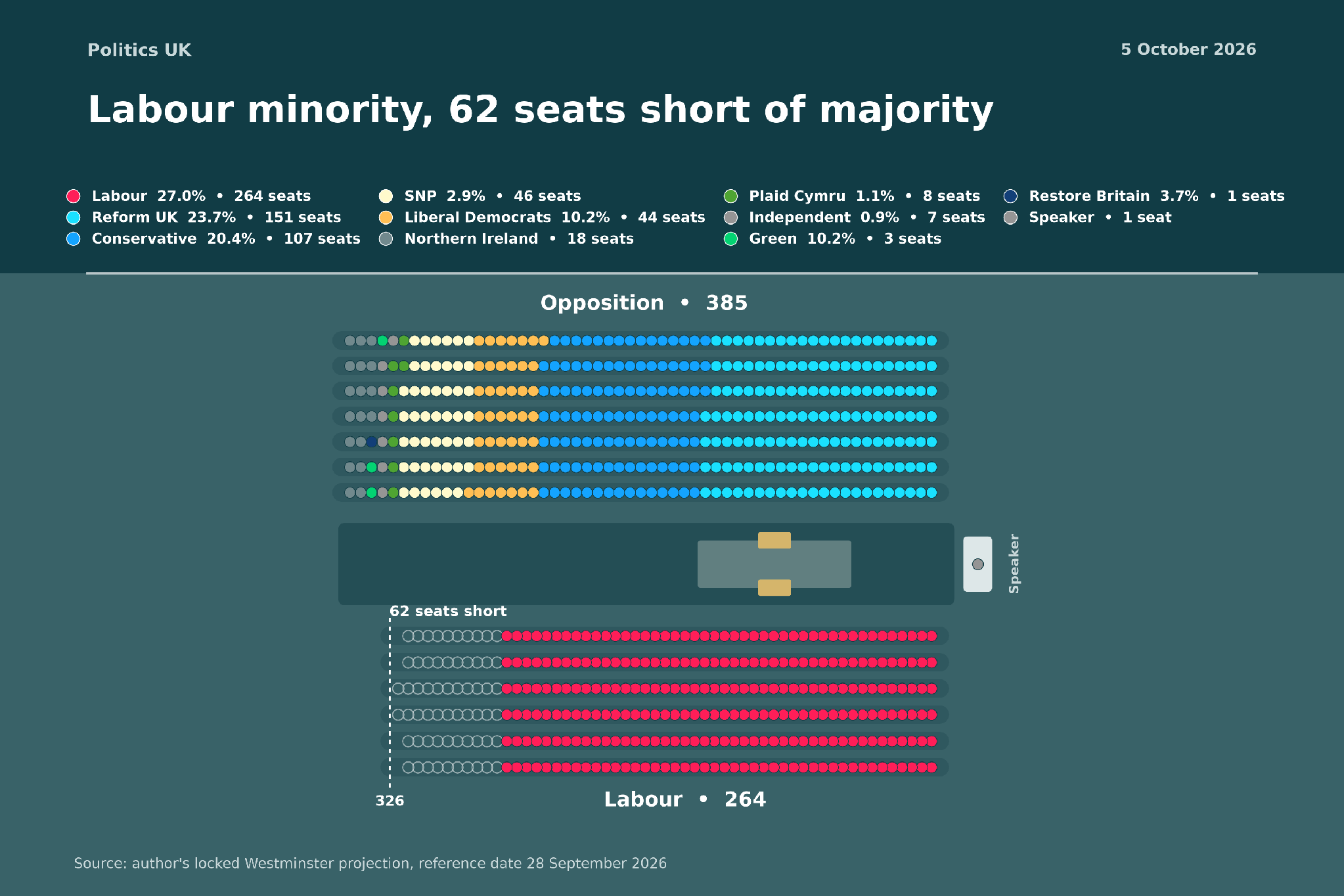
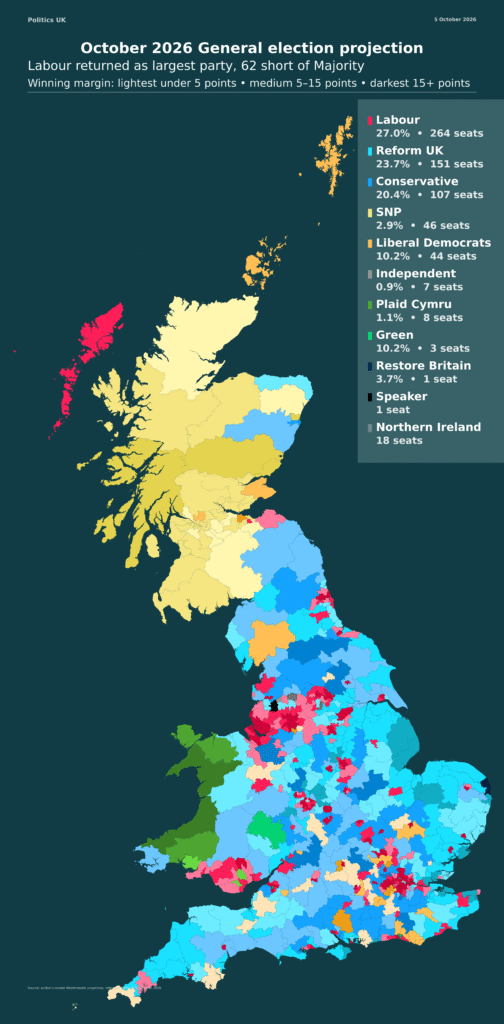
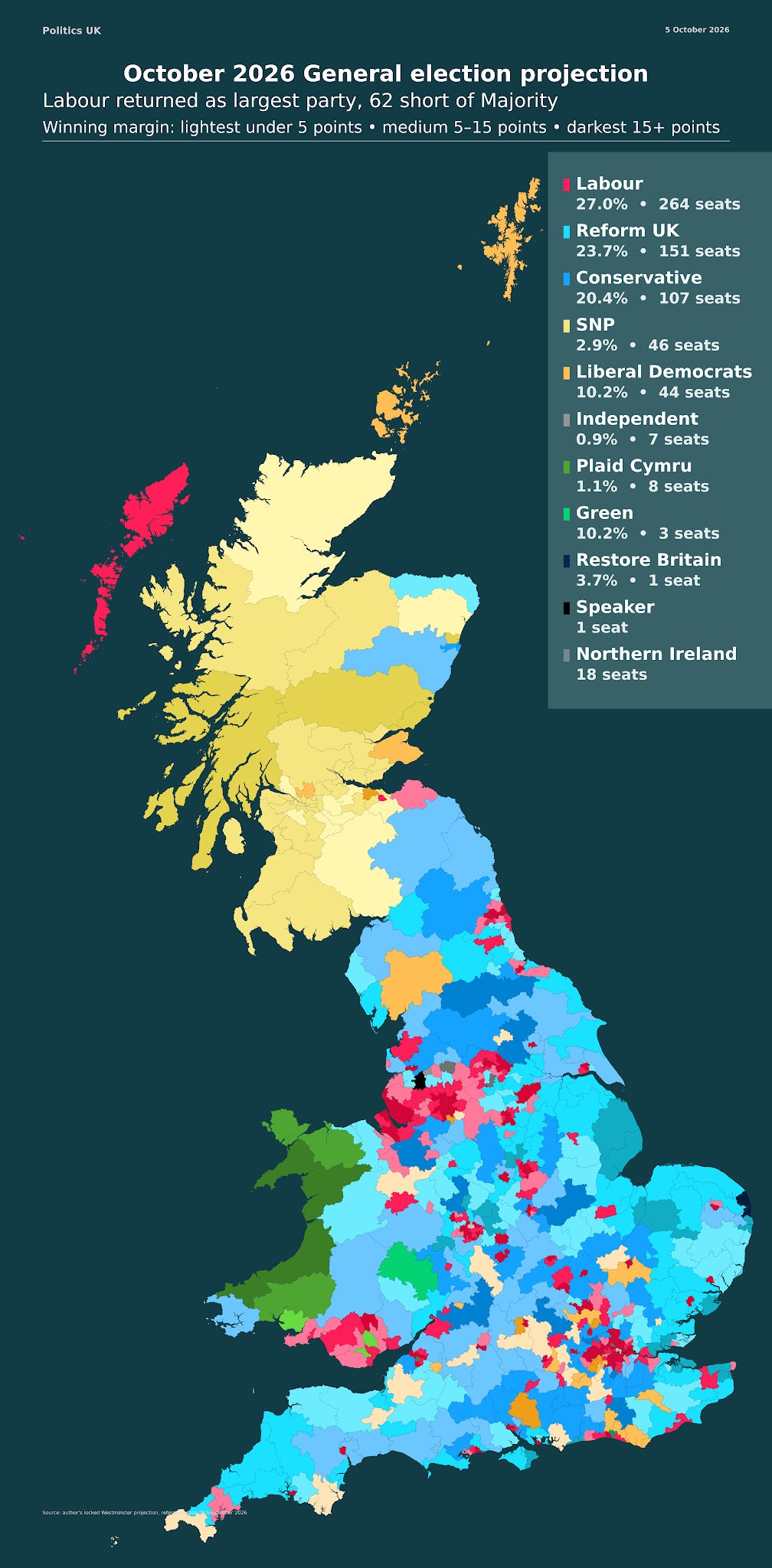
The modelled projection covers the 632 constituencies in Great Britain. The parliamentary totals also include Northern Ireland’s 18 seats, carried forward separately. The central finding is that if an election were held today, Labour would comfortably win the most seats but still be well short of a majority.
🌹 Labour 27.0% • 264 seats
➡️ Reform UK 23.7% • 151 seats
🌳 Conservative 20.4% • 107 seats
🔶 Liberal Democrats 10.2% • 44 seats
🌍 Green 10.2% • 3 seats
🟡 SNP 2.9% • 46 seats
🔵 Restore Britain 3.7% • 1 seat
⚪ Northern Ireland • 18 seats
🟢 Plaid Cymru 1.1% • 8 seats
⚪ Independent 0.9% • 7 seats
🎩 Speaker • 1 seat
TLDR
Burnham changes the game
Labour are now in the lead.
Farage fumbles the ball
Reform is bleeding support in all directions but still on course to displace the Tories as the main force on the right.
Tactical voting is key
In a first-past-the-post system with five or six parties competing, who you are voting against is as important as who you are voting for. Labour is both more popular and less unpopular, Reform are losing support and crystallising opposition. This will be a key dynamic at the next election.
Labour: a Burnham half-bounce
Labour has now established a clear lead in the opinion polls. Its current projected vote share is 27.0%, giving it a 3.3-point lead over Reform. The party is projected to win 264 seats, making it comfortably the largest party in Parliament, albeit without an overall majority.
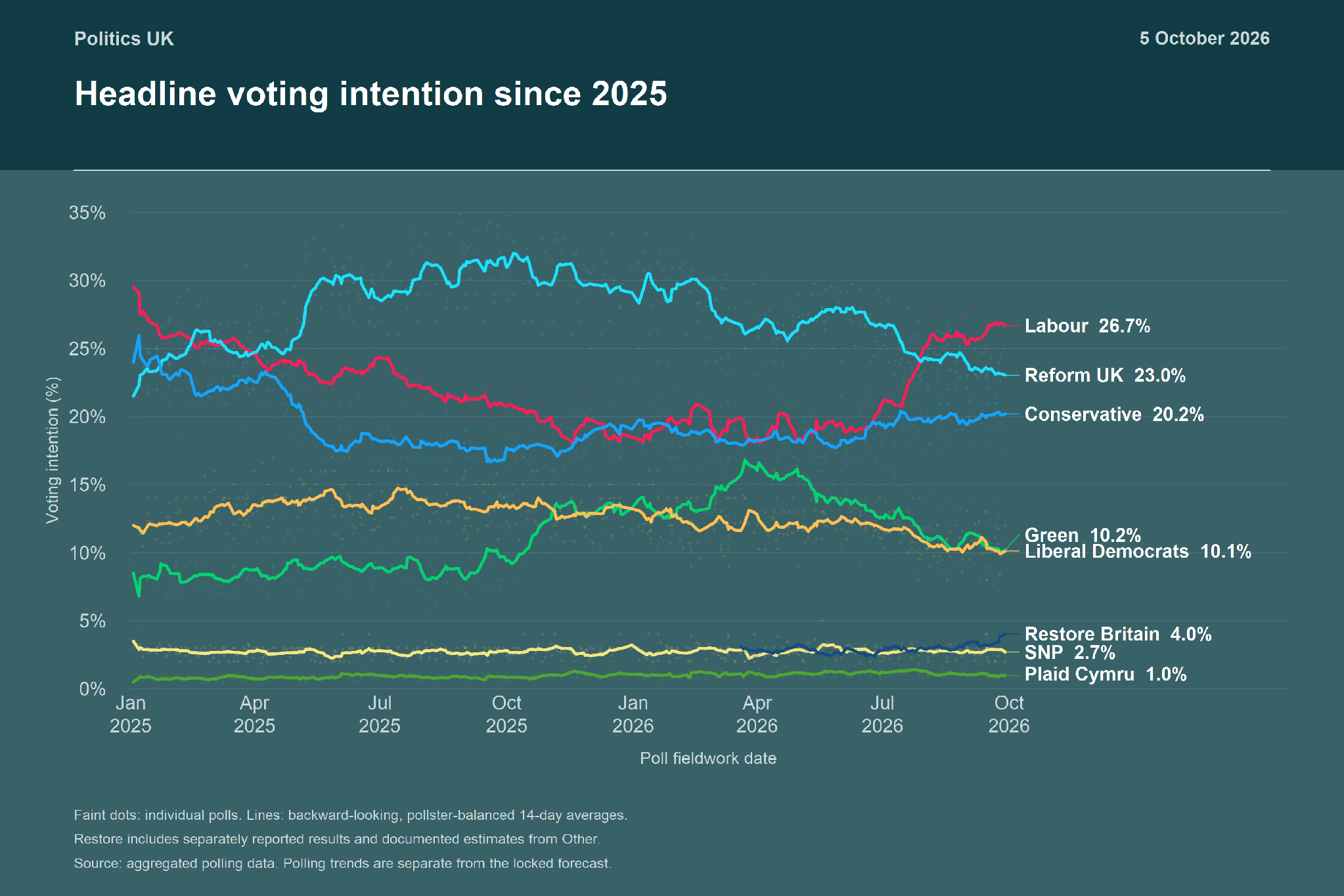
For months, Labour experienced continuous decline followed by stagnation, eventually bottoming out at roughly 17.3% in May 2026, its lowest sustained level of this parliament. It began to recover following Starmer’s resignation, with this recovery accelerating after Burnham entered Downing Street on 20 July and his so-called honeymoon phase began.
Even from the 20.8% Labour was polling shortly before Burnham became prime minister, the party has gained more than six points.
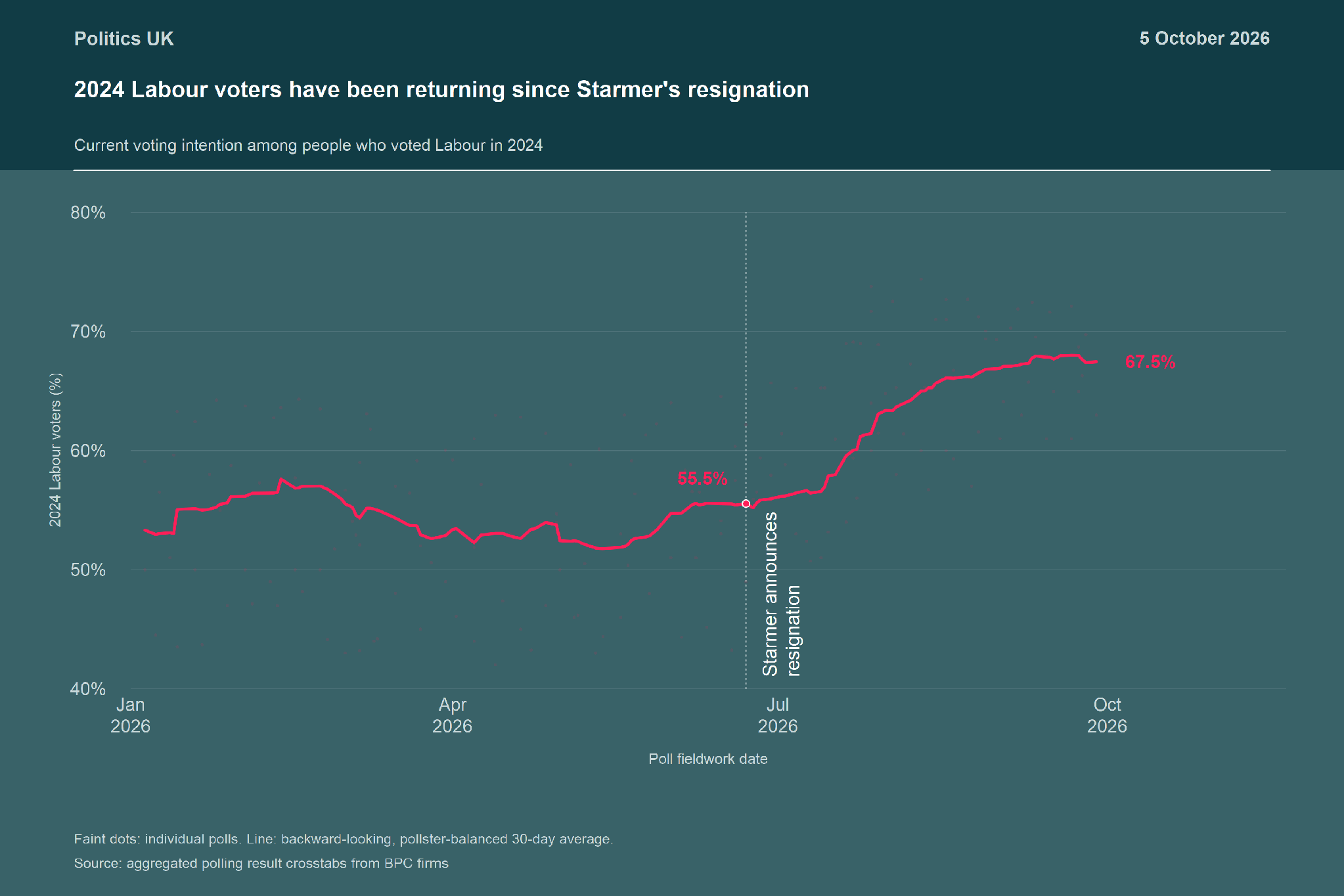
The biggest source of Burnham’s new coalition is simply the return of people who voted Labour in 2024. In the 30-day average ending on 22 June, only around 55.5% of 2024 Labour voters said they would vote for the party again. By late September, that figure had risen to 67.5%.
Over the same period, Labour-to-Green movement fell from 14.0% to 8.9%, Labour-to-Reform from 11.7% to 8.9%, and Labour-to-Liberal Democrat from 8.6% to 5.6%.
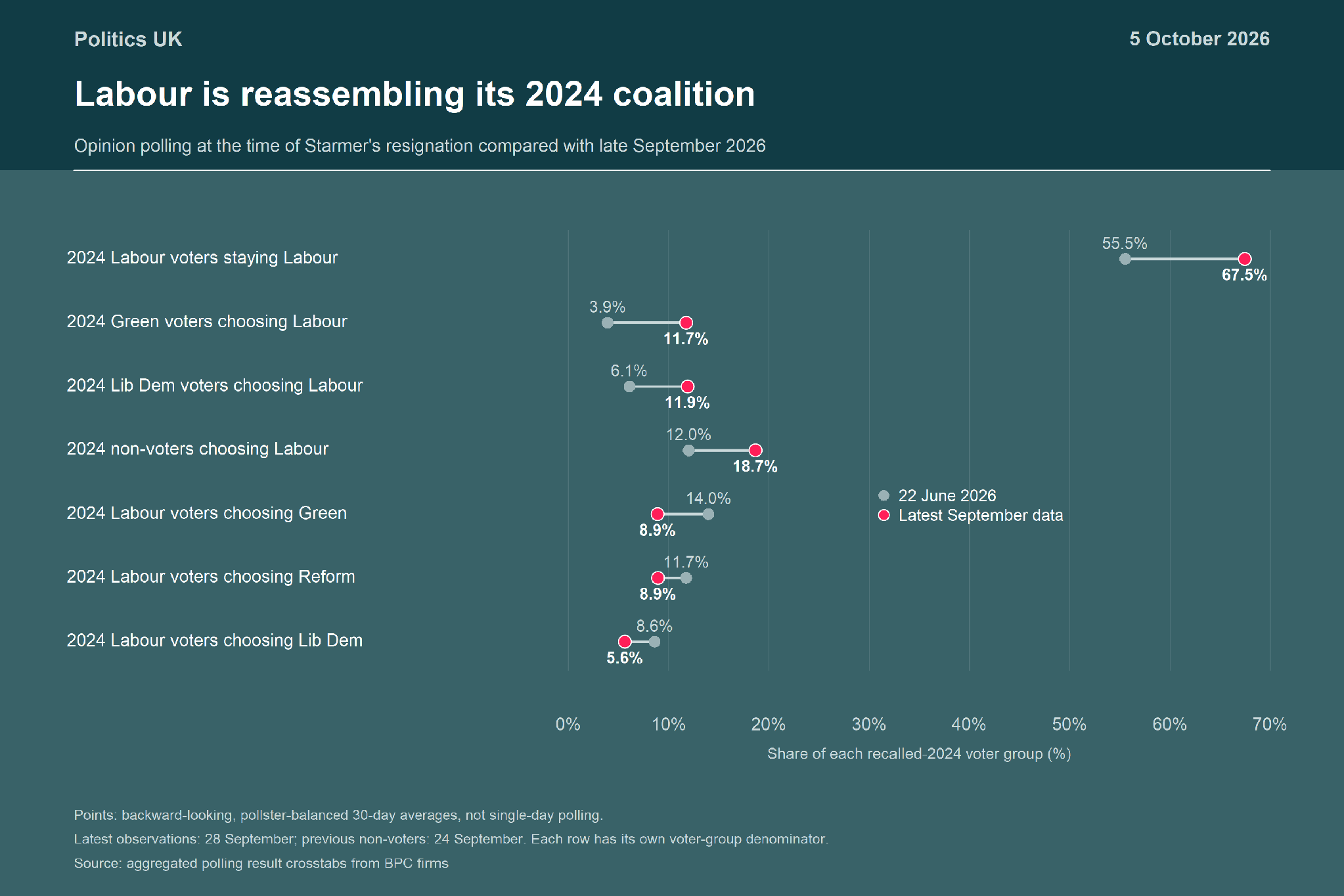
Labour is also gaining support from voters outside its 2024 coalition. The proportion of 2024 Liberal Democrat voters now choosing Labour has roughly doubled, rising from 6.1% to 11.9%.
Among 2024 Green voters, it has risen from 3.9% to 11.7%. Among previous non-voters, it has climbed from 12.0% to 18.7%. Movement from those who voted for right-wing parties in 2024 has been much more limited.
One of Labour’s biggest improvements, however, has come in tactical-voting contests. In February, YouGov gave Labour only a four-point advantage over Reform in Labour versus Reform contests. By September, Labour’s advantage had increased to fifteen points.
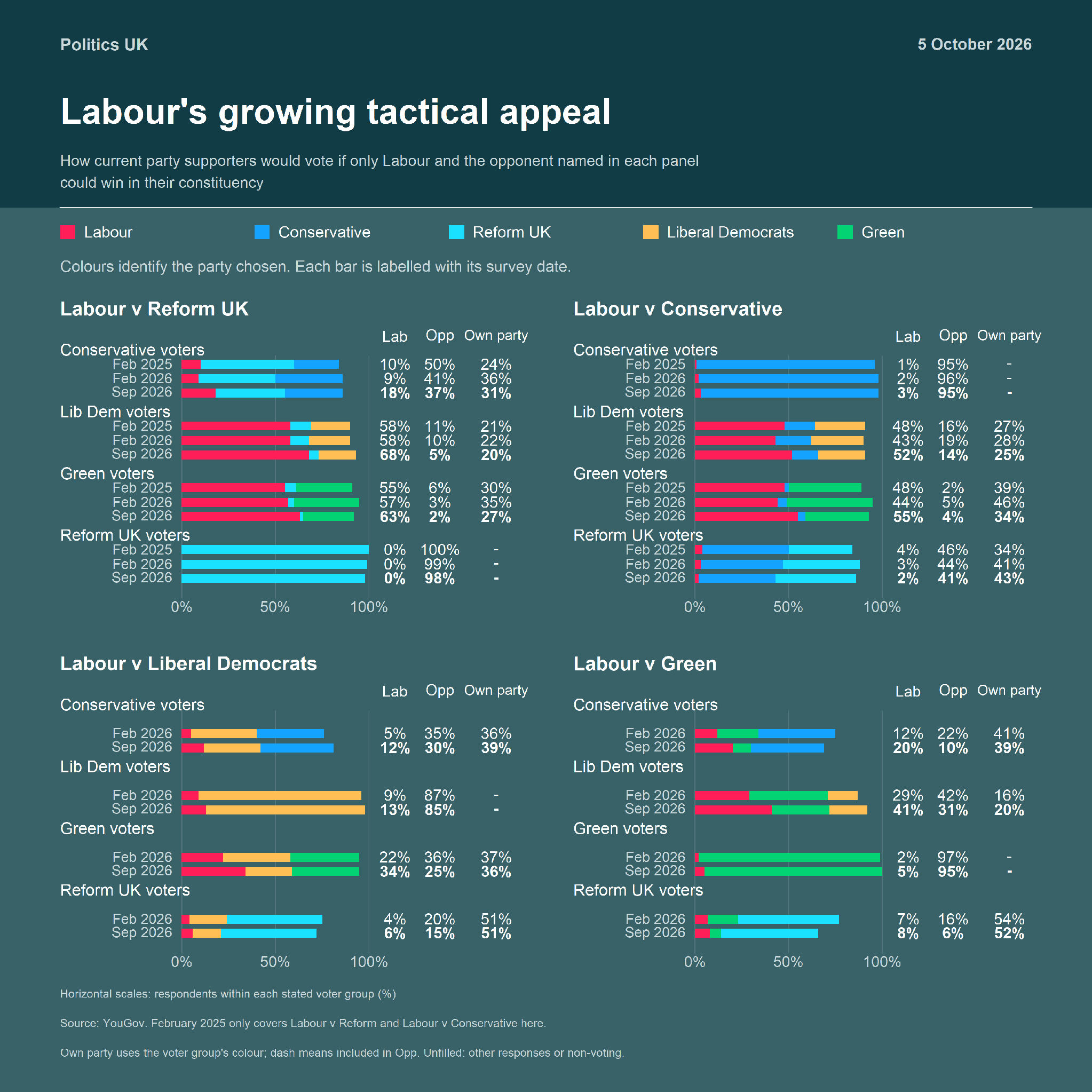
The improvement extends across other contests as well. Labour’s advantage over the Conservatives has increased from approximately one point to seven. Against the Greens, Labour has gone from losing by ten points to leading by six. Against the Liberal Democrats, Labour has moved from an eight-point deficit to a seven-point lead.
All of this suggests that Burnham has made the Labour brand much less disliked and, consequently, a far more acceptable vehicle for tactical voting.
Finally, I want to ensure that the effect of the Burnham bounce is not overstated. Labour is polling at 27%, a figure that would be considered very low by the standards of the postwar era. The party is not projected to win a majority, nor is it certain that its polling lead will continue to grow. There is already some early evidence of stagnation. Nevertheless, it is difficult to deny that the change in leadership has been the leading cause of the change in Labour’s political fortunes.
Reform: Loss of Momentum
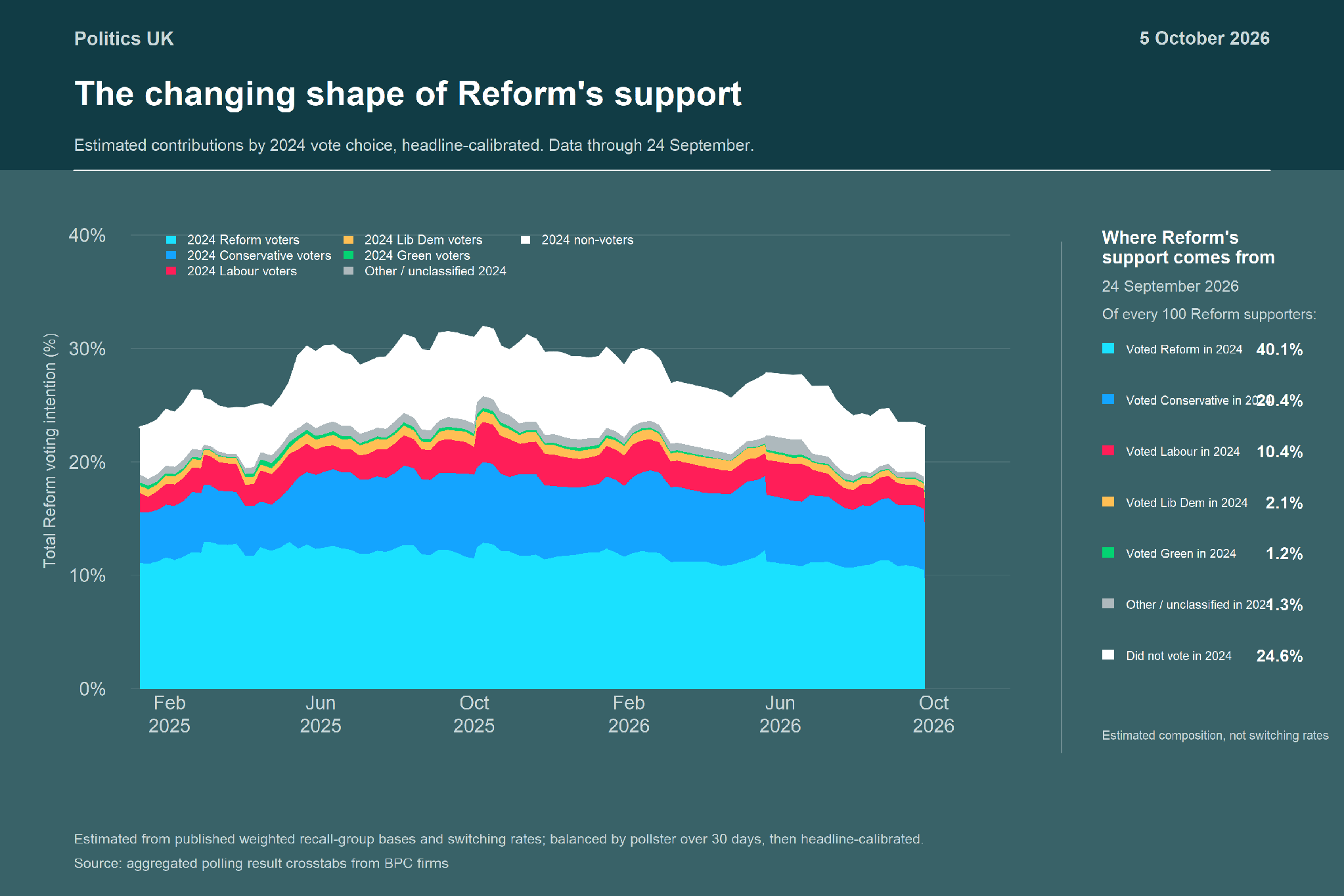
Reform remains a huge electoral force, easily outpolling its 2024 performance, but it has seen a steep decline since early this year.
From around May 2025 until February 2026, Reform’s polling share bounced between the high twenties and low thirties. Since late February, however, the party has experienced a sustained decline from which it has not recovered, despite some brief improvements along the way.
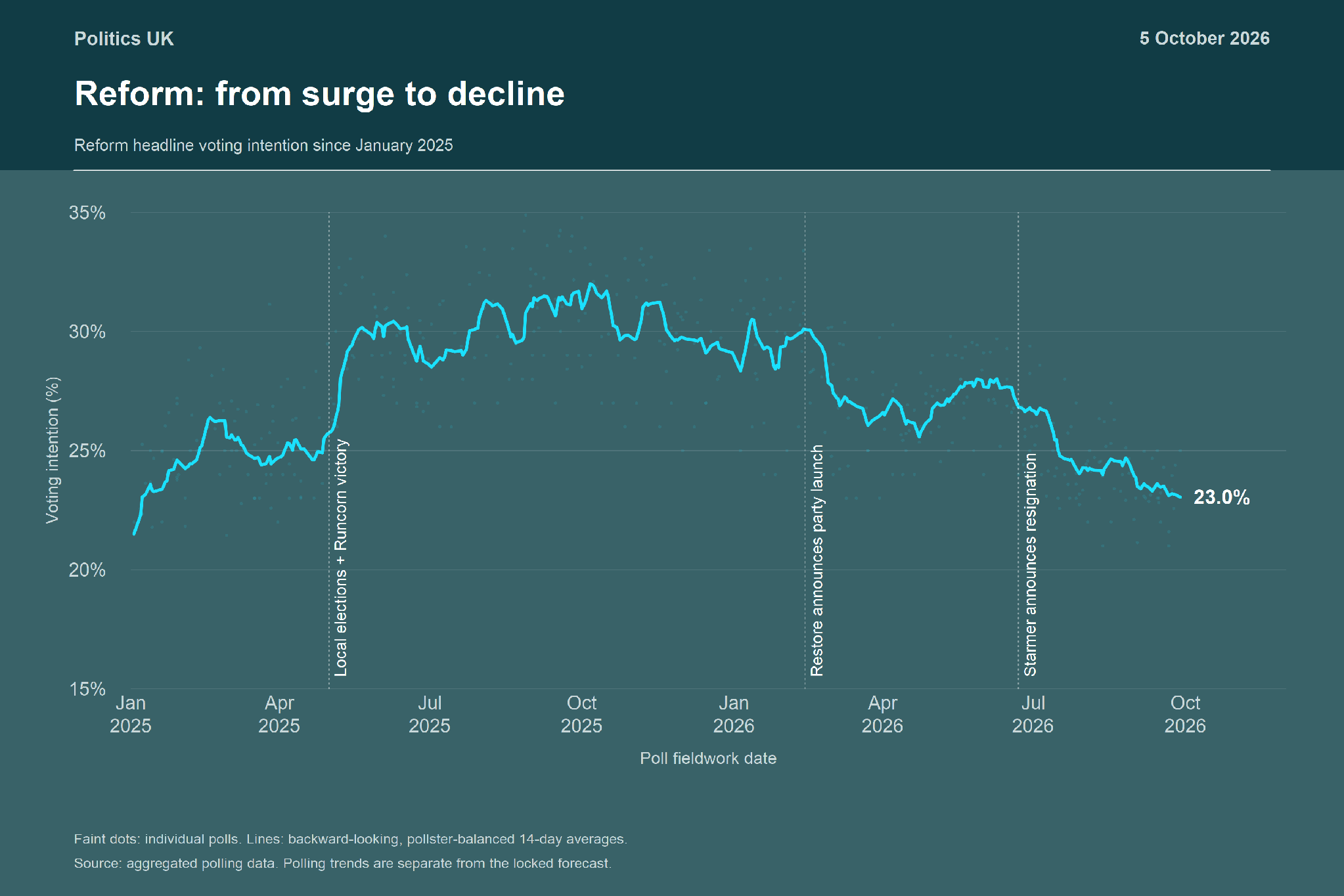
The model’s current headline estimate is 23.7%, a fall of about 6.8 points from the roughly 30.5% Reform was polling when the decline began. As it stands, I see three primary catalysts for Reform’s decline this year.
Restore
The first is the launch of Restore Britain as a political party in February. Many within Reform had grown dissatisfied with how the party was handling questions around immigration and demographic change, its perceived pivot towards the centre, Farage’s reluctance to engage with popular far-right figures such as Tommy Robinson and the increasing number of former Conservative politicians entering the party.
Restore gave these dissenters a home around which to organise. Following the announcement of Restore’s launch, Reform experienced its first sustained loss of polling support since this Parliament began, while Restore began polling at around 3% once data became available.
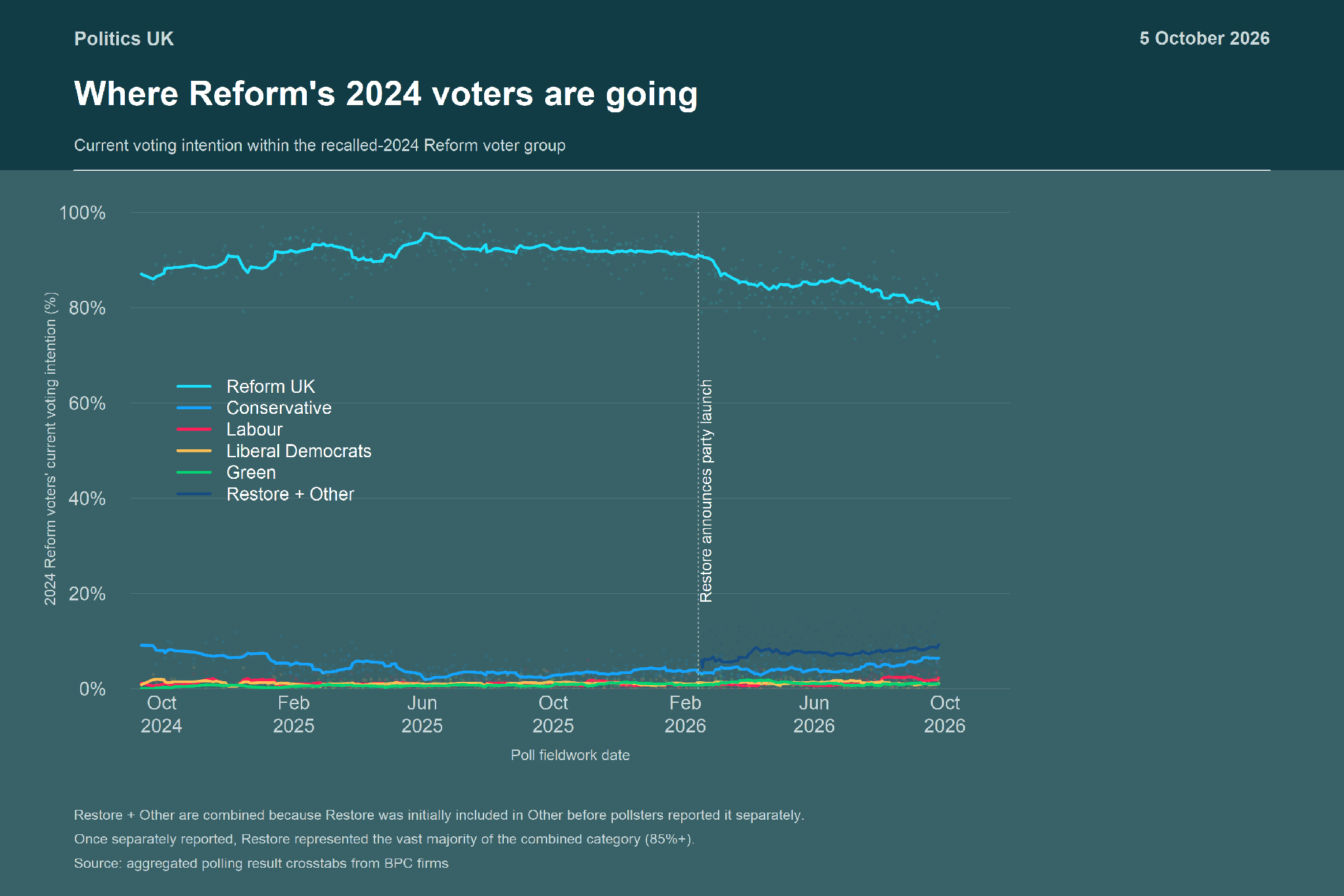
Today, Restore is polling at 3.7% nationally. While it would be false to say that all of these voters would otherwise be supporting Reform, a close inspection of the data, combined with the parties’ ideological alignment, suggests that much of its support has come from groups that Reform previously relied upon, including 2024 Reform voters and previous non-voters. It is therefore difficult to deny that Restore’s rise has had an outsized direct effect on Reform this year. However, its indirect effect may be even larger.
Some of Reform’s most active members left for Restore, taking with them some of the enthusiasm, momentum and sense of inevitability that Reform appeared to possess for much of the previous year. These effects are less tangible, but in future editions I will show how this period also saw a measurable decline in enthusiasm for Reform, which is difficult to separate entirely from the rise of Restore.
Starmergeddon
The second catalyst was Starmer’s resignation. Starmer was historically unpopular, and that unpopularity drove many voters towards opposition parties. His resignation weakened the anti-Labour vote, while many of Labour’s 2024 voters, particularly in the north of England where Burnham is more popular, began returning to the party.
In the 30-day polling average ending on the day of his resignation, 55.5% of 2024 Labour voters said they would vote Labour again. By late September, that figure had risen to approximately 67.5%. Over the same period, the proportion moving from Labour to Reform fell by around 3 points.
Next month, I shall examine a third reason for Reform’s decline in greater depth: the increasing unpopularity of Nigel Farage. This has coincided with greater scrutiny of his finances, including investigations and questions concerning undeclared gifts and donations, as well as the widely criticised decision to resign his seat in Clacton and trigger a by-election.
Greens: Surge to Squeeze
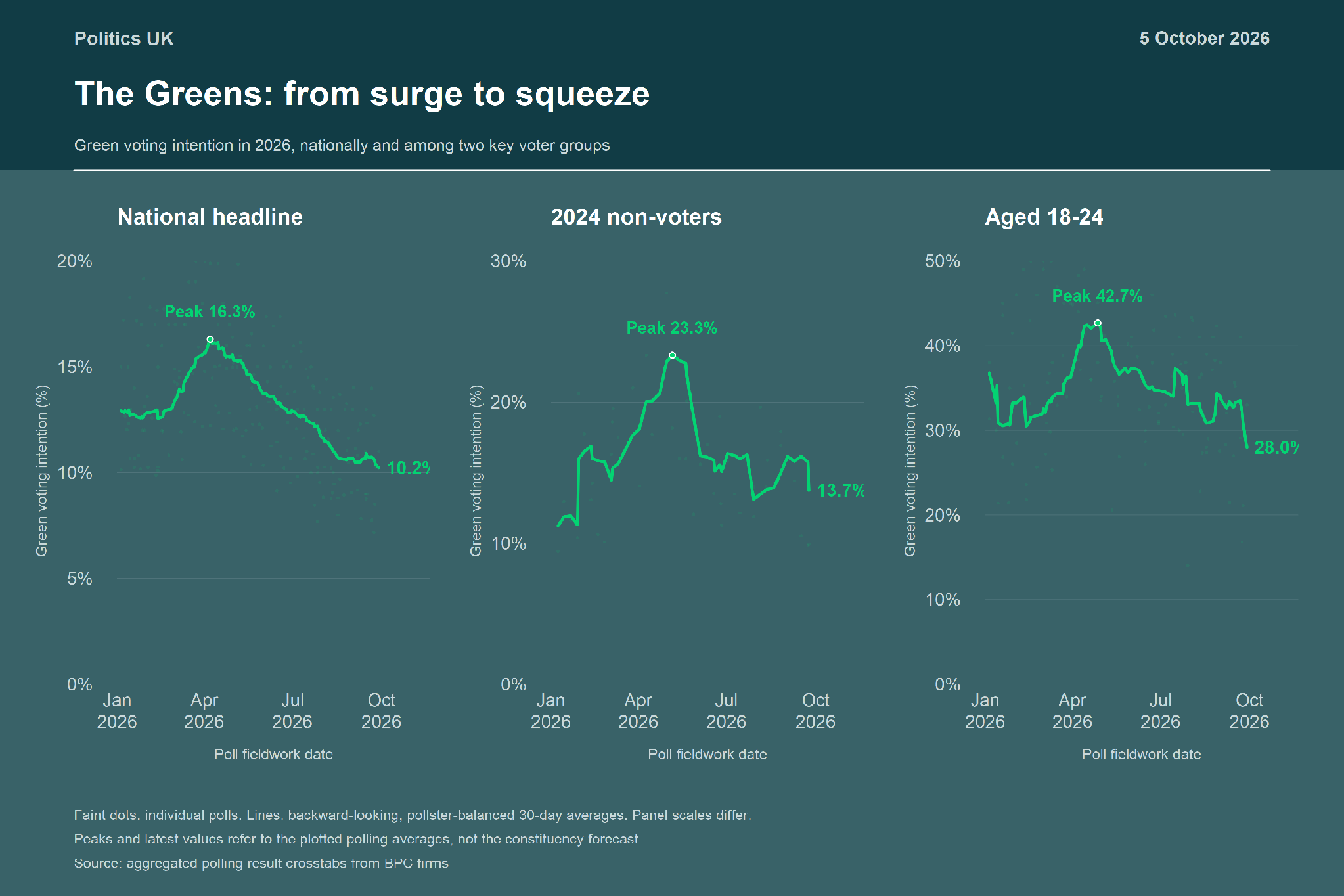
The Greens are also doing much worse than they were only a few months ago. The current forecast puts them on 10.2% nationally, down more than six points from their April peak of roughly 16.3%.
It is clear from the data that many voters who were alienated by Starmer moved to the Greens, while previously disengaged voters, especially younger people, began to rally around the party after Polanski became leader and momentum built around him. Since then, however, two things have happened.
Firstly, and most obviously, Starmer resigned. As previously discussed, Burnham has been popular with progressive voters, siphoning back many people who had moved from Labour to the Greens primarily because they disliked Starmer.
Secondly, Zack Polanski has become less popular. This is something I will explore more fully next month when I examine leadership approval ratings, but it appears to have reduced enthusiasm for the party. Among people who did not vote in 2024, Green support has fallen from a peak of approximately 23.3% to 13.7%. Among voters aged 18 to 24, it has fallen even further, from approximately 42.7% to 28%.
The Holborn and St Pancras by-election will be a major test for the Greens. If they lose, as I and the betting markets currently expect, the scale of that defeat will matter. A narrow loss in a historically safe Labour seat would represent a failure compared with the expectations of a few months ago but would not be a disaster.
A more significant defeat, particularly one in which the Greens fall clearly below the roughly 29% support they achieved across the constituency area in the 2026 council elections, could produce further polling declines and raise questions about Polanski’s leadership.
Either way, the clear relationship between the Burnham bounce and the steep decline in Green support makes one question the wisdom of the party’s decision to run only a scaled-back campaign against him in Makerfield. That decision helped Burnham enter Parliament and begin the political recovery that the Green leadership may now pay for dearly in only a few weeks.
Enjoying the analysis? Why not share it with someone so you can discuss!
Liberal Democrats: Losing Votes, Holding Ground
The Liberal Democrats are currently projected to win 10.2% of the vote, which is 2.0 points lower than they won in 2024 and 4.4 points below their peak of roughly 14.6% in July 2025. This is the lowest level at which they have consistently polled during this parliament.
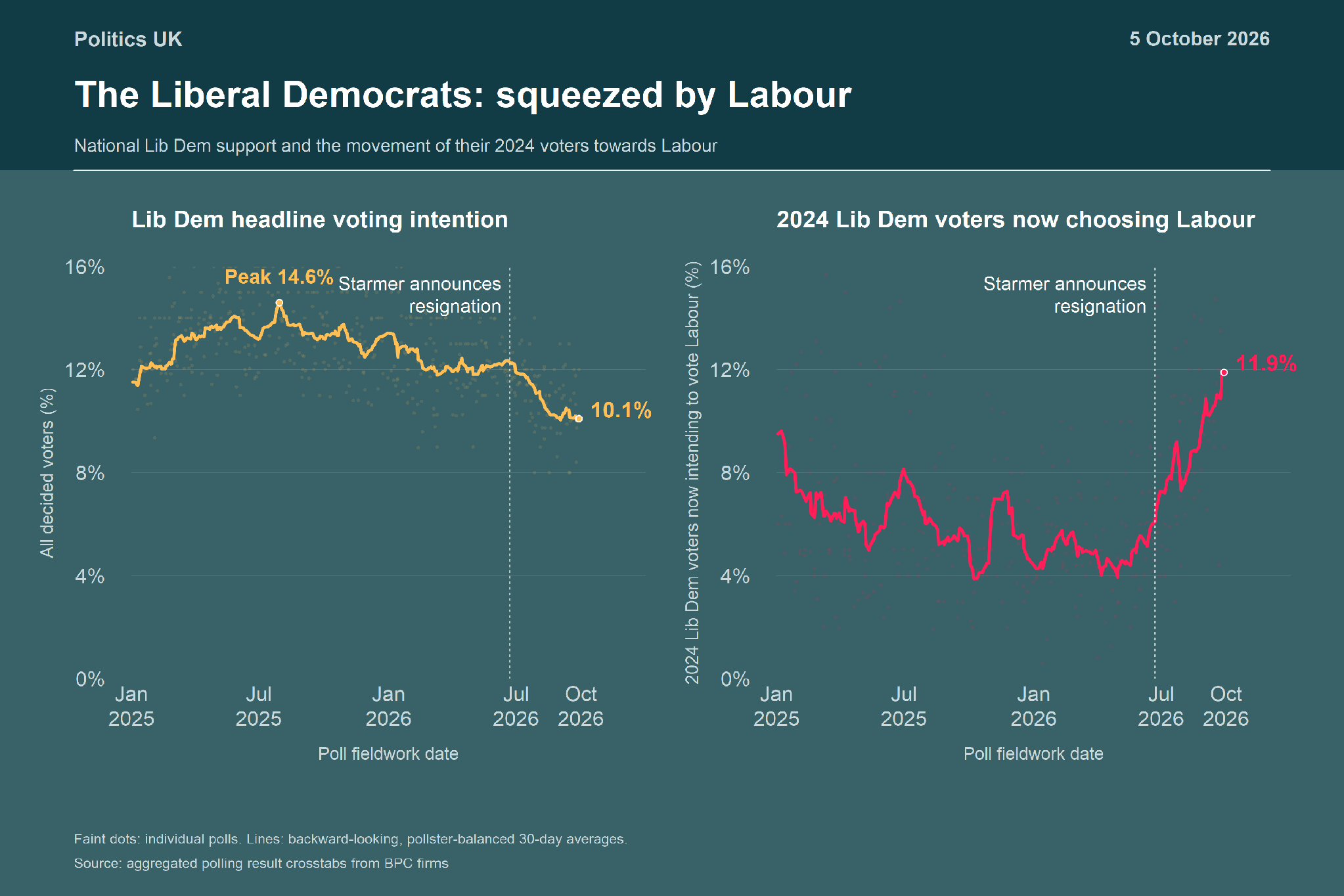
As with the Greens, the rise of Andy Burnham has created a direct challenge to the party’s popularity, and the vote-transfer data demonstrate this. In the 30-day average ending on Starmer’s resignation day, around 6.1% of 2024 Liberal Democrat voters intended to vote Labour. By late September, that figure had risen to approximately 11.9%.
While my model projects the Liberal Democrats to retain most of their seats, returning 44 MPs, it still has them losing 28 of the 72 constituencies they won in 2024. It’s important to note that this model does not yet include a robust local-persistence/incumbency mechanism. Future versions will make greater use of recent local-election results to estimate continuing organisational strength within individual constituencies. This should improve estimates of concentrated Liberal Democrat support and may result in a higher projected seat total for the party.
Seventeen are lost to the Conservatives, nine to Reform and two to the SNP. Ten of these defeats are by less than five percentage points, showing how a relatively small national decline can produce much larger parliamentary losses when so many seats are marginal.
These losses are not only caused by weaker national polling. They also reflect a decline in the Liberal Democrats’ advantage in tactical contests against the Conservatives. In YouGov’s February 2026 experiment, the Liberal Democrats led the Conservatives by eight points, 34% to 26%, when respondents were told that only those two parties could realistically win. By September, that advantage had narrowed to only three points, 31% to 28%. This suggests that the heavy anti-Conservative tactical voting seen during the last parliament has weakened now that the Conservatives are no longer in government.
Conservatives: Stagnation and Recovery?
There is not much interesting to say about the Conservatives’ headline polling fortunes. For most of this year, they polled between roughly 17.5% and 19.5%, before rising to the model’s current estimate of 20.4%.
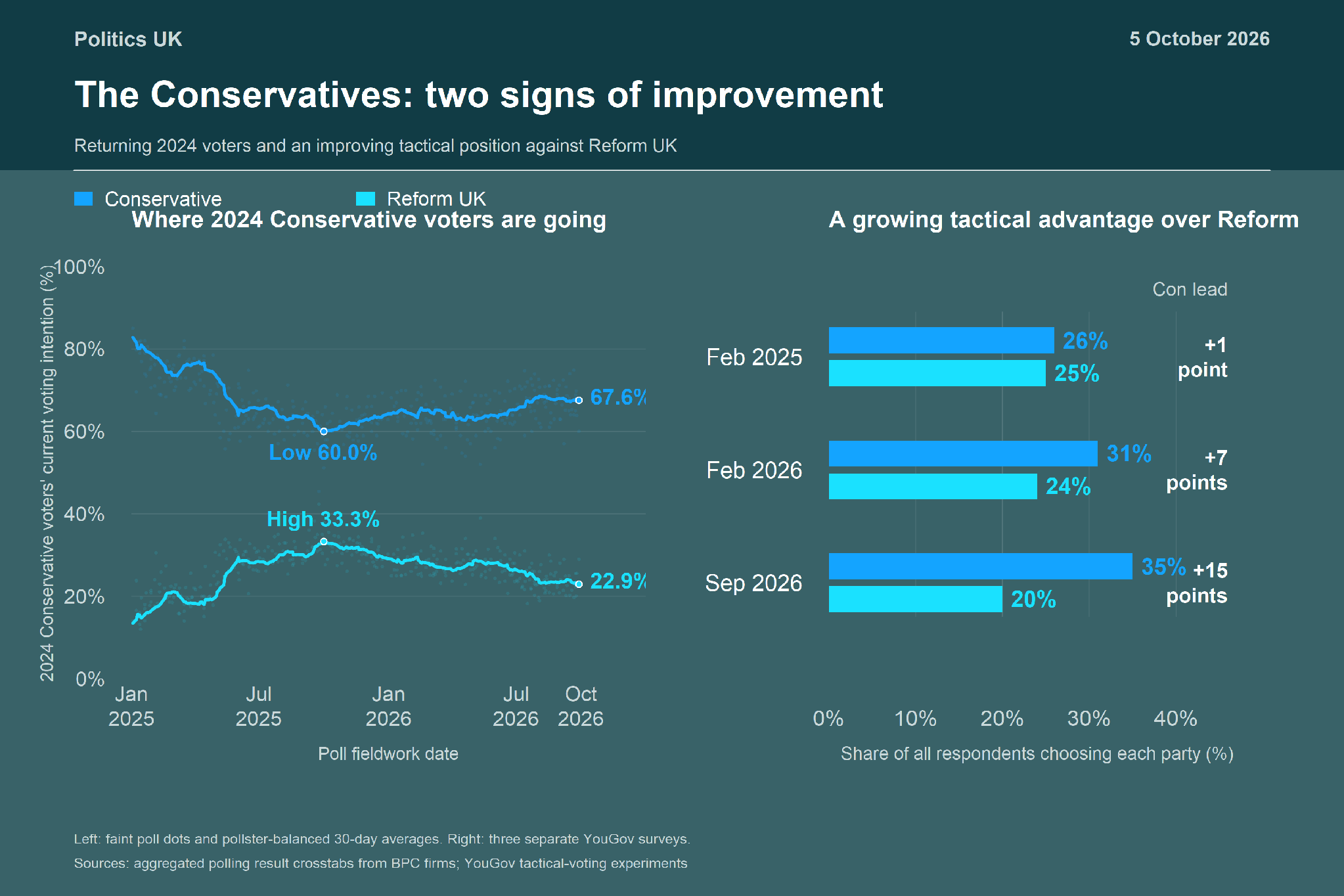
Most of this improvement has occurred over the past few months and appears to reflect Reform’s decline and the gradual return of some 2024 Conservative voters. Conservative retention has increased from around 61.2% at Reform’s polling peak to 67.6% today, while the proportion of 2024 Conservative voters intending to vote Reform has fallen from 30.3% to 22.9%.
Not Farage
There are, however, a few pieces of underlying data that should give the party some optimism. The first is tactical voting. Anti-Conservative tactical voting has weakened, while the Conservatives are increasingly winning tactical contests against Reform, even among progressive voters.
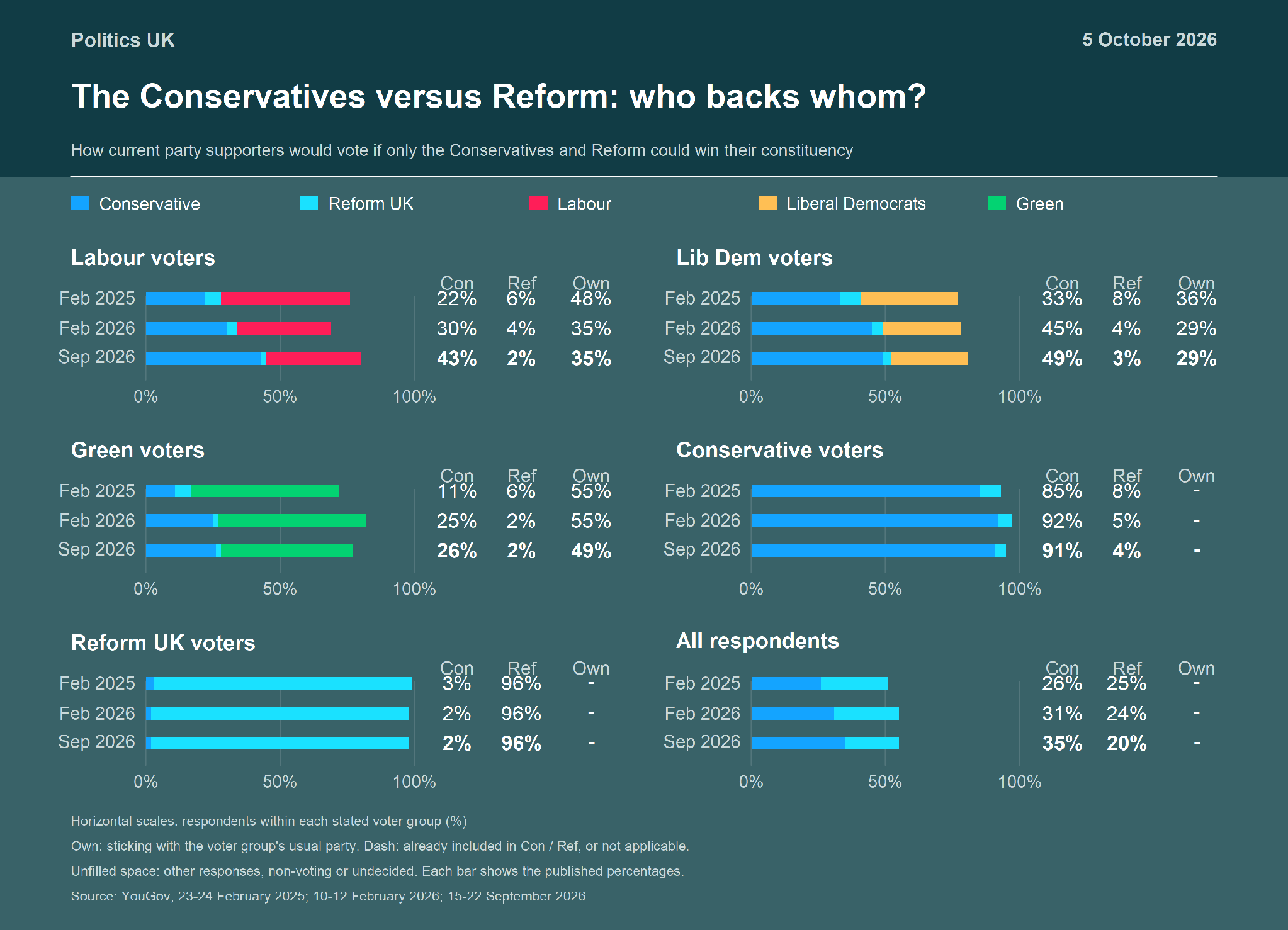
In February 2025, voters preferred the Conservatives to Reform by only one point when told that those were the only two parties capable of winning their constituency. By February 2026, that advantage had increased to seven points. It now stands at fifteen points, with the Conservatives leading Reform by 35% to 20%.
This advantage is strengthened by support from progressive voters. In a Conservative versus Reform contest, 43% of Labour voters, 49% of Liberal Democrat voters and 26% of Green voters say they would vote Conservative to stop Reform from winning.
The second reason for Conservative optimism is the marginality of Conservative-Reform contests. There are currently 60 constituencies in which the Conservatives and Reform are the leading pair and are separated by no more than five percentage points. In an environment where tactical voting is becoming increasingly favourable to the Conservatives, having so many marginal contests creates significant opportunities for future seat gains.
Overall, the Conservatives are in a much better position than they were a year ago. Reform’s decline offers a potential path to once again becoming the biggest party on the right of British politics. Nevertheless, if an election were held today, they would still finish firmly behind Reform. They therefore remain at risk of following other traditionally dominant, big-tent parties of the European right that have been overtaken by populist challengers and struggled to regain their former relevance.
The Numbers Game
Burnham bounce: The overwhelming story of the current moment is the transformation of the polling landscape brought about by Andy Burnham’s premiership. Labour is now leading in the polls and would win the most seats if an election were held tomorrow. Its recovery in national support has come primarily at the expense of the Liberal Democrats and Greens.
Farage fumble: Reform has struggled this year because of the rise of Restore Britain, the arrival of Burnham and the decline in Farage’s personal popularity. Farage no longer looks like the inevitable prime minister-in-waiting that he once did. Meanwhile, the Conservatives have begun to recover some former voters and are benefiting from a tactical-voting environment that has become increasingly hostile to Reform.
Tactical voting: Outside the headline figures, Burnham’s arrival has altered how voters behave when forced to choose between the parties most likely to win their constituency. Labour has become a more acceptable tactical option for Liberal Democrat and Green voters, while even some progressive voters are prepared to support the Conservatives when the alternative is Reform. These changes matter enormously in an election where dozens of seats are separated by only a few percentage points.
Strap in: Britain is experiencing one of its most volatile political moments in history. Labour is projected to win only 27% of the vote and 264 seats, leaving it well short of a parliamentary majority. Reform remains a major electoral force, the Conservatives are still on life support, and smaller parties continue to command an unusually large share of the vote. In such a volatile environment, small movements in public opinion, tactical behaviour or local organisation could still produce enormous changes in the final result.
As you have probably gathered, a lot of work goes into this model. Subcribe to help us keep this sustainable!
How the Model Works
The model uses national polling, election results and demographic analysis to project vote shares in each constituency and convert them into seats. It begins with the 2024 general-election result and estimates how different groups of 2024 voters now intend to vote using recent recalled-vote polling.
It then adjusts the geographic distribution of those votes using age, region, constituency demographics and evidence from recent local and devolved elections.
Finally, it applies cautious adjustments for tactical voting, strong local campaigns, prominent independent candidates and recent by-election results, before bringing the constituency totals back into line with the national polling figures.
Model Source
Forecast vote shares, seat totals, constituency margins, projected Liberal Democrat losses and the count of close Conservative–Reform contests are the author’s calculations from the locked Westminster projection, with a reference date of 28 September 2026. Publication date: 5 October 2026.
You can still get a copy of our new edition of ChamberUK. Our parliamentary journal.