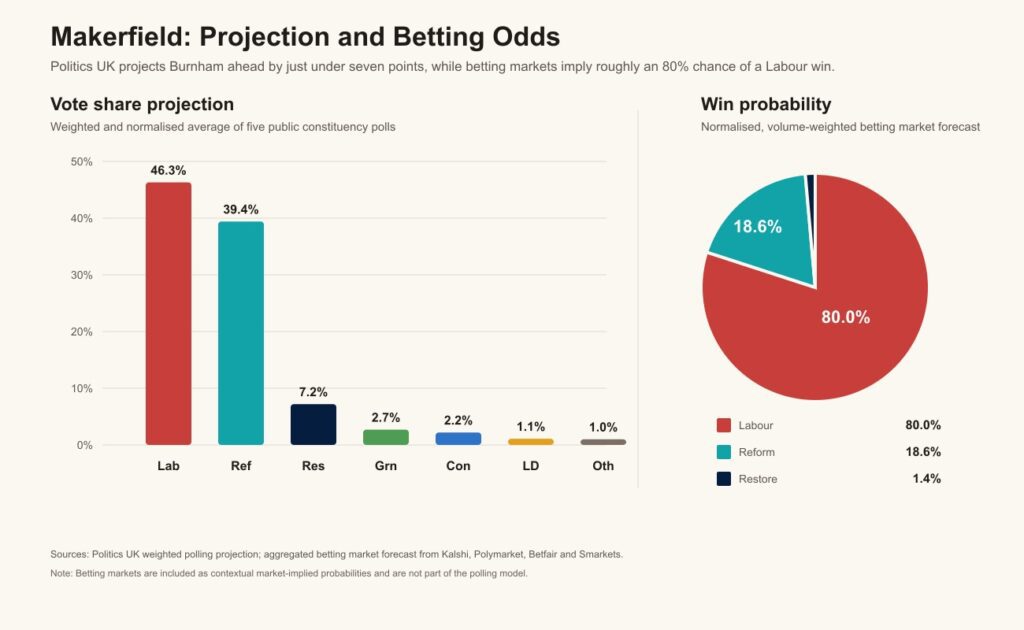

Politics UK projects that Andy Burnham is very likely to win the Makerfield by-election. Our headline forecast, based on a weighted aggregation of public polling data, puts Labour on 46.3%, ahead of Reform UK on 39.4%, with Restore Britain finishing a surprising third on 7.2% and all other candidates below 3%.
That gives Burnham a projected lead of just under 7 points. Our aggregated betting market forecast points in the same direction, implying roughly an 80% chance of a Labour win, compared with 19% for Reform and 1-2% for Restore Britain.
On the eve of polling day, the outcome in Makerfield is not certain, but Burnham enters polling day as the clear favourite.
Why Labour is ahead – The Burnham Effect
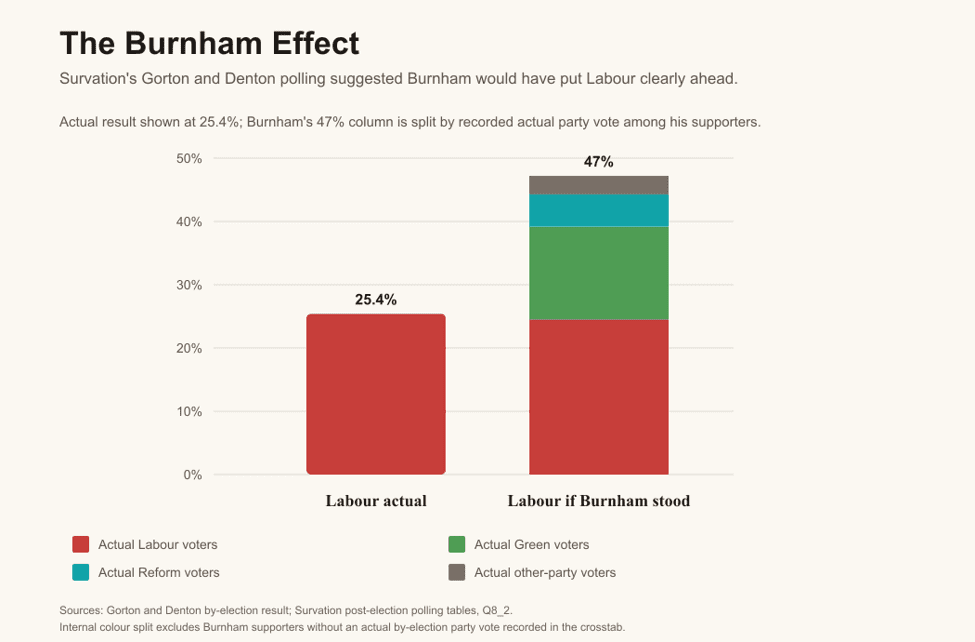
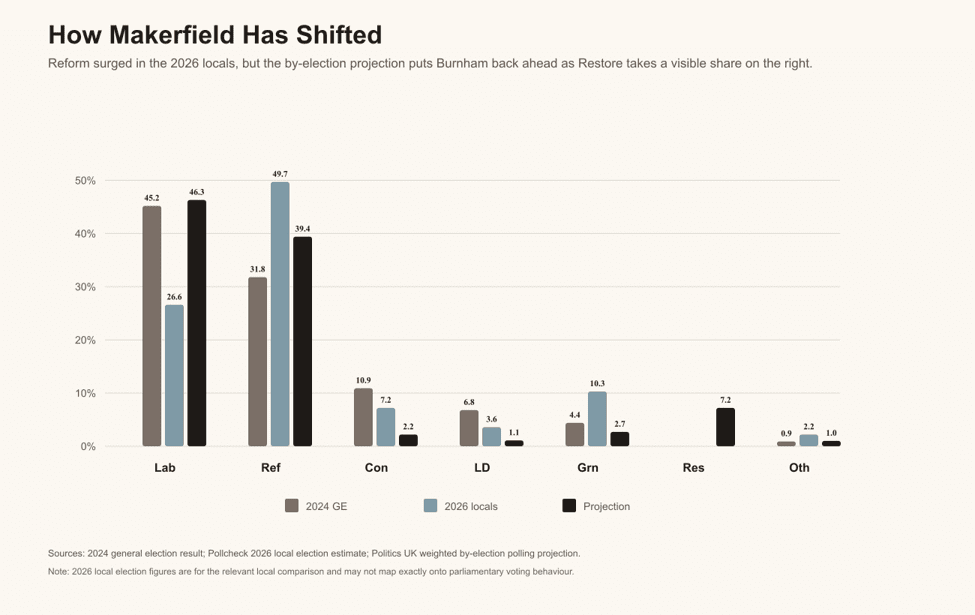
While Burnham is the clear favourite, he is fighting in unfavourable underlying territory for Labour. Reform was already strong in Makerfield at the 2024 general election, winning 31.8% of the vote, its sixth strongest constituency in the country. Furthermore, Reform performed exceedingly well here in the local elections, winning about 50% of the vote compared with Labour on roughly 27%. In this context, Labour’s current polling figure should not be read simply as evidence of generic Labour strength. It is better understood as evidence of Burnham’s personal appeal, his ability to outperform the national Labour brand, and the possibility that some voters see a Burnham victory as a route to a change in Labour’s leadership. Evidence for the “Burnham effect” was also seen in Survation’s post-election polling after the Gorton and Denton by-election, which suggested that Labour would have won 47% of the vote had Burnham stood, with the poll indicating he would have attracted 43% of actual Green voters and 17% of actual Reform voters. It is therefore no surprise that Labour’s campaign has concentrated heavily on Burnham’s personal brand, alongside anti-Reform messaging, nor that Labour’s current polling in Makerfield implies both a squeeze of left-wing voters and some crossover appeal to Reform voters.
Reform’s difficult campaign
While Burnham’s personal popularity and Labour’s relatively disciplined campaign have helped him, Reform’s own weaknesses have also made his path to victory easier. Robert Kenyon’s candidacy has attracted controversy, particularly over past social media posts and online forum comments, some of which were perceived as misogynistic. Focus group evidence from More in Common suggests the issue had some cut-through, particularly among women, with Kenyon’s comments on abortion and his failure to apologise for crude remarks appearing to matter most. That is backed up by wider polling data, with Survation finding that 55% of Makerfield voters would be less likely to support a candidate who had posted offensive material online.
More broadly, Reform has tried to frame the contest around anger at Labour and Keir Starmer, but that message may be less effective in a by-election where a Burnham victory could itself be read as a threat to Starmer’s leadership. The bigger problem for Reform, however, has been Restore Britain. Rupert Lowe’s party has invested heavily in the contest, campaigning to Reform’s right, especially on migration, and arguing that Reform is “becoming the Conservatives”, with too many former Tory MPs and senior figures now inside or close to the party. With Restore now projected on 7.2%, almost exactly the size of Burnham’s lead, the split on the right is central to the forecast. Reform’s problem is not just that the anti-Labour vote is too small; it is that Restore appears to be stopping it from consolidating enough to beat Burnham.
The squeezed smaller parties
One striking feature of the campaign has been the limited role played by the Greens and other smaller parties. In theory, the Greens had a clear incentive to compete hard in Makerfield: polling from Gorton and Denton, as well as wider hypothetical polling on a Burnham premiership, suggests they could be among the parties most exposed to a Burnham-led Labour recovery. They also had some local base to work from, having won more than 10% of the vote in the local elections. Yet the party has not appeared to put major resources into the contest, and our projection suggests much of its vote has been squeezed behind Burnham. If Burnham wins, becomes prime minister, and Labour recovers at the Greens’ expense, they may come to regret not contesting Makerfield more aggressively. The Conservatives and Liberal Democrats, meanwhile, have been almost absent from the race and are each unlikely to win more than 3% of the vote.
If Burnham wins
If Burnham wins, the consequences will reach far beyond Makerfield. A victory would return him to Westminster and immediately sharpen the question of Labour’s leadership, with YouGov polling of Labour members in May finding that members would back Burnham over Starmer by 59% to 37% in a head-to-head contest, and by even larger margins against other potential candidates. Yet the campaign has also shown how constrained a Burnham premiership could be. He has signalled support for Shabana Mahmood’s tougher immigration package, including her changes to indefinite leave to remain, moved to reassure markets by committing to Labour’s fiscal rules, and ruled out paying compensation to Waspi women. A Burnham victory may therefore accelerate the end of Starmer’s leadership, but it would not automatically mean a clean break from the political and fiscal limits that have defined the current government.
If Burnham loses – a volatile future awaits
The more dramatic question is what happens if Burnham does not win. Our aggregated betting market forecast still gives Labour around a 20% chance of losing, and the polling shows there are enough undecided voters to swing the election. The More in Common/UCL Policy Lab poll, for example, had Labour ahead by only 5 points, with more than one in ten voters still undecided. If Burnham loses, Starmer may try to fight on, and YouGov’s Labour member polling from mid-May suggests he would not be without a route through a contest: he would be favoured to beat every major potential challenger except Burnham. But even if he avoided a leadership challenge or survived one, his position would remain tenuous at best. According to LabourList, nearly 100 Labour MPs have already called on him to resign, a sign of how badly his authority has already been damaged. The resignation of the defence secretary, seen as one of Starmer’s closest allies in government, has further exposed the weakness of his position. Even though Burnham himself would be the candidate on the ballot, a defeat in Makerfield would almost certainly be blamed on Starmer’s unpopularity, putting even more pressure on the prime minister. Either way, a Burnham loss would create a volatile and unpredictable situation inside Number 10.
What Makerfield means for Reform – and the future of the right in Britain
For Reform, the implications are also significant. The first question is whether Burnham’s personal appeal can pull back enough voters who might otherwise be open to Reform. Survation’s post-election polling in Gorton and Denton suggested that Burnham could win some support from actual Reform voters, and if that pattern holds more widely, a Burnham-led Labour Party could move back within touching distance of Reform. The second question is Restore Britain. If Restore wins a substantial vote in Makerfield, it will raise serious questions for Reform about whether it can afford to leave space on its right, particularly on immigration and especially legal migration. A strong Restore performance would strengthen the argument inside Reform that it needs to harden its position; a weak Restore result would suggest Reform can still squeeze that vote when it matters. In that sense, Makerfield is not just a test of whether Burnham can win. It is also a test of Reform’s ability to consolidate the anti-Labour right, and of what it may have to do if that vote remains fragmented.
Whatever happens, Makerfield looks less like a local by-election than a stress test for the next phase of British politics.