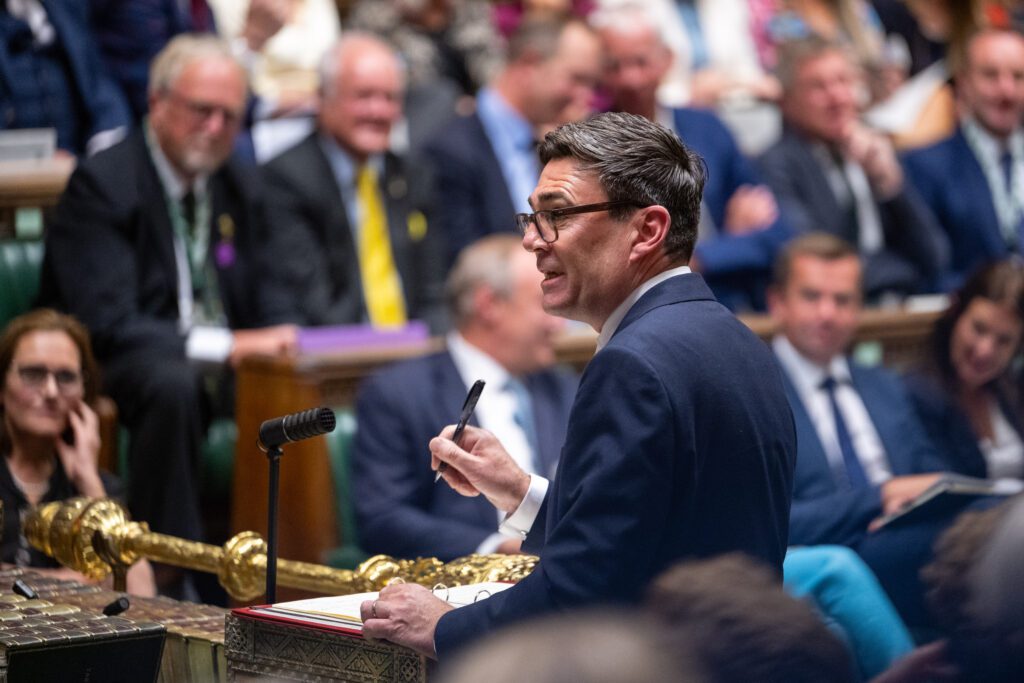
Prime Minister Andy Burnham used his first statement to the House of Commons to define his Government around devolution, public control and regional growth. It was a clear account of how he believes Britain went wrong, but Labour Party Conference must provide a more detailed programme for improving health and care, supporting life sciences and making Britain an AI and science superpower.
A place-first vision for government
Andy Burnham’s first Commons statement as Prime Minister was intended to reinforce some of the key messages he has made over the summer and establish a governing philosophy and a political dividing line. Commentators have a mixed view on how he achieved.
However, his central argument was that the UK’s economic problems stem from four decades in which political power was centralised, economic power was privatised, industry declined and local government was weakened. Brexit, he argued, then compounded the damage through lower growth and stalled regeneration.
The solution offered was the “biggest redistribution of power this country has seen”, with Number 10 North acting as a single point through which regions can secure faster decisions, greater powers and access to government resources.
Burnham’s political proposition is therefore distinct: growth will not be delivered principally through national targets or decisions taken in Whitehall, but by giving places greater control over infrastructure, skills, transport, housing and investment.
“This is politics done differently. Problem solving over point scoring. It is what the country needs.”
The statement also gave an indication of his governing style. Burnham promised continuity where he believed the previous administration had made progress, including support for Ukraine and action on small boat crossings, while signalling changes to prisoner-release policy and the structure of economic decision-making.
There was, however, considerably more diagnosis than delivery detail. The proposed 10-year plan for Britain, expected later this year, will have to explain which powers will move, which budgets will follow them and how local and national accountability will work.
Health and care: important signals, but not yet a reform programme
Health did not occupy a central position in the statement, although Burnham identified two areas that are likely to become significant features of his domestic programme.
The first was social care. He confirmed that cross-party discussions had begun during the summer, suggesting that the Government recognises the need for a settlement capable of surviving changes in political leadership. That is a constructive beginning, but the statement offered no indication of the model under consideration, its funding, the timetable for reform or how social care will be integrated with NHS services.
The second was mental health. Burnham promised more accessible, community-based mental health provision as part of the Government’s response to the forthcoming Milburn Report. This connected health reform to his wider economic argument: better community support can help more people remain in or return to employment.
Yet the statement was largely silent on the wider pressures facing health and care. There was no substantive account of how the Government will reduce waiting lists, address workforce shortages, shift resources towards prevention or modernise services through data and technology.
Life sciences were not mentioned directly. That is a notable omission for a Government seeking an innovation-led economy. The sector connects many of the Prime Minister’s priorities, including regional growth, university research, advanced manufacturing, NHS productivity and inward investment, but it was not incorporated into his theory of place-led growth.
Before Labour Party Conference, the Government should explain how local industrial strategies will support life sciences clusters beyond the established “golden triangle”; how the NHS will become a more effective partner in research and adoption; and how discoveries developed in Britain will be scaled, manufactured and deployed here.

AI, science and technology: an ambition without a national mission
Burnham committed the Government to building “an innovation-led economy in all parts of the UK” through a “triple helix” bringing business, academia, and government together. He also said that more must be done to help British start-ups and scale-ups remain in the country.
“We can lift the prospects of all our people and places. We can put more power into every postcode. We can let Britain believe again.”
That language provides the beginnings of a regional innovation strategy. The recognition that grid connections, energy costs, technical education and local investment capacity affect growth is particularly relevant to AI, advanced computing and technology infrastructure.
However, neither artificial intelligence nor quantum technology featured directly in the statement. There was no clear account of how Britain will compete for compute capacity, commercialise its research base, improve access to growth capital or use public procurement to create markets for British technology.
Nor was there an explanation of how greater regional autonomy will be reconciled with the need for national infrastructure, common regulatory standards and strategic investment at scale. Devolution can develop stronger technology clusters, but it cannot by itself provide the computing, energy, data access and patient capital required to compete with the United States, China and increasingly ambitious European and Asian economies.
At Labour Party Conference, Burnham should turn the “innovation-led economy” into a recognisable national mission. That should include clear priorities for AI, quantum, engineering and life sciences; regional specialisms linked to university and industrial strengths; national infrastructure commitments; and measurable routes from research through commercialisation to adoption.

Conference must supply the missing delivery plan
The first statement succeeded in setting out Burnham’s political philosophy: Britain will grow by transferring power, rebuilding local capacity and giving communities greater control over the economy and essential services.
What it did not yet provide was a sufficiently detailed account of how those principles will change public services or establish the UK as a scientific and technological leader.
Labour Party Conference is therefore the Prime Minister’s opportunity to move from diagnosis to delivery. He will need to show how devolution will improve NHS and care outcomes, how life sciences will become a central component of regional growth and how AI, quantum and advanced technology will be supported as national strategic capabilities.
The vision is “power in every postcode”. The next test is whether the Government can attach institutions, investment, deadlines and measurable outcomes to it.