

New planning rules will create a “default yes” for homes around well-connected stations. But the announcement also puts Kemi Badenoch’s own housing argument under the spotlight, after she admitted to PoliticsUK that Conservative councillors have too often opposed development because “it helps them win elections”.
Thousands more homes could be built around England’s railway, Underground and tram stations as the Government moves to make development in well-connected locations the default rather than the exception.
Changes to the National Planning Policy Framework (NPPF), announced on Monday, will establish a default “yes” for housing within reasonable walking distance of well-connected stations, together with new minimum expectations for housing density.
It represents a significant attempt to change how England decides where new housing should go. The revised framework strengthens the presumption in favour of development in sustainable locations and means conflicting local policies will carry less weight where they are inconsistent with national decision-making policies.
The Government is also reducing some consultation requirements, while making it easier to approve developments supporting jobs, clean energy, shops, leisure facilities, AI Growth Zones, and data centres. Ministers say the reforms form part of the push towards delivering 1.5 million homes.
But beyond the battle between ministers, councils, and the planning system, the announcement poses an intriguing political question for the Conservatives.
Before the new policy was announced, Conservative leader Kemi Badenoch offered a candid assessment to PoliticsUK of her own party’s record on housebuilding.
‘It helps them win elections’
Asked how the Conservatives could win back younger voters who feel locked out of home ownership, Badenoch identified insufficient supply as one of the three fundamental causes of the housing crisis.
“We have not been building enough,” she told PoliticsUK.
She then acknowledged her own party’s role in resisting development.
“Hands up, the Conservative Party is only behind Labour and the Liberal Democrats in saying no to things being built because it’s very easy for local councillors to say no,” Badenoch said.
“It helps them win elections but it’s been very bad for supply.”
Badenoch also argued that regulation was adding substantially to the cost of housebuilding, while increased demand from migration without corresponding increases in supply had contributed to higher prices. Her proposed answer was not simply redistribution between generations but greater supply, deregulation and stronger economic growth.
That diagnosis creates a potentially difficult distinction between the Conservatives’ national economic message and the incentives facing Conservative politicians locally.
And nowhere is that tension clearer than in Enfield.
The Crews Hill test
In May, the newly Conservative-led Enfield Council formally withdrew from the Government’s New Town programme following the election of Councillor Alessandro Georgiou as council leader.
The Conservatives had explicitly campaigned against the New Town proposals and, after taking control, withdrew council support for development associated with Crews Hill, Vicarage Farm and parts of Enfield’s Green Belt.
Before the change of administration, Crews Hill and Chase Park had been considered as a location capable of delivering around 21,000 homes, including family and council housing, alongside schools, GP surgeries, jobs and transport improvements. The previous council leadership said the scheme could support more trains at Crews Hill station as well as new bus, walking and cycling connections.
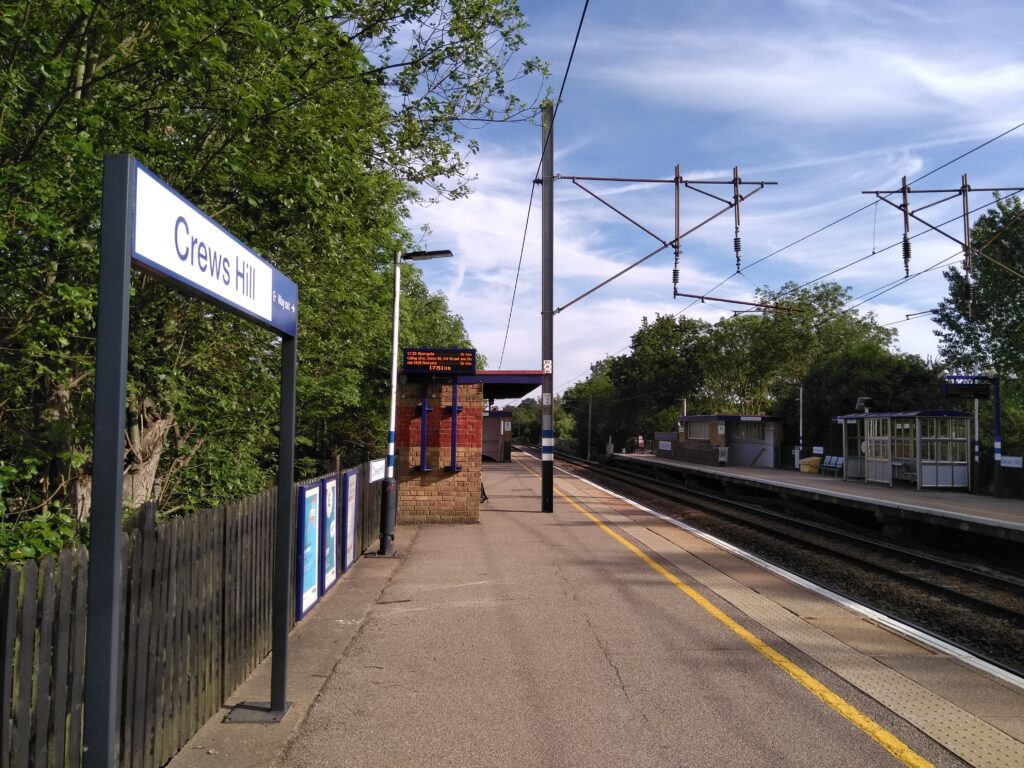
Crews Hill already has a railway station with services towards Moorgate in central London, placing the area squarely within the broader political debate about whether transport-connected locations should accommodate substantially more housing.

Georgiou, however, has rejected the suggestion that withdrawing from the New Town programme amounts to rejecting housebuilding altogether.
He said his administration had been elected with a clear mandate to protect the Green Belt and pledged instead to work with government on meeting housing need through a “brownfield-first approach”, unlocking underused land and regenerating town centres.
The Crews Hill and Chase Park proposal is far larger than simply constructing higher-density housing immediately surrounding a station, and opposition to one scheme does not automatically amount to opposition to all transport-oriented development.
Politically, however, the comparison is difficult for the Conservatives to avoid.
Badenoch has herself argued that local councillors have been rewarded electorally for saying “no” to development, while acknowledging the cumulative consequence has been inadequate housing supply. In Enfield, the Conservative administration was elected after campaigning against a major housing proposal in a location already served by rail.
The Government’s new planning framework now seeks explicitly to change that political equation.
Rayner: Homes and growth around transport hubs
Housing Secretary, Angela Rayner said the reforms were intended to make living close to employment and public services more attainable.
“A safe, secure home is the foundation of opportunity, but too many people are being priced out of the communities where they want to live and work,” she said.
“By unlocking thousands of homes around well-connected transport hubs, we’re helping people live closer to work, school and the services they rely on, while backing local businesses and driving growth in our communities.”
Chancellor John Healey linked the policy directly to home ownership and economic growth, arguing that government wanted to “drive growth in every postcode and help more working people into home ownership”.
Transport Secretary, Heidi Alexander said densification around well-connected stations would also improve access to jobs and services while supporting public transport, walking and cycling.
The argument from ministers is therefore straightforward: if the country needs more homes, putting them close to existing transport infrastructure should be one of the least controversial places to start.
The politics are considerably harder.
For Badenoch, housebuilding is becoming an early test of whether her emerging pro-growth Conservative offer can overcome the very local political incentives she has identified.
There is an obvious electoral reason why councillors resist unpopular developments. Badenoch has now said so herself.
The question is what happens when Conservative councils continue to do it.
If the Tory leader believes the UK cannot restore home ownership without building significantly more houses, the challenge will be demonstrating that this applies not only when criticising Labour’s planning system nationally, but when Conservative administrations face controversial developments in their own backyards.
In that sense, Crews Hill could become more than a local planning dispute. It offers an early test of whether Badenoch is prepared to confront the Conservative Party’s longstanding tension between building for growth nationally and opposing development locally.
Final thought
Independent policy institute Curia has long advocated for homes, businesses and public sector infrastructure to be built close to pre-existing transport infrastructure, making better use of existing connections while supporting economic growth, access to services and more sustainable communities.
The Government’s plans go some way towards delivering on those calls. The test will now be whether national planning reform can translate into delivery on the ground, particularly where local political pressures conflict with the need for new homes and infrastructure.
Curia continues to work with policymakers, local and regional government, industry, and public sector leaders on devolution, planning reform, and the infrastructure needed to support sustainable growth across the UK.
To find out more about Curia’s work, contribute to its research or discuss opportunities to engage with forthcoming policy programmes, get in touch with Partnerships Director, Ben McDermott at ben.mcdermott@chamberuk.com.
The Conservative Party and Enfield Council has been contacted for comment.
Image: Conservative Party and Politics UK