
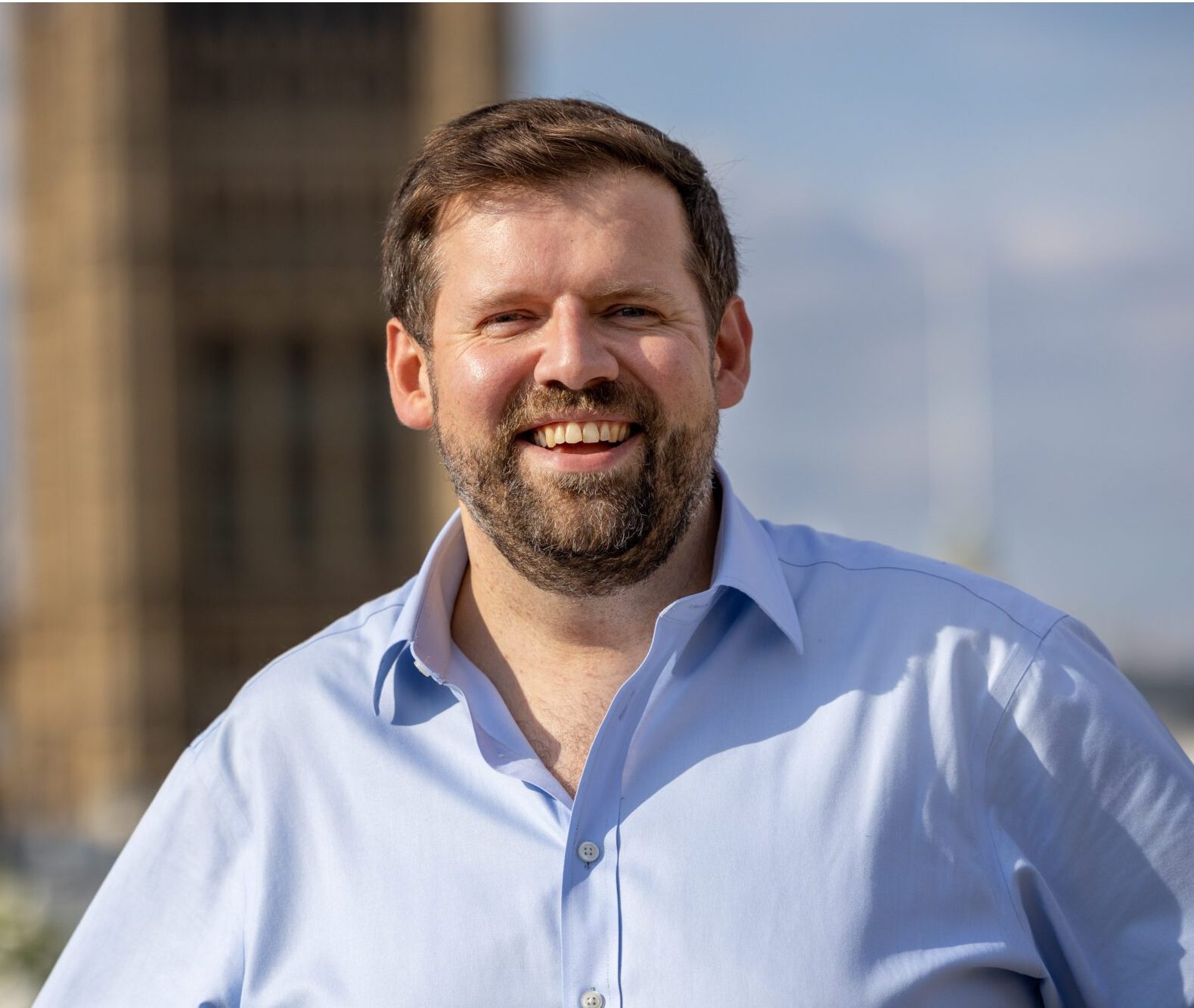

Ben Howlett
Chief Executive, CuriaFor two decades, Chief Executive of Curia has not only advocated for further devolution, he has written books and articles, and championed the case as an MP in the West of England. Writing for Politics UK, Ben Howlett sets out how a prospective Prime Minister such as Andy Burnham’s could offer a Manchesterism alternative to Westminster.
Andy Burnham’s argument for Manchesterism is a direct challenge to the way Britain is governed. Following the by-election result last night, this challenge may result in one of the biggest transformations in British governance since the formation of the NHS.
As Mayor of Greater Manchester, Burnham has argued that the United Kingdom has become too centralised, too short-term, and too fragmented to solve the problems facing its communities. Decisions about transport, housing, skills, health, utilities, and economic development are still too often made through separate national silos, even though people experience them as one connected reality.
Manchesterism, as Burnham describes it, is an attempt to reverse that logic. It starts with place. It assumes that the people who understand a local economy, a local labour market, a local housing crisis or a local transport network are more likely to build workable solutions than departments operating from Whitehall. It is not anti-government, but it is strongly anti-centralisation.
For public service reform, that matters. The argument is not just that regions such as Greater Manchester should have more freedom. It is that the British state itself may work better if it learns to trust places with power.
From Fragmentation to Integration
The most interesting part of Manchesterism is its view of public services – can anyone remember the ‘bonfire of the lanyards’? Burnham’s critique is that too many public systems have been separated from one another by decades of deregulation, outsourcing, austerity, and administrative churn.
A person utilising public services does not neatly divide their life into departmental categories. Poor transport affects access to work and education, poor housing affects health. Low pay affects wellbeing and family stability. Weak skills pathways affect productivity. Social care failure affects hospitals. As proven from decades of public service failure, each problem is treated separately, the state ends up paying more and achieving less.
A Manchesterism approach would mean designing public services around the person and the place, rather than around the boundaries of individual institutions. That could mean pooled budgets, shared outcomes, and stronger local partnerships between councils, health services, colleges, employers, police, housing providers, and voluntary organisations.
This is where devolution becomes more than a constitutional debate. For decades it has been argued that devolution is a practical reform tool. If a mayor or combined authority can align transport, skills, housing, and health prevention behind a shared plan, public services can start acting earlier, rather than waiting until people reach crisis.
The Bee Network as a Public Service Case Study
Burnham’s strongest example is transport. As well as a transport project, the Bee Network is a public service reform argument in physical form.
By bringing buses back under local control and integrating them into a wider network, Greater Manchester has sought to show that public services can be planned around residents rather than market gaps. Of course, there will be those who argue that buses matter – don’t get me wrong, they do – it is more that local control can create clearer accountability.
When services are fragmented, nobody is fully responsible. When they are integrated locally, residents know who to hold to account. That principle could be applied far beyond transport.
In health and care, it could mean more emphasis on prevention and community support. In housing, it could mean linking planning decisions to public health and local labour market needs. In education and skills, it could mean building clearer routes from school to college, training, and employment in the sectors where a city region is actively trying to grow.
Good Growth and Social Responsibility
Manchesterism also raises an important economic question: what is growth for?
Burnham’s answer is that growth must be felt in ordinary communities, not just measured in city centre skylines or headline investment figures. His model links economic development to housing, jobs, infrastructure, and social value. It is pro-investment, but not indifferent about the kind of investment that arrives.
For public service reform, this is significant. Too often, growth policy and public service policy are treated as separate conversations. Building on the foundations created by Sir Howard Bernstein and others, Manchesterism suggests they should be brought together. A stronger economy should reduce pressure on public services by creating better jobs, improving living standards, and giving young people clearer opportunities.
That is a different approach from simply cutting demand once it appears. It asks how the conditions that create demand can be changed in the first place.
This is particularly relevant to health, social care, homelessness, and criminal justice. If policy remains focused only on crisis response, public services will remain overwhelmed. If devolved leaders have the tools to shape housing, employment, prevention, transport, and community support together, they may be better placed to reduce demand over time.
Devolution Must Come with Accountability
However, devolution cannot simply become a slogan used to pass responsibility downwards without passing power, funding, and accountability with it.
This Government’s intention for devolution has been scuppered by a Treasury wedded to consultations and insistence for devolution without attached funding.
If local leaders are expected to fix national problems without sufficient fiscal freedom or long-term certainty, Manchesterism could become another form of managed decline.
Real devolution requires the centre to let go of control in meaningful areas. That includes multiyear funding, greater flexibility over local investment and clearer powers over the systems that shape everyday life.
But it also requires high standards locally. Devolved government must be transparent, measurable and open to scrutiny. If mayors and combined authorities are given more power, they must be judged on outcomes: better transport, more homes, improved skills, stronger public health, lower inequality, and higher productivity.
The case for devolution is strongest when it is tied to delivery.
A Blueprint or a Brand?
The question now is whether Manchesterism can move from a Greater Manchester story to a national reform agenda.
Its appeal is obvious. Britain’s public services are under pressure. Trust in Westminster is at an all-time low. Many communities feel that national politics has been done to them, not with them. A model built around place, integration and long-term planning speaks to that frustration. These are all reasons why people have turned to the populist right – and now it is time for someone like Andy Burnham to offer and deliver an alternative.
But scaling Manchesterism will not be simple. Not every region has the same institutions, leadership capacity, civic networks or economic base as Greater Manchester. Some areas may need far more support before they can take on deeper powers. Others may require different governance models altogether.
That should not weaken the case for devolution. It should make the case for serious, practical devolution rather than a one size fits all settlement.
The Bigger Lesson for Westminster

The real challenge posed by Burnham’s argument is not a lift and shift of what he achieved in Greater Manchester. The test is whether Westminster can accept that the old model is no longer working.
Public service reform cannot be delivered by endless departmental reorganisations, short funding cycles, consultations, and national strategies disconnected from local reality. It requires trust, continuity and the ability to join up policy around people’s lives.
Manchesterism is not a complete answer. But it is a serious proposition: that public services improve when power is closer, institutions work together and growth is judged by whether it changes life in communities.
Devolution is likely to be central to the future of the British state.
If Burnham’s Manchesterism is to mean anything beyond a political brand, it must prove that local power can deliver national renewal. That means better services, stronger accountability and a model of growth that reaches beyond the most successful parts of our cities.
Is Westminster prepared to let that happen?
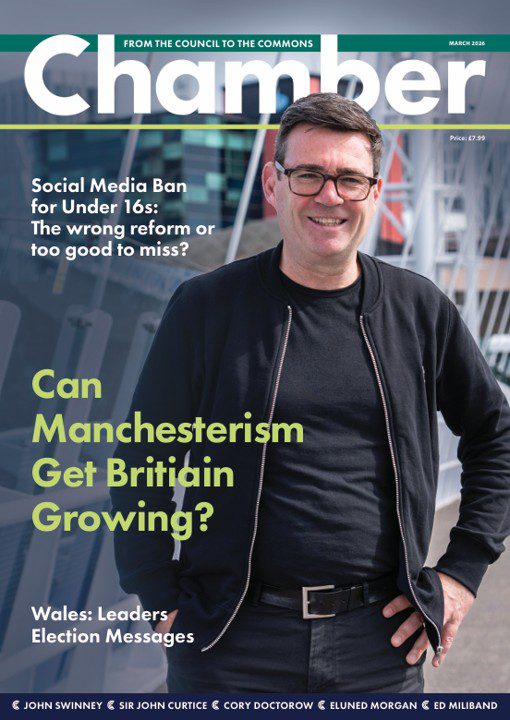
You can still get a copy of our new edition of ChamberUK. Our parliamentary journal.
Photo Credit: NorthSky Films/Shutterstock
In-text Image: Rathfelder/Wikimedia