

Pranjay Parashar
Founder at Stats&DataMethodology Note: The following analysis and underlying vote-share projections are driven by the Stats&Data QWA modelling — validated as the closest and most accurate UK MRP forecast against Sky News’s May 2026 local election projections. Full constituency-level seat projections for all five leadership scenarios will be published in the complete Stats&Data QWA 26Q1 dispatch. This analysis is not based on polling conducted by Stats&Data.
The political numbers out of Westminster are unsparing. Since the 2024 general election, Labour’s national vote share and Keir Starmer’s approval ratings have been in free fall.
The story after the May 2026 locals was that Labour avoided a wipeout. That reading doesn’t survive the constituency data. Labour’s results were exceptionally poor — saved from total disaster only by a temporary stall in Reform UK’s vote share. With Keir Starmer’s resignation now triggering an active leadership contest, Westminster has one question: who comes next?
The candidates – from Northern figures like Andy Burnham to those representing a traditional centrist platform – are almost always debated on ideological grounds. Under First Past the Post, that’s the wrong frame. Ideology is secondary to geography.
As detailed in our recent breakdown of FPTP for Politics UK, the system has become a lottery of hyper-localised pluralities. National vote share is increasingly decoupled from seat outcomes. The QWA 26Q1 modelling applies that framework directly to the leadership question, and the answer is not comfortable. A change in leader is a zero-sum game. Labour can fix the Northern collapse, or it can hold its Southern gains. The map does not allow both.
The Northern Collapse: The Baseline Reality
The scale of what has happened in Labour’s heartlands under Starmer needs to be stated plainly before anything else.
In 2024, Labour secured 91 out of 99 available seats across Greater Manchester and the Northern industrial belt. The QWA 25Q3 projection puts them at 32. Reform UK is on course to take 59 seats in that region alone. Yorkshire tells the same story: Labour held 43 of 54 constituencies in 2024; the current projection is 10, with Reform surging from zero to 32.
For Reform to build anything resembling a parliamentary majority, these Northern and Yorkshire seats are not optional. They are the whole equation. Because most of these constituencies are straight fights between Labour and Reform, they are the definitive front lines of the next election — and right now, Labour is losing them badly.
The Northern and Urban Counter-Offensive: Reclaiming the Red Wall
A Northern leader from the left of the party is a direct geographic counter-offensive against that Reform surge. The QWA 26Q1 five-scenario modelling shows how much it matters who Labour picks.
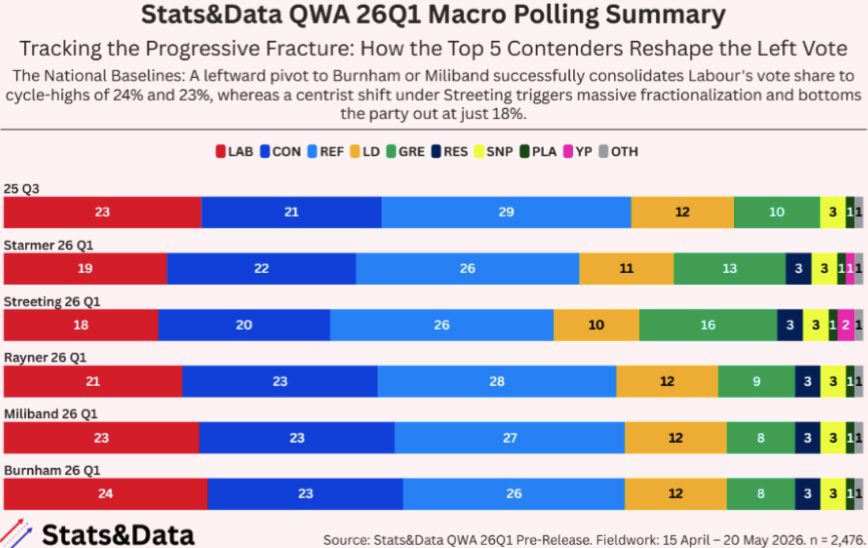
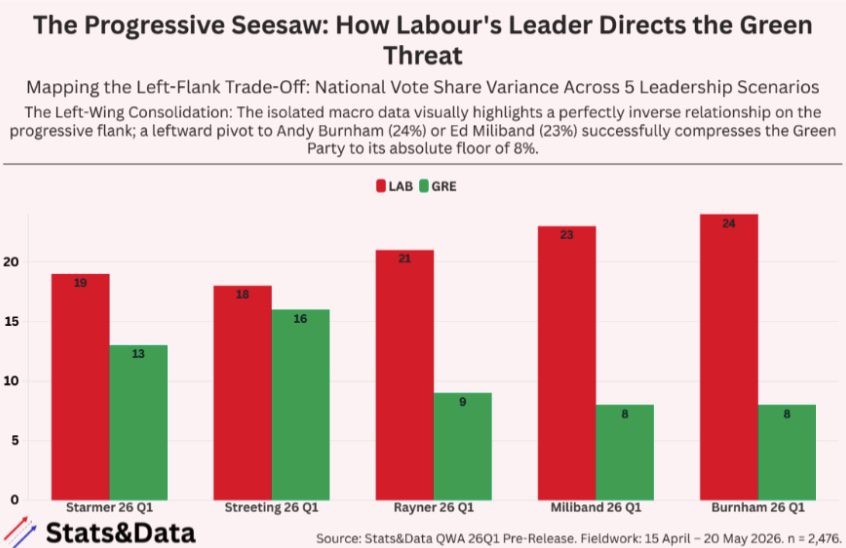
Burnham moves Labour’s national vote share to 24% — up from Starmer’s 19%. Miliband gets to 23%. Rayner reaches 21%, a meaningful improvement on the current baseline but short of what the other two manage. The gap between Rayner and Burnham is not trivial under FPTP arithmetic.
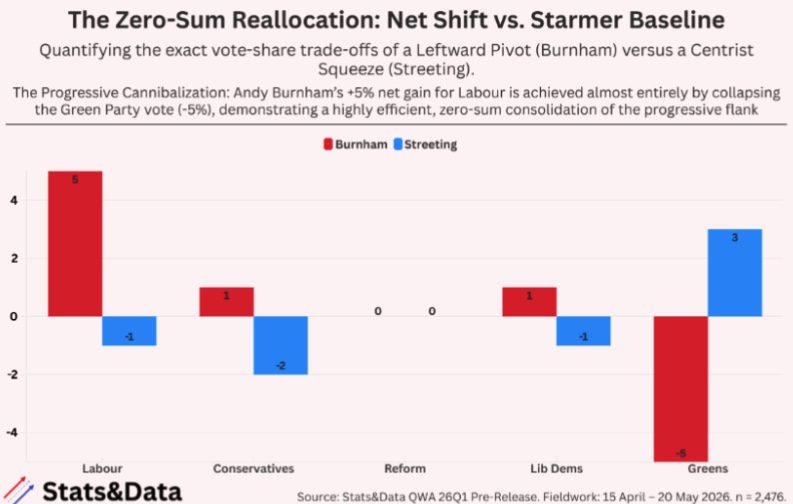
The mechanism is the Green vote. Under Starmer, disillusioned progressive voters drift to the Greens and fracture the left. That fractionalisation is what lets Reform slip through in urban and suburban seats on vote shares that would have been unwinnable a decade ago. Burnham and Miliband pull those voters back. Under Burnham, the national Green vote drops to 8%. That single movement — soft-left voters returning to Labour rather than defecting to the Greens — is what locks Reform out of seats they would otherwise take on split votes.
Rebalancing the Parliamentary Arithmetic
The seat-level consequence is significant. If Burnham, Miliband, or Rayner leads Labour, the QWA 25Q3 data indicates the party can reclaim 51 seats across the North East, North West, and Yorkshire. The breakdown matters:
- 44 seats taken directly from Reform UK
- 4 seats taken from the Green Party
- 1 seat each taken from the Conservatives, Liberal Democrats, and Others
That 44-seat figure is worth sitting with. It is roughly the entire margin between Reform being a plausible governing force and being a parliamentary irrelevance. Clawing those seats back would push Reform’s national count below 250 — mathematically paralysed, dependent on the Conservatives for any viable government. Labour wins the Red Wall. The Conservatives become the indirect beneficiaries in the wider arithmetic.
The Multi-Party Southern Squeeze
The North and South operate on completely different electoral logic. Northern seats are largely binary — Labour versus Reform, head to head. The South is a volatile multi-party battleground where small vote shifts scramble local outcomes in ways that are harder to predict and harder to control.
One Westminster assumption is that changing Labour’s leader disrupts the populist right. The data does not support this. Across all five scenarios, the combined right-populist vote — Reform plus Restore UK — stays locked between 29% and 31%. The range is just two percentage points across five completely different leadership configurations. Changing the Labour leader moves the centre-left. It does not move to the right.
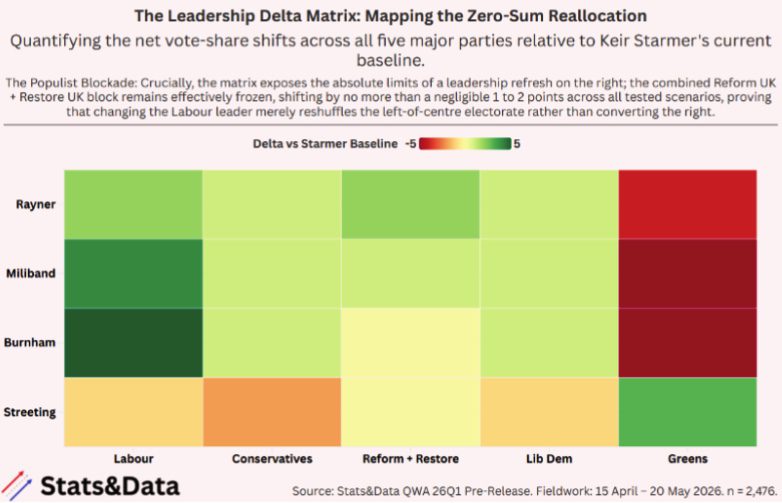
That is the trap. A leftward pivot under Burnham, Miliband, or Rayner triggers an exodus of centrist voters in London and the South — people who lent their votes to Starmer but have no loyalty to a left-wing Labour party. When those voters move, they flip seats that were already on a knife-edge in the QWA 25Q3 data:
- Conservative Rebound: The Conservatives capture 20 seats across London and the South — mostly constituencies where they were trailing narrowly. Returning centrist voters provide exactly the marginal density needed to overturn Reform’s thin leads. These are Reform losses, not Labour losses directly, but the effect is the same: the populist right gets locked out of Southern footholds it was close to taking.
- Liberal Democrat Breakthrough: The Lib Dems pick up around 5 seats. They were sitting close second in these Southern marginals already; the centre-left fracture is all they need to push through, at the simultaneous expense of both Labour and Reform.
The progressive map shifts as well. In Greater Bristol, the Greens had built real pluralities by consolidating voters abandoned by Starmer’s Labour. A Burnham or Miliband leadership breaks that coalition. As soft-left voters consolidate behind a repaired Labour baseline, Green vote concentration falls below the FPTP tipping points — and the Greens lose a number of their most prized Bristol-cluster seats back to Labour.
The Centrist Paradox: Squeezing the Left Flank
If a left-wing pivot costs Labour the South, does moving right save it?
No.
While Wes Streeting has declined to enter the race, our model tested a traditional centrist platform under this exact profile, and the data serves as a vital structural warning for the centrist wing of the party. Placing a candidate under this centrist blueprint at the helm creates the worst electoral outcome in the entire dataset. On the right of the party, a traditional centrist takes negligible structural votes from the Conservatives or Reform – those voters are not coming back for a Blairite Labour leader. What it does instead is drive Labour’s progressive base directly to the Greens. Under this centrist scenario, the Green vote doubles to 16%. That level of left defection creates lethal vote-splitting nationwide. Labour bottoms out at 18% – worse than the Starmer baseline the leadership race was called to escape.
Conclusion: The Architecture of 2029
The idea that the right leader can reassemble the 2024 Labour coalition is an illusion. The FPTP map has realigned. The fault lines are not moving.
What Labour’s MPs and members are really deciding is which part of the country to write off. A left-wing leader locks down the Red Wall, squeezes the Greens, and bleeds out in the South. A centrist leader haemorrhages the North to Reform and gets picked apart by left-wing fractionalisation everywhere else. Critically, neither path leads to a parliamentary majority.
There are no easy answers. Only the hard mathematics of a map that no longer favours them.
Full constituency-level MRP seat projections for all five leadership scenarios — including an additional configuration not discussed in this teaser — will be released in the complete Stats&Data QWA 26Q1 dispatch.
Visit statsanddataglobal.com to view all of our past polls and analysis.

You can still get a copy of our new edition of ChamberUK. Our parliamentary journal.