

Tim Flagg
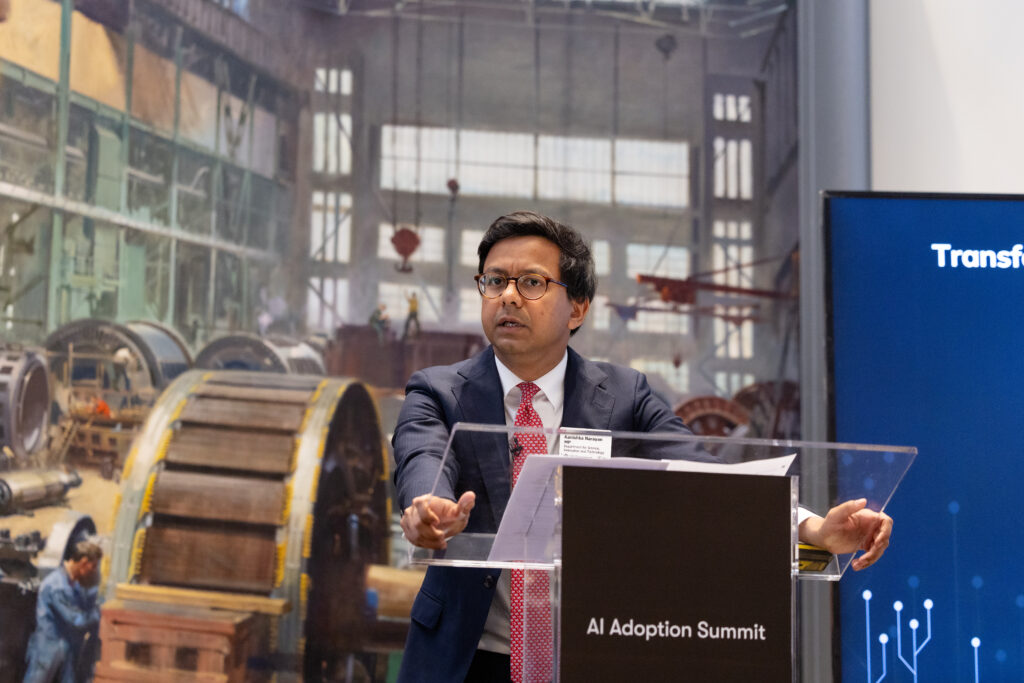
Chief Executive, UKAIAndy Burnham has made an ambitious start, with early reforms on AI, devolution, and skills reflecting many of the priorities long championed by UKAI. But while structural changes are encouraging, the real test will be whether government backs British AI businesses through procurement and investment, ensuring AI-driven growth creates jobs, skills, and prosperity across the UK. (Photo: Minister Narayan opens the AI Adoption Summit at the Science Museum. Photo: Alecsandra Dragoi/DSIT)
Since Andy Burnham entered Number 10, the sense of mission has been unmistakable. Here is a Prime Minister who communicates with clarity and conviction, and who has assembled a team built to match that ambition. It is telling that some of his closest advisors cut their teeth under Blair, when Labour last had to prove it understood what business actually needs to grow. That combination of communicators and operators, of people who can both articulate a vision and deliver it, gives me real confidence that this Government intends to be judged on outcomes, not slogans.
At UKAI, we welcome that ambition. Britain needs a Prime Minister prepared to be bold about social progress. But ambition on its own does not build an economy. Growth comes from businesses, not from governments. The state’s job is to create the conditions in which firms can invest, hire and scale. The early signals suggest Burnham understands this distinction and he is listening. That is no small thing in politics, and it should not be taken for granted.
Listening Government
Nowhere is that listening more evident than in his instinct for devolution. Burnham made his name as Mayor of Greater Manchester, and he has brought that experience into government. Real devolution means handing power to local leaders and local industry, the people who understand what their region actually needs. Seen in that light, the restructuring of DSIT may well reflect a longer-term goal: shifting power and decision-making away from Whitehall, not just north to Manchester, but out to every region of the country. Giving power away is hard for any government, especially one with a mission as large as this one. It requires ambition and trust. So far, Burnham has shown both.
That trust matters most where AI is concerned. UKAI has long argued that artificial intelligence is the single biggest lever available to reform public services and improve outcomes for people in every community in the UK, provided it is deployed responsibly. Burnham appears to see the same opportunity. The clearest evidence is his decision to elevate Kanishka Narayan to Cabinet as the UK’s first Minister for AI, alongside the reform that folded the old Department for Science, Innovation and Technology into a new Department for Business, Innovation, Science and Trade under Jonathan Reynolds. That is a serious structural signal. Senior civil servants have been telling us for months that government AI strategy needs greater, cross-departmental coordination, replacing fragmentation and duplication. This restructuring, with Minister Narayn now sitting in the Cabinet Office, goes a long way toward answering that call.
It also answers two of the three asks in the open letter that UKAI sent to Burnham last week. We called on the Prime Minister to engage industry leaders across the regions to build ecosystems tailored to each area’s own strengths and its own people. The devolution agenda, done properly, is exactly that. We called for education reform to produce the skills that British industry will require to lead in the future, and Burnham has already made announcements about his desire to refocus education around the jobs that industry needs. Two out of three delivered within the first couple of weeks is a strong start for any new government.

UK AI Companies
Our third ask is to back British businesses and invest taxpayer-funded contracts in procuring services from AI companies in the UK. That means ensuring a minimum percentage of contracts go to British firms, enabling them to scale and hire British workers to fill the jobs that AI adoption creates. Sovereignty in AI was never about building everything domestically. It is about finding a balance, while ensuring that when public money is spent, it strengthens our own capability – providing jobs and skills for the next generation. This is the piece of the puzzle Burnham has not yet closed, and it is the one on which his mission will most visibly be judged by the businesses that UKAI represents.
None of this diminishes what has been achieved in a matter of weeks. Burnham has shown he can be both ambitious and disciplined, both a devolver of power and a coordinator of strategy, both optimistic about what Britain can become and clear-eyed about the machinery needed to get there. That is a rare combination, and it is why UKAI’s initial verdict is positive.
But delivery, not rhetoric, is what will define this Government’s legacy on AI. British AI should be responsible AI: sustainable, inclusive, and built to empower people in every community. AI will unlock growth. Burnham must ensure it is built by British workers, for British benefit. Get that right, and this Government will have shown Britain how to make AI work for everyone.
To find out more about UKAI, please visit www.ukai.co