
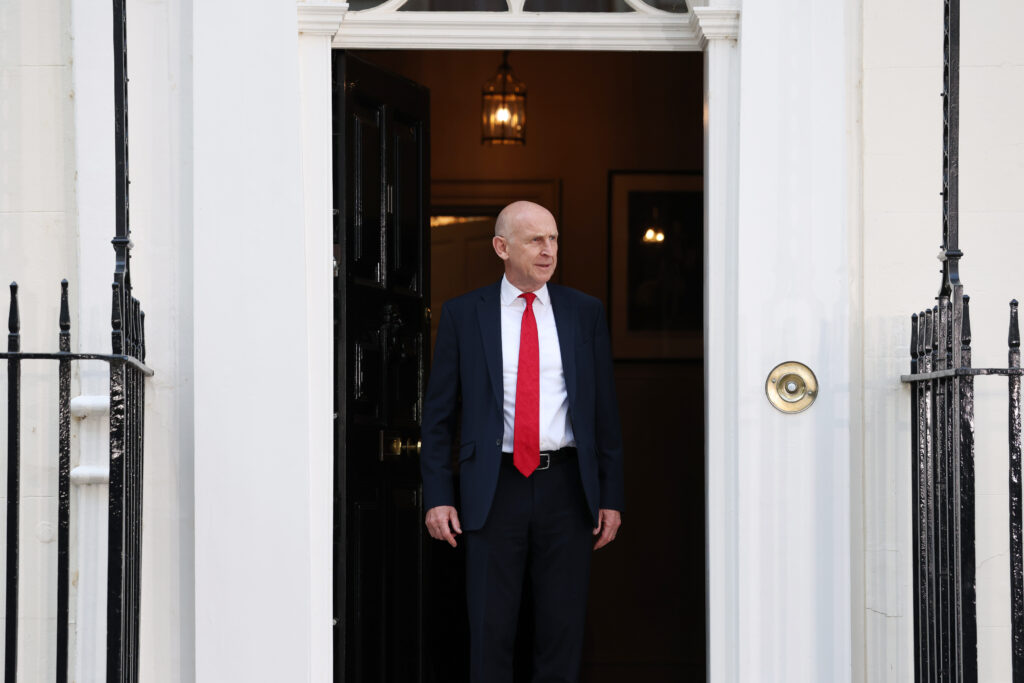
in his first major speech as Chancellor, John Healey has pledged to make Britain a country of wealth creation and reverse decades of deindustrialisation, as Jaguar Land Rover prepares to cut around 4,000 jobs.
The announcement came moments after the Chancellor completed his first major economic speech at the Manufacturing Technology Centre in Coventry, turning his promise of an industrial revival into an immediate test of the Government’s economic credibility.
Jaguar Land Rover is seeking to remove £1.7 billion from its cost base over the next two years. The proposed reductions are expected to be concentrated among salaried and management employees, with a significant proportion likely to affect its UK operations.
The company employs around 30,000 people in the UK, including thousands across the West Midlands and Merseyside. It has faced falling sales, US tariffs, stronger competition from Chinese electric vehicle manufacturers and the continuing financial consequences of last year’s cyberattack.
For Healey, the timing was particularly uncomfortable. During his speech, he acknowledged that the UK had been “deindustrialised” as the cost of making and building things increased.
Within minutes, the country’s largest car manufacturer provided a stark illustration of that challenge.
A new story about Britain
Healey used the speech to present an optimistic account of Britain’s economic prospects while acknowledging the pressures facing businesses and households.
He pointed to the country’s strengths in life sciences, defence technology, creative industries, financial services and advanced manufacturing. Britain, he said, was home to nearly half of Europe’s most innovative companies and remained a world leader in several frontier technologies.
The Chancellor also highlighted six interest rate reductions since the election, growth that he said had been the fastest in the G7 during the first half of the year and productivity beginning to improve after decades of underperformance.
“I dedicate myself to this mission as Chancellor, to make Great Britain ‘Growth Britain’ again, with more investment, more innovation and more jobs,” he said.
Healey said he wanted to tell a “fresh story” about a country turning a corner and ready to seize the opportunities created by new technologies.
However, he recognised that energy bills, labour costs, regulatory burdens and planning constraints had all increased the cost of doing business since the pandemic.
“I want to see this country as a country of wealth creation,” Healey said. “I want our government decisions and policies to raise the levels of confidence, investment and profit in British businesses.”
The Chancellor promised to “draw the line” under increasing business costs and argued that stronger growth was the only sustainable answer to both the cost of living and the cost of doing business.
JLR announcement tests industrial ambitions
Jaguar Land Rover’s plans demonstrated how quickly Healey’s industrial strategy will need to produce tangible results.
The company is not simply part of an industry from Britain’s economic past. It is a major exporter preparing to invest between £15 billion and £18 billion over the next five years in electrification, digital technology, advanced manufacturing and new products.
At the same time, it is seeking to reduce its workforce and lower its break-even point to approximately 300,000 vehicles as it responds to international competition and rising operating costs.
That tension encapsulates the challenge facing the Chancellor. Investment in new technology does not automatically protect existing employment, particularly when British manufacturers are exposed to tariffs, high energy prices and competition from overseas producers.
Helia Ebrahimi of Channel 4 News challenged Healey during the press conference about the difficulties facing Jaguar Land Rover employees.
The Chancellor responded by arguing that stronger regional growth, investment and innovation would allow Britain to move beyond its long-term reliance on a small number of economically successful places.
Business Secretary Jonathan Reynolds is expected to meet Jaguar Land Rover’s leadership, although he has ruled out a direct bailout. The Government has indicated that any public support would need to be linked to future investment rather than used to cover immediate losses.
Borrowing costs narrow the Chancellor’s options
Healey’s difficulties extend well beyond the automotive industry.
Government borrowing costs have increased amid volatility in international bond markets, while conflict, higher energy prices and global trade tensions are contributing to inflationary pressure.
Mortgage rates have also started to rise again, intensifying the pressure on household finances and threatening to weaken consumer confidence.
Healey said government borrowing costs were at “historic highs” and argued that Britain had been paying a “Truss penalty” since the 2022 mini-Budget damaged confidence in the country’s fiscal position.
National debt has risen from approximately 64 per cent of GDP in 2009 to almost 100 per cent today. The Government is now spending around £1 in every £10 on debt interest.
“If debt interest were a government department, it would be the second biggest in Whitehall after health, bigger than defence, the Home Office and justice put together,” the Chancellor said.
Healey insisted that he and Prime Minister Andy Burnham were “in lockstep” over meeting the fiscal rules at the Budget on 28 October. He promised to balance the books with a buffer against further uncertainty while controlling borrowing and reducing long-term pressure on the public finances.
That commitment leaves the Chancellor confronting difficult choices over tax and spending. The Government must find room for its commitments on social care, defence, infrastructure and regional investment at a time when its fiscal headroom is under pressure.
Asked repeatedly whether taxes would rise at the Budget, Healey declined to provide a guarantee.
“If I respond to speculation now, that will only fuel more speculation,” he said. “Every Chancellor would say that is for the Budget.”
Power and money to move out of Whitehall
At the centre of Healey’s growth programme is a proposed transfer of economic power and resources from Whitehall to local leaders.
The Chancellor confirmed that the Budget would include a roadmap for fiscal devolution. This will include greater business rates retention for councils and strategic authorities, alongside plans to replace some central government grants with a share of local income tax for every mayoral strategic authority from 2028.
He also announced a £150 million British Business Bank allocation for fast-growing companies in the North and the creation of the Northern 500, a network bringing together ambitious medium-sized businesses.
South Yorkshire, Liverpool City Region, North East England and the Cardiff Capital Region will become strategic partners of the National Wealth Fund, helping them to develop regional investment pipelines.
Healey argued that local leaders were better placed to identify the transport, skills and infrastructure constraints that could easily be overlooked from Whitehall.
“The next chapter of Britain’s growth story will be written in more places,” he said. “That is not sentimentality, it is supply-side economics.”
Green Book and regulatory reforms
The Chancellor also announced changes intended to alter how the Government makes investment decisions.
The Treasury will reduce the Green Book discount rate from 3.5 per cent to 3 per cent, giving greater weight to projects expected to produce long-term economic benefits.
Healey said the Government would introduce “economic potential analysis”, assessing places not only according to their present economic performance but what they could become with the right investment.
He also promised to align public financial institutions, backed by £200 billion, more closely with government priorities and use public procurement strategically to support British companies.
The measures will sit alongside a commitment to reduce the burden of business regulation by 25 per cent before the end of the Parliament.
Healey announced that judicial review reforms would be extended from energy developments to all major infrastructure projects. He also promised to end what he called the “consultation culture” across the Treasury and wider government.
“The people who elected us as a government expect us to get on with it,” he said. “The role of government is to act.”
Government seeks to back British innovation
Innovation formed the second major component of the Chancellor’s growth programme.
Healey set an ambition to double the number of British unicorn companies and promised to identify the next generation of high-growth businesses alongside the Business Secretary.
The Government could become an early customer for some of those companies, helping them secure the support needed to expand while remaining based in Britain.
New regulatory sandboxing powers are also expected to be introduced next year. These would allow businesses to test frontier technologies, including pavement robots, drones and medical treatments, in controlled environments.
Healey placed particular emphasis on artificial intelligence, describing it as a general-purpose technology that would transform businesses, public services and communities.
He accepted that AI could replace some jobs while creating others and that its growth carried risks for national and business security. Nevertheless, he said he would not allow the opportunity to “pass Britain by”.
The test facing Healey
The Chancellor ended his speech with a promise of “good growth in every postcode, hope in every heart”.
The political challenge is that economic disruption is already being experienced in particular postcodes, including communities dependent on Jaguar Land Rover and its extensive supply chain.
Healey has presented a broad framework based on devolution, public leadership, investment, innovation and employment. His first Budget must now demonstrate how that framework will respond to immediate pressures as well as long-term weaknesses.
The 4,000 positions threatened at Jaguar Land Rover underline what is at stake. The test will not simply be whether the Government can announce new funds or attract headline investment.
It will be whether Healey’s economic programme can reduce the cost of doing business, strengthen Britain’s industrial capacity and protect employment while companies confront increasingly intense global competition.
(Photo: Lauren Hurley/No 10 Downing Street)