

The Government has launched the first £100 million Sovereign AI competition and R&D Procurement Scheme, with healthcare, defence, cyber security and computing infrastructure among the first areas targeted. (Photo: AI Minister, Kanishka Narayan MP said “when we said that Sovereign AI would put the heft of a nation behind Britain’s AI founders, we meant it.” (Photo: Alecsandra Dragoi/DSIT)
Rather than operating solely as a conventional innovation grant programme, the scheme is intended to use the purchasing power of the state to give emerging UK AI businesses opportunities to develop and demonstrate technology against real public sector challenges.
One of the first four competitions will focus specifically on NHS productivity, with companies asked to develop AI systems capable of automating workflows, improving the co-ordination of care and supporting decision-making across health services.
Government turns to procurement to scale UK AI as part of sovereign AI competition
The programme forms part of the Government’s wider Sovereign AI strategy and is intended to address one of the longstanding difficulties faced by smaller technology businesses attempting to sell into the public sector.
Ministers argue that innovative start-ups can struggle to secure major public contracts because they lack the turnover, cash reserves or established procurement track record of larger suppliers.
Under the new model, upfront payments will be available where appropriate, while businesses selected through the competitions will retain the intellectual property they create. The intention is to allow companies to develop technologies with Government before taking successful products into wider UK and international markets.
NHS productivity among first four challenges
The first stage of the £100 million programme contains four competitions.
The NHS productivity challenge, developed with the Department of Health and Social Care, will look at how artificial intelligence can automate administrative and clinical workflows, better co-ordinate care and support decision-making across health services.
The Government says the technologies should contribute to the ambitions of the NHS 10 Year Health Plan while improving both staff experience and productivity.
A second competition will examine how to improve the efficiency of the computing infrastructure needed to run AI systems.
Further challenges will focus on securely integrating data and advanced AI capabilities across defence systems, and developing technology to test the security and resilience of increasingly autonomous AI agents.
The technologies being sought are not expected to be early research projects. Instead, the programme is targeting products which have progressed beyond initial research and development but still require a real-world environment in which to prove their effectiveness.
Successful companies will work alongside Government departments to build demonstrator-stage technologies that could subsequently be deployed more widely across the public sector.

Opening public procurement to UK AI companies
The scheme has been welcomed by the UK AI industry, which has repeatedly argued that Government should make greater use of procurement to support the development and growth of domestic technology companies.
Welcoming the announcement, Tim Flagg, Chief Executive of UKAI, said:
“UKAI wholeheartedly welcomes today’s announcement of the £100 million Sovereign AI R&D Procurement Scheme, something we have been calling for for years, and a genuinely positive sign that the Burnham administration is willing to back British AI with funding, not just words.
“By opening up public procurement to innovative UK start-ups, this scheme should accelerate the growth of the UK’s AI industry, build much needed sovereign capability, and help tackle real inefficiencies in our public services, from the NHS to national security.
“Just as importantly, investment in British AI is investment in future jobs, for young people entering the workforce and for workers displaced by economic change alike. This is a strategic investment in Britain’s future.”
The Government says becoming an early customer could help businesses overcome one of the most difficult stages of technology development: moving from a successful prototype to a product with a proven customer and a credible route towards large-scale adoption.
That distinction could prove particularly important in healthcare.

From AI pilots to NHS adoption
The NHS has no shortage of emerging artificial intelligence technologies. The bigger policy question is increasingly how technologies that demonstrate improvements in care, productivity or patient safety move beyond individual pilots and become safely embedded within everyday NHS services.
The Government’s wider health reform programme identifies the move from analogue to digital as one of the major shifts required across the health service, including greater use of digital services, data and technology to change how patients access care and how staff deliver it.
But procurement is only part of the challenge.
Introducing AI into healthcare raises questions about clinical accountability, interoperability between systems, cyber security, patient consent, data use and public trust. Technologies also have to work for frontline professionals rather than creating additional processes or administrative burdens.
Dr Mark Ratnarajah, Chair of the AI Working Group at UK Healthcare and Life Sciences Innovation and Chief Clinical Information Officer at Sword Intelligence, said:
“Real procurement budget behind real NHS problems – this is how you turn promising AI pilots into national impact to address the real world problems facing patients and healthcare professionals.
“Sword Intelligence welcomes a scheme that finally lets innovative British firms prove their technology inside live NHS services, generate IP, and scale.”
Those implementation questions are becoming increasingly important as ministers seek to turn national digital ambitions into changes that patients and NHS staff experience in practice.

UKHLSI to examine the NHS shift from analogue to digital
The same questions will be examined by UK Healthcare and Life Sciences Innovation (UKHLSI) as part of its NHS Modernisation Bill Programme.
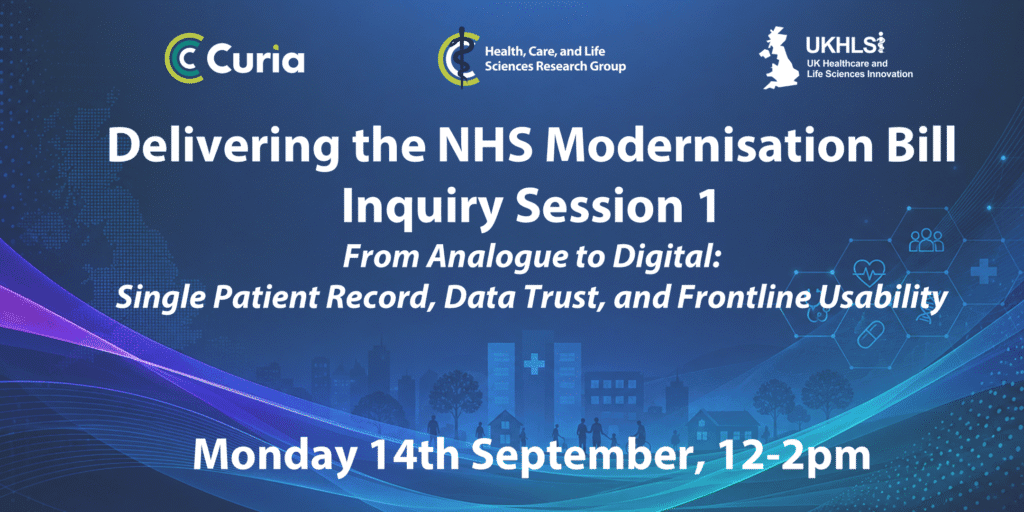
On Monday 14 September, UKHLSI and independent policy institute Curia will convene the programme’s From Analogue to Digital evidence session in Central London.
Chaired by Dr Mark Ratnarajah, with James Freed among those confirmed to contribute, the session will bring together healthcare leaders, clinicians, innovators and policy specialists to examine what needs to change if digital technology, data and AI are to become successfully embedded throughout NHS services.
The discussion will consider privacy and consent, cyber security, interoperability, accountability and public trust, alongside the practical usability of new technologies for staff and patients across primary, secondary, community and social care.
The session forms part of a wider UKHLSI programme examining how national NHS reform can be translated into practical implementation.
It will explore not only what new technology can do, but the conditions required for adoption: procurement reform, clinical confidence, effective governance, interoperable systems, workforce engagement and evidence that technologies genuinely improve patient outcomes or staff productivity.
For the new £100 million AI procurement scheme, that distinction will matter.
Backing UK companies to develop promising technology is one part of the equation. The longer-term test will be whether the NHS can create the procurement processes, infrastructure, governance and frontline conditions required to take technologies that work and adopt them responsibly at scale.
Find out more
The From Analogue to Digital NHS Modernisation Bill session takes place on Monday 14 September 2026, from 12pm to 2pm in Central London.
The session will examine privacy and consent, cyber security, interoperability, accountability, public trust and frontline usability as the NHS seeks to accelerate its shift from analogue to digital.
Evidence will consider how digital transformation can work across primary, secondary, community and social care, and what needs to change nationally and locally to move effective innovation from individual pilots into routine NHS delivery.
To find out more, contact Partnerships Director, Ben McDermott bmcdermott@ukhlsi.co.uk