

Catherine Thompson
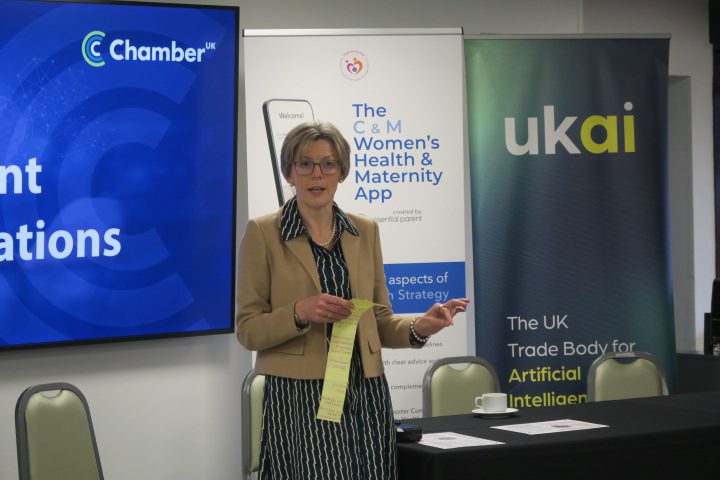
Former Associate Director of Clinical Policy, Strategy and IFR, West Yorkshire Health and Care Partnership (NHS ICBWomen’s health services have too often been organised around fragmented pathways, leaving women to navigate a system that does not reflect the full reality of their lives. Drawing on insights from the North of England Accelerating Innovation in the NHS Women’s Health Sprint, Catherine Thompson argues in the foreword of the report that the NHS already has examples of what works. The priority now is to move beyond pilots and embed community-based, life-course women’s health services as standard provision across the system. (Photo: Catherine Thompson presenting the sprint findings to the group in Barnsley)
Women’s health services do not need another exercise in describing what is wrong. The problems are well understood. Too many women still face fragmented care, long waits, inconsistent access, and a system that too often expects them to advocate for themselves before support is offered.
The more urgent question is whether the NHS is prepared to act on what it already knows.
That is the key message from Catherine Thompson’s foreword to Reframing Women’s Health: From Fragmentation To System Reform. Drawing on the North of England Accelerating Innovation in the NHS Women’s Health Sprint in Barnsley, Thompson makes the case that the challenge is no longer one of diagnosis, but delivery.
Across West Yorkshire and beyond, the system has already seen what better women’s health provision can look like. Community-based services, integrated pathways, and more holistic models of care are not abstract ideas. They exist and operate effectively in many parts of the country. They are already improving access, reducing pressure on secondary care, and giving women a clearer route to the support they need.
But there is a postcode lottery in service delivery – these examples remain too dependent on local leadership, local conditions, and local capacity. The result is a mixed picture, where pockets of excellence sit alongside areas where provision remains underdeveloped. For women, that means access to good care can still depend too heavily on where they live.
The gap in the middle
At the heart of the problem is a model of care that has not kept pace with need. Women’s health services are still too often organised around a binary structure: general practice on one side, secondary care on the other.
That leaves too little space in between.
Yet it is precisely this middle layer where much of the opportunity lies. It is where earlier intervention can happen. It is where continuity of care can be built. It is where women can receive support before conditions worsen, before hospital referral becomes necessary, and before avoidable distress becomes normalised.
For many women, the current system does not provide that route. Instead, they are passed between services, asked to repeat their story, or left waiting for care that could have been delivered sooner in a more joined-up community setting.
This is not just inefficient. It is unfair.
Women’s health is not only a clinical issue
One of the strongest arguments in Thompson’s foreword is that women’s health must be understood in its wider social context. The way women experience health is shaped not only by clinical symptoms, but by culture, stigma, trust, work, family responsibilities, and expectations about what is considered “normal”.
“The challenge is not identifying what works, it is all about implementing it consistently.” Catherine Thompson
For too long, women’s health has been reduced to a set of individual services or conditions. That approach misses the broader life-course reality: adolescence, menstrual health, reproductive health, pregnancy, menopause, later life, and the long-term impact of prevention or its absence.
Without a clear shared narrative of what good women’s health looks like, women themselves may not know when something is wrong or what support should be available. The system, in turn, struggles to design services around women’s lives rather than around institutional boundaries.
This is why awareness and empowerment are not optional extras – Thompson argues they are core parts of reform.
Women need clear, trusted information. Services need to be easier to access. Professionals need the confidence and structures to respond properly. And the system needs to stop treating women’s ability to self-advocate as a substitute for good design.
The answer is implementation
The Sprint highlighted two immediate priorities
- Empowerment and awareness. There remains significant unmet need, with many women unaware of what support should be available to them. Better education, clearer communication and stronger public confidence are essential if women are to engage with their health earlier and more effectively.
- Development of community-based services. Crucially, this is not primarily a workforce skills problem. The capability already exists across the NHS and wider system. The problem is that it is not organised cohesively enough.
Bringing that capability together into accessible, community-based models of care offers one of the clearest opportunities for improvement. It would support earlier intervention, reduce unnecessary referrals, improve patient experience and help shift women’s health from reactive care to prevention.
But this cannot be left to isolated pilots. The system has tested many of these approaches already, with significant data available. It was demonstrated at the sprint that women’s health services can work, the question is whether commissioning, funding, and national expectations will now support them to work everywhere.
From optional innovation to standard provision
The main report, Reframing Women’s Health: From Fragmentation To System Reform, argues that women’s health reform must move beyond fragmented services and towards a coherent, life-course model of care. Thompson’s foreword speaks directly to that central theme.
Local insight has shown what is possible. Women’s Health Hubs and community-based models demonstrate how care can be brought closer to women, organised around need, and delivered in a way that feels more accessible and joined up.
The task now is to make that the norm.
As was demonstrated in many places across West Yorkshire, that will require clear direction, appropriate resourcing, and stronger alignment between national policy, regional planning and local delivery. It will also require a shift in mindset: women’s health cannot be treated as a specialist side issue or a discretionary area of innovation. It must be seen as a core part of a modern health system.
The future direction is achievable. In many places, it has already been demonstrated.
What is needed now is the will to move from insight to implementation, from pilots to scale, and from optional innovation to standard provision.

To find out more about the UK Healthcare and Life Sciences Innovation Women’s Health Working Group, contact chair Paula.Sherriff@curiauk.com