
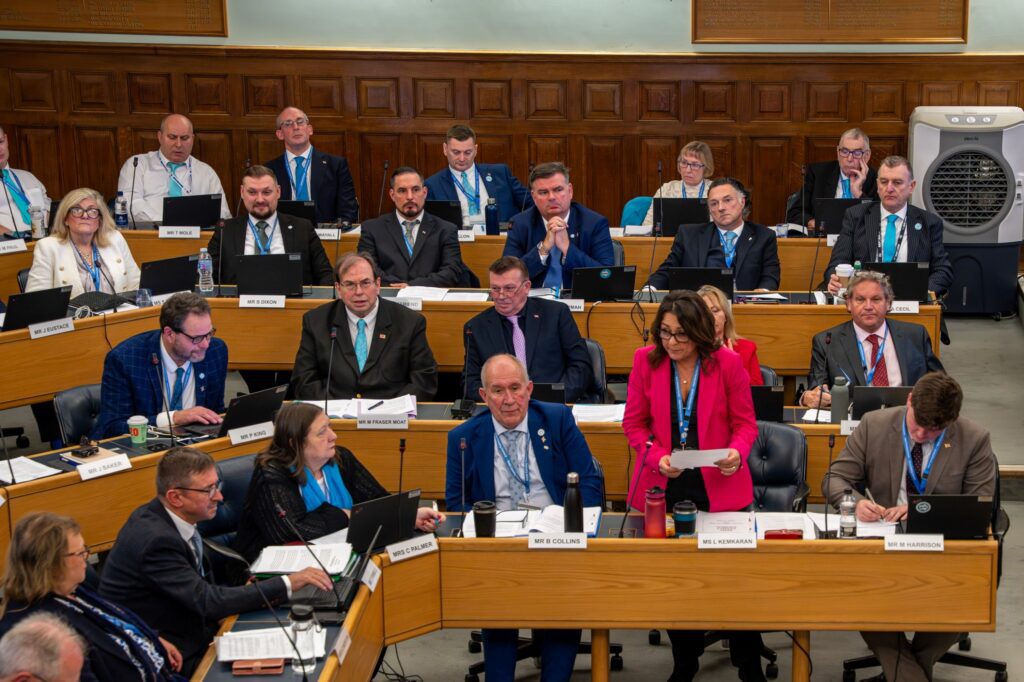

Linden Kemkaran
Leader of Kent County CouncilWith Reform and the Greens riding high in the polls, local government is faced with an influx of new councillors with little experience of power. In this article, Linden Kemkaran, Leader of Kent County Council, sets out what she thinks local government really needs from central government, the leadership lessons she has learned from the front line, and why Kent chose to raise council tax in its latest budget.
Leading a county council in today’s environment is not a theoretical exercise. It is not an abstract debate about governance models or fiscal frameworks. It is a daily test of judgment, responsibility, and leadership under sustained pressure.
For more than a decade, local government has been told to “do more with less”. At first, this was framed as a challenge to innovate. Over time, it became an expectation. Today, it has hardened into an assumption that councils can absorb rising demand indefinitely through efficiency alone.
Kent County Council is one of the largest local authorities in the country. We deliver services to more than 1.6 million residents, many of them statutory, many of them demand-led, and almost all of them under growing strain. Like other councils across England, we are dealing with rising costs in adult social care, children’s services, special educational needs, and temporary accommodation, while operating within a funding system that remains short-term, uncertain, and increasingly disconnected from reality.
Linden Kemkaran: Efficiency Has Limits
Efficiency has limits. Resilience has limits. And pretending otherwise does not protect public services, it quietly erodes them.
Local government does not need sympathy from Westminster. It needs honesty, trust, and reform.
One of the clearest lessons I have learned since becoming Leader is that the pressures facing councils are no longer cyclical. They are structural. Demand is rising faster than funding, and councils are too often left to absorb national policy decisions without the resources, flexibility, or timescales required to implement them properly. Announcements are made centrally, expectations are set publicly, and delivery is quietly delegated to local authorities already operating at the limits of resilience.
The uncomfortable truth is that the gap between responsibility and resource has widened year after year.
This is not a sustainable model.
Unsustainable
What local government needs from Westminster is not more initiatives, but a different relationship. Multi-year funding settlements would allow councils to plan responsibly rather than react defensively. Greater flexibility would enable local leaders to design services around local need rather than national prescription. Most importantly, there must be recognition that councils are delivery partners, not administrative outposts.
Leadership at local level matters more than ever, precisely because the margins are so tight. There is no room for complacency or delay. Decisions that might once have been deferred must now be confronted directly. That requires political courage, strong working relationships with officers, and a willingness to be honest with residents about the challenges we face.
In Kent, my focus has been on restoring grip and realism. That means understanding where pressures genuinely sit, challenging assumptions, and acting early rather than allowing risks to compound. It also means recognising that leadership is not about choosing the most politically convenient option, but the most responsible one.
That approach was tested most visibly during this year’s budget.
When we took office, plans were already in place for a 4.99 per cent council tax increase. That option was available to us. It would have been easy to accept it as inevitable, particularly given the scale of financial pressure councils are under. Many would have argued that taking the maximum allowed rise was the safest course.
We chose a different path.
We concluded that a 3.99 per cent increase was the correct course. That decision required discipline. It required confidence in our grip on the budget and a willingness to be held accountable for the choice we made.
This was not an attempt to minimise the seriousness of the council’s financial position, nor to pretend that pressures can be wished away. It was a conscious decision to demonstrate restraint, to recognise the cost pressures households are already facing and to show that local government can exercise judgment rather than default to the maximum permitted rise.
Social Responsibility
Leadership is often revealed in small but significant choices. In this case, it meant sending a clear signal that we would not automatically reach for the highest available option simply because it existed. It meant proving that financial discipline and social responsibility are not mutually exclusive.
The reality is that councils like Kent will continue to face profound challenges in the years ahead. But local government is not broken. What is broken is the framework within which it is expected to operate.
With the right support from Westminster, councils can be financially responsible, operationally innovative, and genuinely responsive to the communities they serve. Without it, even the best leadership will be forced into managing decline rather than delivering progress.
The choice facing central government is straightforward. Treat local government as a trusted partner in national renewal, or continue with a system that stores up risk and pushes difficult decisions further down the line.
From where I sit, leadership under pressure has taught me one thing above all else: local government does not lack capability or commitment. What it lacks is a system that matches the scale of the responsibility it carries.
This article features in the new edition of ChamberUK. Our parliamentary journal.
Photo Credit: Linden Kemkaran