


By Rt Hon Andrew Stephenson CBE
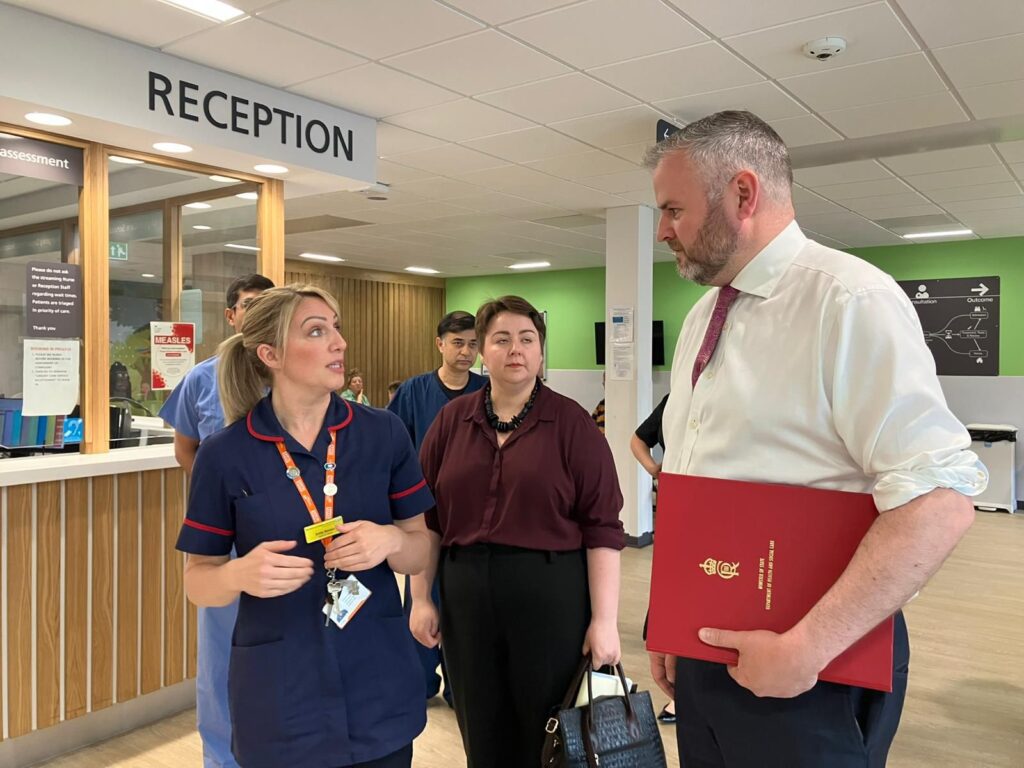
Former Minister of State for Health, Chair of University Hospitals of Morecambe Bay NHS Foundation Trust, and Chair, Curia, Health, Care, and Life Sciences Research GroupToday’s NHS reorganisation debate on the Health Bill is about far more than the abolition of NHS England. It is about who is accountable for the NHS, where decisions should be made, how patient data should be used, and whether structural reform can genuinely improve care at the front line. (Photo: As Minister of State for Health, Andrew Stephenson visiting frontline NHS staff)
The Government’s central argument is that the current division of responsibility between the Department of Health and Social Care (DHSC) and NHS England has created duplication, blurred accountability and too much distance between ministers and delivery. By abolishing NHS England and transferring functions into the Department or out to integrated care boards (ICBs), ministers believe they can create a clearer, leaner and more responsive system.
There is a case for simplification. Anyone who has worked in or around the NHS knows that the national architecture can be difficult to navigate. Lines of accountability are not always clear. Local leaders can find themselves answering to multiple national teams, while patients and the public understandably ask who is actually responsible when services fall short.
But the test of this Bill is not whether it creates a tidier organogram in Whitehall. The test is whether it helps patients get safer, faster and more joined-up care.
That is where the debate must focus.
NHS reform cannot become another distraction from delivery
The NHS is already under immense pressure. Waiting lists remain high, emergency departments face sustained demand, primary care is stretched and mental health services are seeing rising levels of need. Industrial action has left deep operational scars. NHS leaders are being asked to improve productivity, adopt new technology, shift care into the community, reduce health inequalities, and deliver better value for money.
Against that backdrop, another major reorganisation carries real risks. Structural change absorbs time, energy and leadership capacity. It unsettles staff. It can slow decisions. It can also lead to the loss of institutional knowledge at exactly the point when the system needs experience and clarity.
That does not mean the Bill should be dismissed. Some of its ambitions are right. But Parliament should scrutinise whether the legislation will make reform easier to deliver, or whether it risks becoming another distraction from delivery.
The abolition of NHS England is the headline measure, but it is also the most politically significant. NHS England has, since its creation, acted as a buffer between ministers and the operational NHS. Removing that buffer means ministers will have clearer democratic accountability. In principle, that is welcome. The public should be able to know who is responsible for the performance of the health service.
However, clearer accountability cuts both ways. Ministers will now own more of the system directly. With that comes not only power, but responsibility. If operational decisions become more closely tied to the political cycle, there is a danger that short-term pressures crowd out long-term reform.
Local leaders need real freedom, not just new responsibilities
The Bill also strengthens the role of ICBs as strategic commissioners, including through the formal transfer of primary care commissioning responsibilities. In theory, this should support more local decision making and better planning across primary, community, hospital, mental health and social care services.
That is the right direction of travel. The future of the NHS cannot be built around hospitals alone. If we are serious about prevention, earlier intervention and care closer to home, local systems need the tools to design services around population need.
Yet here too there is a tension. The Bill talks the language of localism, while also transferring substantial powers to the Secretary of State. ICBs may gain responsibilities, but they will also operate in a system where national direction, regulation and enforcement remain strong. The question is whether local leaders will have the practical freedom to act, or simply the formal responsibility to deliver decisions made elsewhere.
A single patient record could transform care, but only if public trust is earned
One of the most promising parts of the Bill is the proposal for a single patient record. For patients, this is long overdue. People are often surprised to discover that the NHS cannot always see their full medical history across different settings. A hospital consultant may not have access to the same information as a GP. Mental health, community, maternity and social care records can sit in separate systems. The result is duplication, frustration and, at times, avoidable risk.
A properly implemented single patient record could improve safety, reduce administrative burden and support more personalised care. It could help frail patients avoid repeating their story every time they meet a new professional. It could support better medicines management. It could make it easier for clinicians to see the whole picture rather than one fragment of it.
This is exactly the kind of reform the NHS needs. But it will only succeed if public trust is earned. Patients need to know who can access their information, for what purpose, and with what safeguards. Clinicians need confidence that systems will work in practice, not simply in Whitehall policy documents. General practice, in particular, will need reassurance about data controllership, confidentiality and liability.
The NHS has been here before. Digital reform can deliver enormous benefits, but only when it brings the public and professionals with it. Transparency, cybersecurity, audit trails, and clear consent arrangements will matter just as much as the technology itself.
Patient safety and patient voice must not be weakened
The Bill also proposes significant changes to patient safety and patient voice. Of all the measures in the Bill, the proposed transfer of Health Services Safety Investigations Body functions into the Care Quality Commission is one of the areas that should cause the greatest concern. I understand the argument for simplifying the patient safety landscape, and there is merit in ensuring that recommendations lead to action. But HSSIB was created for a specific purpose: to conduct independent, learning-focused investigations into serious patient safety risks. That independence matters.
There is a real danger that merging HSSIB into the CQC could blur the distinction between investigation and regulation. Patients, families and NHS staff need confidence that when something goes wrong, there is a body able to investigate openly and without the perception that its work is being shaped by the priorities of a regulator. Safe, honest learning depends on trust. If staff fear that a learning investigation is too closely linked to enforcement, the system risks becoming more defensive rather than more transparent.
This is not a minor technical concern. It goes to the heart of how the NHS learns from failure. Parliament should therefore examine this proposal in detail and test whether the safeguards in the Bill are strong enough to preserve the independence, credibility and culture of HSSIB’s work. If ministers want to improve patient safety, they must be able to show that this change will strengthen independent investigation, not dilute it.
The abolition of Healthwatch raises similar questions. The Government argues that patient voice will be brought closer to decision making through a new patient experience directorate and local duties on ICBs and local authorities. That may work, but only if it preserves genuine independence and challenge. Patient voice should not become another internal feedback mechanism. It must remain capable of telling the system uncomfortable truths.
The Bill must be judged by outcomes, not structures
There are also important changes to foundation trusts and financial accountability. The Bill moves away from collective system balance and towards clearer accountability for individual organisations. There is logic in ensuring that boards are responsible for the money they spend. But the NHS increasingly depends on organisations working together across pathways. Financial rules must not unintentionally make collaboration harder.
The wider question is whether this Bill supports the Government’s stated ambition to move care from hospital to community, from analogue to digital, and from sickness to prevention. Those aims are broadly right. They are also not new. Successive governments have recognised the need to prevent ill health, strengthen primary care, integrate services and use technology better.
The challenge has always been delivery.
For this legislation to succeed, ministers must show that the transition will be managed carefully, that local systems will not be overwhelmed, and that reform will be judged by improvements in outcomes rather than changes in structure.
The NHS does not need reform for reform’s sake. It needs reform that frees staff to deliver. It needs digital systems that reduce workload rather than add to it. It needs local leaders who are trusted to make decisions and national accountability without constant central interference. Above all, it needs a relentless focus on improving patient outcomes.
Today’s debate should therefore be the start of serious scrutiny, not a contest of slogans. Abolishing NHS England may prove to be the right decision if it simplifies accountability and supports faster improvement. But if it continues to be another disruptive reorganisation, the opportunity will be lost.
The Health Bill is ambitious and necessary. But the Government must now prove that it is not simply moving boxes around the system.
It must prove that this reform will help patients.