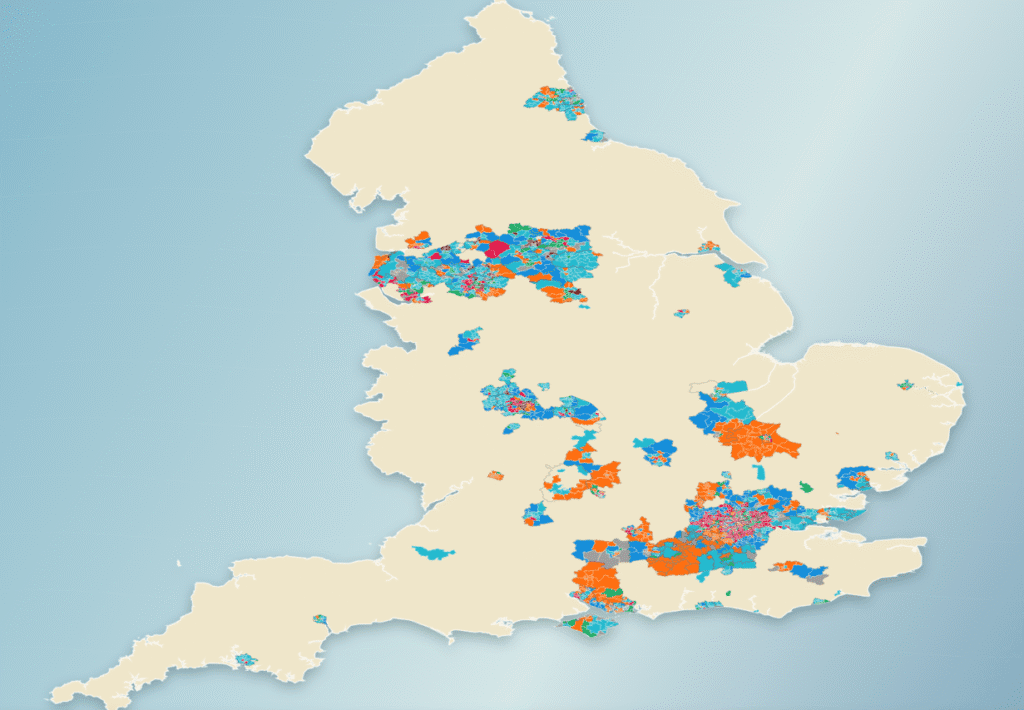

View the interactive map in full: https://politicsuk.com/election-map-2026/
Reform: a second wave
If the model is right, Reform UK will repeat and consolidate last year’s breakthrough performance, winning more English council seats than any other party and doing so across a remarkably broad geography. The projection, built from ward-level vote-share modelling covering all 136 English councils holding elections, puts Reform on 1,580 seats on a central estimate. The reason is straightforward: Reform are polling somewhere between five and twelve points clear of every other party, and that kind of lead translates into gains almost everywhere outside of inner urban cores and highly-educated university towns, the two environments where their brand has consistently struggled to travel. In many ways tonight looks like a repeat of last year, only with a slightly sharper edge. Reform’s base is broadly similar and their polling is at a comparable level, but Labour and the Conservatives have both slipped back a little further, which means Reform’s advantage over their nearest rivals is wider than it was twelve months ago. There is genuine uncertainty about the scale of the night, as there always is in local elections, but the direction of travel looks about as settled as these things get. Reform are going to win, and they are going to win clearly.
| PARTY | PROJECTED SEATS | VOTE SHARE |
| ● Reform UK | 1,580 | 25.5% |
| ● Liberal Democrats | 950 | 15.1% |
| ● Labour | 941 | 18.1% |
| ● Conservatives | 572 | 16.9% |
| ● Greens | 503 | 16.0% |
| ● Independents | 213 | 4.7% |
| ● Muslim Independents | 208 | 2.5% |
How bad a night is this for Labour?
The projection suggests the government’s worst fears may just be avoided, but only just. With so many marginal wards on a knife edge, a swing of a few points in either direction could dramatically change Labour’s final tally. What the MRP polling from More in Common, YouGov and JL Partners does suggest is that Labour is holding on slightly better in wealthier, more educated, more urban areas, which means their inner London core should largely survive the night. Places like Camden and Southwark look set to remain Labour, insulated by the kind of graduate-heavy, metropolitan electorate that has drifted toward the party in recent years even as their broader coalition has frayed.
But elsewhere, the picture is far grimmer. Across much of the so-called red wall, Labour is braced for heavy losses, with seats in places like Tamworth and Wigan, which once formed the bedrock of their English local government presence, looking set to fall. In younger, slightly less affluent parts of London, the student-heavy, renting-class boroughs, the Greens are continuing to eat into Labour’s vote, a reflection of a generational and cultural shift that shows little sign of reversing. And then there are the Muslim Independent candidates, whose rise at local and by-elections has already cost Labour dearly and who this model projects to win 208 seats, gains carved almost entirely out of Labour’s former strongholds in towns with large Muslim-majority wards. Labour, in short, is being squeezed from every direction at once: Reform to their left-behind working-class flank, the Greens to their progressive urban one, and Muslim Independents in the communities where the fallout from Gaza has been most politically acute. The question tonight is not whether Labour loses, they will, but whether the losses are merely painful or something closer to catastrophic.
The Greens: will high expectations be met?
Tell a Green supporter ten years ago that their party would be winning 500 council seats in a single local election and they would have been euphoric. Today, that same number lands differently. The projection puts the Greens on 503 seats, which would be the highest seat total in the party’s history, a genuinely remarkable milestone by any measure, yet the mood going into tonight is one of cautious rather than confident optimism. The reasons are twofold. First, the Green coalition has been built substantially on young and intermittently engaged voters, and these are precisely the people least likely to show up for a local election, a stark contrast to five years ago when their support base was comparatively more civically engaged. Second, they are still polling fractionally behind Labour nationally, which in a first-past-the-post system creates an outsized vulnerability: votes piled up in the wrong wards simply do not convert. The momentum that drove their recent surge has also visibly slowed, and Zack Polanski’s popularity figures have taken a significant hit following his widely-criticised comments about the officer who apprehended an antisemitic attacker, an episode that dented his carefully cultivated image at an awkward moment. There are reasons the Greens could outperform: dissatisfaction with the Labour government remains high and the pollsters who have consistently rated them well may yet prove to have had the sounder methodology. But on a night when a record-breaking 500 seats should feel like a triumph, the risk is that expectations, quietly and perhaps unfairly, end up dampening a genuinely historic result.
The Liberal Democrats: steady as she goes
The Liberal Democrats are projected to finish in a near-dead heat with Labour for second place, and for a party that has spent years quietly rebuilding its local government base, that alone is a statement. Their strategy tonight is essentially the same one that has served them well for the past decade: pile up votes where they are already strong, hold what they have, and make incremental gains in the constituencies they captured from the Conservatives at the 2024 general election. Those new parliamentary footholds give them a platform to expand their local presence, and some modest gains in those areas are baked into the projection. There is not a great deal of drama in the Lib Dem story tonight, no existential threat, no spectacular breakthrough, just the steady, unglamorous accumulation of council seats that has become their trademark. Sometimes the most telling political story is the one that does not need telling.
The Conservatives: decline, but not devastation
The Conservatives are heading into tonight polling significantly worse than they were at the 2022 local elections and marginally worse than 2024, and the seat losses will reflect that, with most of them going directly to Reform. A projection of 572 seats would have been unthinkable as a floor not long ago. And yet, strange as it sounds, expectation management may be the Conservatives’ unlikely friend tonight. It was not so long ago that whispers of Kemi Badenoch’s imminent departure were circulating freely in Conservative circles, with the next election being cited as a near-certain terminus. Since then, the party’s vote share has stabilised, not recovered, but stabilised, and that modest achievement has been enough to quiet the loudest internal critics and give the leader of the opposition a degree of security she did not previously enjoy. Losing hundreds of seats is, by any objective measure, a bad night. But in the context of where this party has been and what was being said about it twelve months ago, it may not feel like one.
How certain is this?
Local elections are notoriously hard to model. Turnout is low and variable, candidate quality matters enormously at ward level, and national polling can misread the local picture in ways that only become clear on the night. This projection should be treated as a central estimate, not a guaranteed outcome.
| METHODOLOGY NOTE To quantify uncertainty, the model was run through 10,000 Monte Carlo simulations, each varying ward-level vote shares around the central forecast. The resulting 90% confidence intervals are wide: Reform’s seat range runs from 1,245 to 1,878, Labour’s from 600 to 1,366. The central projection is the headline figure; the ranges reflect genuine uncertainty about how the national picture translates to individual wards on the night. |
What the model is more confident about is the broad shape of the result: Reform finishing first, a close fight for second between Labour and the Liberal Democrats, and the Conservatives continuing their retreat from English local government. On those broad strokes, the uncertainty bands all point the same way.
Results will begin coming in from Thursday night. By Friday morning, we will know whether 2026 confirmed Reform’s local government breakthrough, or whether the polls, once again, had a story to tell that the models missed.
DATA SOURCES
This projection draws on data from a number of public sources. Candidate and party standing data was sourced from Democracy Club. Ward and council boundary data was provided by the Local Government Boundary Commission for England (LGBCE). Demographic and population estimates were drawn from the Office for National Statistics (ONS). National polling and MRP estimates referenced throughout are from More in Common, YouGov and JL Partners. Electoral geography was cross-referenced against ONS boundary products.