

Partner content: This event was sponsored by autonomous pothole detection, prevention, and repair technology company, Robotiz3d.
Continuing to rely on reactive maintenance is no longer a sustainable way to address the UK’s pothole problem. The parliamentary reception for National Pothole Day, organised by Chamber UK and sponsored by UK road technology company Robotiz3d, focused on how emerging technologies could help prevent potholes forming by identifying and treating early signs of road deterioration.
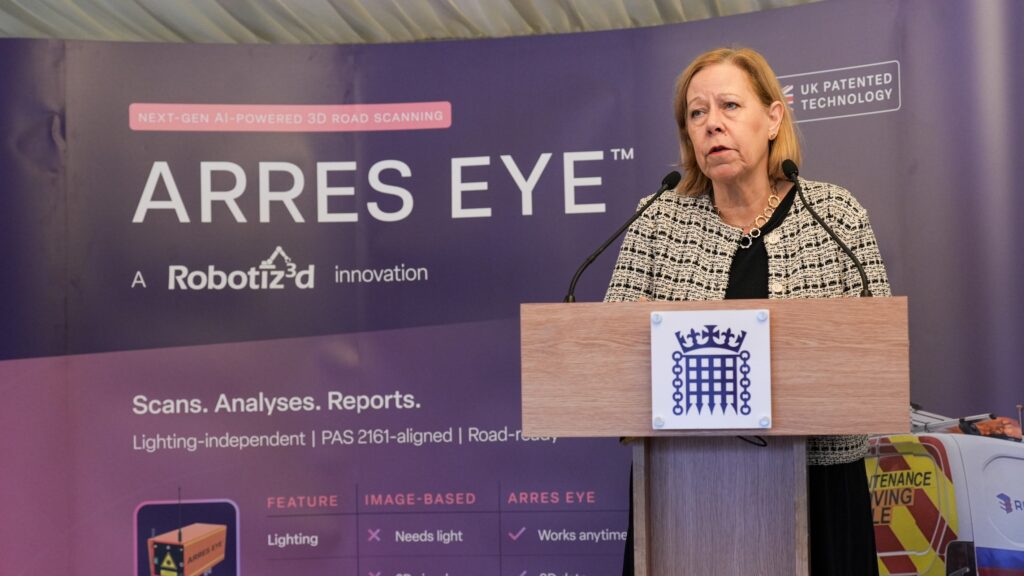
Chaired by former Minister of State at the Department for Transport, Andrew Stephenson, the event brought together parliamentarians, local government experience and industry expertise, alongside a live demonstration of artificial intelligence enabled road scanning and autonomous crack sealing technology.
From Constituency Complaints to National Policy
Opening the event, Stephenson framed potholes as a visible and widely felt symptom of wider challenges in how roads are funded, inspected and maintained.
“It is great to be bringing innovation once again to the Palace of Westminster to showcase a real game changing technology.”
Rt Hon Andrew Stephenson CBE, former Minister of State, Department for Transport
Drawing on his experience as a former transport minister, Stephenson positioned the reception as part of a broader effort to bring policymakers, delivery bodies and innovators together around solutions that can deliver longer term improvements rather than repeated short-term repairs.

That theme was taken up by Ruth Cadbury MP, Chair of the Transport Select Committee, who delivered the keynote address before returning to parliamentary business.
Cadbury outlined the scale of the pothole challenge and its impact on road users, freight operators, local economies and public confidence in local infrastructure. Potholes, she noted, are one of the most immediate ways in which people experience the condition of public services.
“I think we all feel a bit let down when we are in our community… when all we see, whether we are walking or driving, is potholes.”
Ruth Cadbury MP, Chair, Transport Select Committee
Drawing on her 25 years as a councillor in Hounslow, Cadbury gave a candid assessment of the financial pressures facing highway authorities. With statutory obligations to fund adult and children’s social care, she explained, highways budgets have been repeatedly squeezed, leaving councils reliant on patching rather than full resurfacing.
Funding, Fixes and the Limits of Annual Budgets
Cadbury acknowledged that government funding for highways is now at record levels, with £7.3 billion committed over the next four years and an additional £1.5 billion this financial year. New transparency measures, including RAG ratings for local authority road condition, are intended to improve accountability.
However, she was clear that funding alone will not resolve the problem if it continues to be spent reactively.
“Again and again, local authorities are patching up rather than having the funds to resurface.”
One of the strongest points in her remarks focused on the impact of utility street works. Poor quality reinstatement after roadworks, she argued, remains a significant contributor to premature road failure. The Transport Select Committee has recommended longer reinstatement guarantees, ideally five years, with penalties where repairs fail early.
Scotland’s tougher reinstatement regime was cited as an example England could learn from, reinforcing the need for stronger standards alongside new approaches to maintenance.
Why MPs Care So Much About Potholes
If Cadbury set out the national policy context, Alex Mayer MP, Member of Parliament for Dunstable and Leighton Buzzard and event sponsor, spoke from the perspective of constituency experience.
Potholes, she said, are among the most common issues raised by constituents across the country.
“Going around the constituency felt like walking on the surface of the moon.”

Mayer described potholes as both a local quality of life issue and a nationally significant infrastructure challenge, making them a clear test case for how practical innovation can deliver visible benefits for communities.
She welcomed the focus on prevention rather than repeated repair, noting that investment is increasingly being directed towards stopping potholes forming in the first place.
“This event combines one of my favourite subjects now, potholes, with what everyone is talking about, artificial intelligence.”
Alex Mayer MP, Member of Parliament for Dunstable and Leighton Buzzard
Her remarks reflected a wider question raised during the reception: can new technologies help move beyond incremental improvement towards more lasting change?
A Prevention First Approach to Roads
That question sat at the centre of the presentation from Lisa Layzell, Co Founder and Chief Executive Officer of Robotiz3d. A spin out from the University of Liverpool, Robotiz3d develops AI driven systems designed to support prevention led road maintenance.
Layzell described roads as critical national assets but argued that existing inspection and maintenance approaches remain largely reactive, with limited data available to support early intervention.
“The way we manage roads remains largely reactive. We wait for problems to appear, then we scramble to fix them.”
Lisa Layzell, Co Founder and Chief Executive Officer, Robotiz3d
Robotiz3d’s RSI platform uses automated 3D sensing and artificial intelligence to provide detailed, objective data on road condition, including defect depth, severity and progression. This enables highway authorities to identify emerging issues earlier and target maintenance more effectively.
Layzell also introduced ARRES PREVENT, the company’s autonomous crack sealing system. Almost every pothole, she explained, begins as a crack.
“Around seventy five per cent of cracks, if not treated, evolve into potholes within two to three years.”

By sealing cracks early, ARRES PREVENT aims to extend road lifespan by up to ten years, reducing long term costs and disruption for road users.
From Data to Decisions on the M25
The application of AI enabled road intelligence on live networks was illustrated by Shanmeng Wei, Asset Investment Manager at Connect Plus, operator of the M25 on behalf of National Highways.
On a network as complex and heavily trafficked as the M25, Wei explained, the challenge is not identifying defects but quantifying them in a way that supports sound asset management decisions.
“Planning decisions rely heavily on engineering judgement, with inherent uncertainty.”
Early deployment of Robotiz3d’s scanning technology has already begun to change those conversations by enabling more objective assessments of defect severity and deterioration.
Wei emphasised that artificial intelligence supports, rather than replaces, professional judgement.
“AI strengthens the evidence base. It does not replace engineering judgement.”
Instead, it provides a clearer foundation for decisions on timing, scope and value for money.

Collaboration Beyond the Technology
A consistent theme throughout the reception was that technology alone is not enough. Layzell emphasised the importance of collaboration between government, industry and academia, alongside policy and regulatory frameworks that can support the deployment of autonomous systems on public roads.
She closed by acknowledging the customers and partners involved in developing and trialling the technology across UK road networks.

From the Moon’s Surface to Preventive Maintenance
Potholes remain a familiar frustration for road users and a persistent challenge for policymakers. However, the technologies demonstrated at the reception pointed towards a different approach – one based on better data, early intervention and prevention led maintenance.
National Pothole Day, often associated with backlogs and short-term fixes, instead provided an opportunity to focus on practical solutions already being developed and deployed, and how they could be scaled to improve the condition of the UK’s road network.
To find out more about Robotiz3d, visit www.robotiz3d.com.