
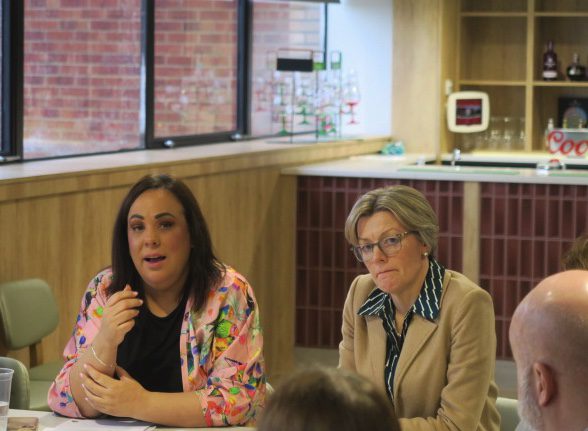

Paula Sherriff
DesignationThis op-ed draws on Paula Sherriff’s foreword and the wider findings of Reframing Women’s Health: From Fragmentation To System Reform, which identifies women’s health as a cross-societal issue affecting outcomes, workforce participation, productivity, and wider public service demand. The report highlights persistent fragmentation, over-reliance on the GP-to-secondary-care model, uneven community provision, postcode variation, and the need to move from pilots to implementation.
Having worked in and around health policy for many years, I know it remains all too common for women’s health to be treated as a specialist concern within the NHS. Something important, yes, but too often seen as peripheral to the main business of the health system.
That framing is wrong.
Women’s health is not a niche issue. It is a cross-societal challenge that shapes individual outcomes, workforce participation, economic productivity, family wellbeing, and the resilience of public services. When women are not supported to access timely, appropriate, and trusted care, the effects do not stop with the individual. They are felt by households, employers, communities, and the wider economy.
That is why women’s health must be understood not only as a clinical priority, but as socio-economic infrastructure. It is part of the foundation on which a healthy, productive, and fair society depends.
The cost of inaction is already visible. Women aged 45 to 64 are the fastest-growing segment of the UK workforce, yet many are reducing their hours or leaving work because of unmanaged menopause symptoms, untreated gynaecological conditions, and long waits for care. These are not isolated personal struggles. They represent lost productivity, lost income, increased pressure on families and greater demand on already stretched public services.
A welcome strategy, but delivery must follow
The Government’s renewed Women’s Health Strategy is a welcome step. Its focus on women’s voices, care closer to home, pathway redesign and greater accountability marks important progress. It recognises that too many women have been left navigating a system that does not listen early enough, respond consistently enough, or provide support in the right place at the right time.
But strategy alone is not reform.
The challenge now is implementation. Where is the delivery plan? Where are the milestones? Who is accountable for progress? How will Government assess whether the ambitions set out in the strategy are being met in practice?
Women have heard warm words before. The test now is whether those words are translated into consistent services, sustained funding and measurable improvements in access, experience, and outcomes.
Fragmentation is designed into the system
One of the clearest findings from the Women’s Health Sprint was that fragmentation is not accidental. It is built into the way services are organised and commissioned.
Sexual and reproductive health, general practice, community services, and specialist care are too often separated by organisational boundaries. For women, the result is duplication, delay, and frustration. Many are bounced between services. Conditions worsen while they wait. Those already facing barriers because of income, language, geography, or previous poor experiences are pushed even further from the support they need.
The current model still relies too heavily on a binary route between general practice and secondary care. For many women’s health needs, that is simply not enough. There is a missing layer in the middle: accessible, community-based services that can provide earlier intervention, continuity, and joined-up support.
This is where reform must now focus.
We need a life-course approach
There is also a more fundamental problem in how women’s health is defined. Too often, it is reduced to reproductive or gynaecological services. Those services are essential, but women’s health is much broader than that.
It spans adolescence and menstrual health, contraception and fertility, pregnancy and postnatal care, menopause, cardiovascular health, mental health, healthy ageing, and later-life conditions. The NHS still lacks a clear, shared, and operational understanding of what good women’s health looks like across the whole life-course.
Without that, too much unmet need remains invisible. Many women do not know that what they are experiencing is not something they simply have to tolerate. Others know something is wrong but face a system that makes it too difficult to find the right support.
A life-course approach cannot sit as a slogan in a strategy document. It must shape commissioning, workforce training, prevention, diagnostics, digital tools, and community pathways.
Community care is where reform becomes real
There are already examples of what works. Women’s Health Hubs and other community-based models show that care can be brought closer to women, delivered more holistically, and organised around need rather than institutional boundaries.
Where implemented well, these models can reduce waiting times, improve access, support prevention, and make better use of the existing workforce. They can also build trust by creating services that feel more accessible, less intimidating, and more responsive to the realities of women’s lives.
But access remains uneven. Too often, whether a woman benefits from integrated community-based care depends on where she lives. That is unacceptable.
We do not need endless pilots that prove the same point again and again. We need implementation at scale. Proven models should move from optional innovation to standard provision.
Trust, dignity, and culture matter
The Sprint also reinforced something that women have known for far too long: services are not only shaped by pathways and funding, but by culture.
Women’s health is bound up with stigma, trust, trauma, communication, and lived experience. Too many women have had symptoms dismissed, pain minimised, or concerns normalised when they should have been investigated. Too many have encountered services that do not feel designed for them.
The renewed strategy’s emphasis on listening to women is therefore important. But listening must lead to change. Dignity, informed consent, pain management, cultural competence, and trauma-informed practice must be embedded across women’s health services, not treated as optional extras.
The workforce already holds enormous skill and commitment. The problem is not a lack of dedication. It is that capability is too often poorly coordinated, inconsistently supported and constrained by structures that make joined-up care harder than it should be.
From ambition to accountability
The central message from the report is simple: this is not an innovation problem. It is a system design and adoption problem.
There is no shortage of evidence, ideas, or passion for reform. What is missing is delivery, accountability, and the political will to treat women’s health as a core priority.
The Government should now publish a clear implementation framework for the renewed Women’s Health Strategy, with named responsibilities, timelines, and measurable outcomes. It should support integrated care boards to scale neighbourhood women’s health services, reform payment models so community care becomes the rational choice and use transparent data to reduce geographical variation.
It should also ensure women’s voices are not simply gathered but acted upon. Patient experience and outcomes must be measured consistently and used to drive improvement.
The renewed strategy is an opportunity. But it will only matter if women see change in the services they use, the waits they face, the information they receive and the way they are treated.
Women’s health has been under-prioritised for too long. The evidence is clear. The models exist. The case for reform has been made.
The question now is whether we are prepared to deliver it.

You can still get a copy of our new edition of ChamberUK. Our parliamentary journal.