
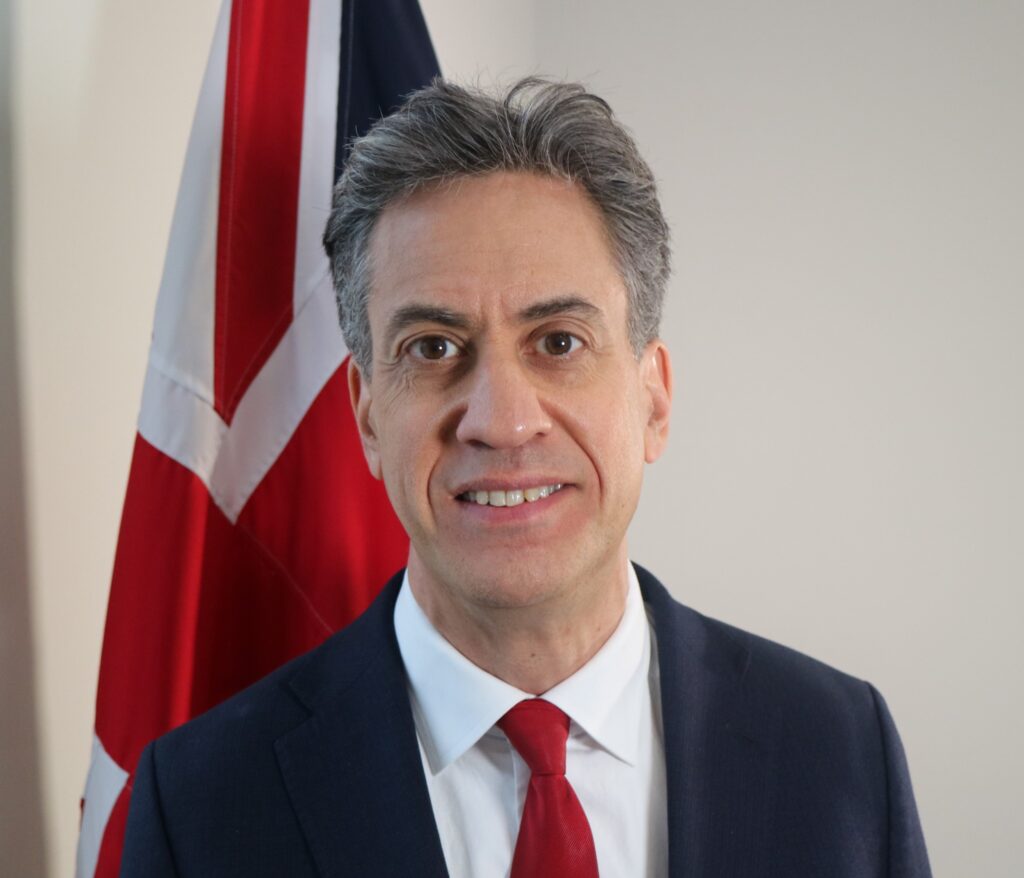
UK Energy Strategy: In an interview with Politics UK, Energy Security and Net Zero Secretary, Ed Miliband argued that the UK must break free from volatile fossil fuel markets, defending the £15 billion Warm Homes Plan as a key strategy to cut energy bills, tackle the cost of living crisis, and deliver long term energy security through clean power.
The Secretary of State for Energy and Net Zero, Ed Miliband, has defended the Government’s £15 billion Warm Homes Plan, arguing that it forms a central part of the Government’s response to the cost-of-living crisis and the UK’s long-term energy security.
Speaking to Politics UK correspondent, Oliver Harries, Miliband outlined how the Government intends to bring down household energy bills while accelerating the transition to domestic clean energy.
Cutting Energy Bills
Miliband framed the Government’s energy policy primarily as a response to the pressures facing households across the UK.
“What I would say is that the cost-of-living crisis is the biggest issue facing the country and we want to do the right thing for the country,” he said.
The Energy Secretary highlighted immediate relief measures, including a £150 reduction in household energy bills scheduled for April. This, he explained, is part of a wider effort to tackle affordability while investing in long-term energy solutions.
“We’re taking £150 of costs off bills in April,” Miliband said, adding that the Government also plans to reduce bills by up to £300 by 2030.
The Warm Homes Plan aims to improve energy efficiency in millions of homes through measures such as better insulation, upgraded rental standards, and support for technologies including heat pumps and solar panels.
Support for Millions of Households
When asked whether most households would benefit directly from the programme, Miliband acknowledged that the initial rollout would focus on around five million homes.
However, he emphasised that the scheme would remain open to broader participation.
“Everyone can be eligible. Anyone can take up these opportunities of the grants or the loans,” he said, stressing that households will be able to choose whether to participate.
The Government hopes these upgrades will reduce long-term energy demand and provide more stable bills for households.
UK Energy Strategy and Clean Power
Miliband also linked the Government’s energy strategy to wider geopolitical instability, particularly volatility in global fossil fuel markets.
“At the moment we are subject to that roller coaster of fossil fuel markets controlled by the petro states and dictators and shaped by geopolitical events,” he said.
Instead, he argued, the UK should focus on expanding domestic clean energy generation.
“Much better to have homegrown clean power that we control,” he added.
He pointed to new offshore wind developments that could provide electricity for around 12 million homes as evidence of the Government’s long-term approach to energy security.
Climate and Environmental Protection
During the interview, Harries raised concerns about potential environmental impacts linked to renewable energy infrastructure projects.
Miliband responded by emphasising the broader environmental context of the energy transition.
“The biggest threat to the natural environment is climate change,” he said, arguing that the shift to clean energy is essential both for reducing emissions and protecting ecosystems.
Delivering Government Policy
On questions about government delivery and the role of the Civil Service, Miliband rejected suggestions that bureaucracy had slowed progress on energy reforms.
“I’m really proud of my relationship with the Civil Service and I’m proud of what we’ve achieved in this department over the last 18 months,” he said.
He pointed to achievements including record offshore wind auctions, new energy projects capable of powering millions of homes, and the establishment of Great British Energy.
The Challenge of High Bills
Miliband acknowledged that energy costs remain a major concern for households but argued that the Government is committed to bringing them down.
“Bills are too high,” he said. “That’s why we made the pledge to reduce bills by up to £300 by 2030.”
For the Energy Secretary, the strategy is about combining short-term relief with structural changes to the UK’s energy system.
“We are determined to do that because we know the cost-of-living crisis facing people and we want to do everything we can to tackle it,” he said.

This article features in the new edition of ChamberUK. Our parliamentary journal.
Photo Credit: Politics UK