
24th February will mark the fourth anniversary of Russia’s “special military operation” in Ukraine. With over 600,000 Ukrainian and 1.2 million Russian casualties (more than any major power since World War Two), the conflict has held a vice grip over global politics since its outbreak in early 2022.
Supported by allies China, Iran, North Korea, and Belarus, Russia has maintained their army primarily through foreign funding: producing arms, armoured vehicles, and other supplies through these means. The result of this has been a major strain placed upon both the Ukrainian army and the nation’s civilian population: with Ukraine only managing to meet 60 percent of its national electricity demand by January 2026, resulting in nationwide blackouts (particularly in Kyiv).
While this has certainly served to lower national morale within the former Soviet republic, Russia’s façade of strength and military domination appears to be crumbling.
Key Moments
The most divisive conflict throughout the entire campaign remains the war’s opening clash at Antonov Airport: lasting from the first day of the operation to 25 February 2022. As Russian forces aimed to utilise Blitzkrieg tactics to capture the airport (a major strategic landmark), the army faced major complications in landing their own heavy transport aircraft, as a result of Ukraine’s 4th National Guard Regiment’s efforts to surround the Russian forces and damage the runways. While Russia eventually succeeded, holding the base until April the same year, the damage sustained by the runways prevented a major aerial advantage for the Russian forces, destroying chances of successful routes into the capital.
28 February 2022, four days after President Putin’s announcement of a Russian invasion, the first rocket attacks were launched in Ukraine’s second largest city, Kharkiv (located in the northeastern part of the country), killing at least nine civilians and wounding over forty. This first spark of the conflict marked a distinct precedent for the “operation”, and was shortly followed by an intensified military effort by Russian forces on the capital, Kyiv.
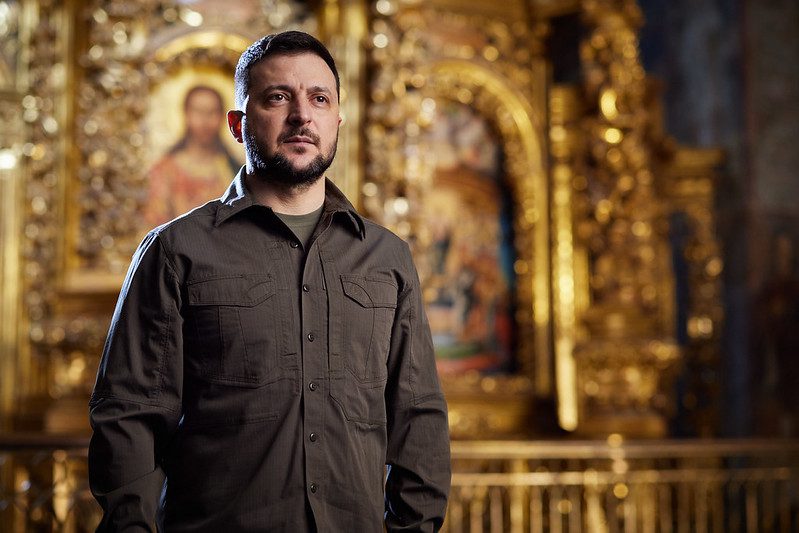
Image: President Zelenskyy delivering an Easter address amid the conflict with Russia – President of Ukraine
The Zaporizhzhia Nuclear Power Plant Crisis has also remained a significant strategic threat since early on in the conflict, with a fire breaking out on 3 March as a result of a persistent shelling campaign by Russian forces. While all six of the plant’s reactors remain in a state of “cold shutdown” for the safety of both the staff and the local civilian population, the site remains a stronghold for occupying Russian units, and has overseen constant bombardment (primarily in the form of drone attacks and shelling) from both parties.
Not only has the Zaporizhzhia occupation caused both logistical and strategic issues for the Ukrainian army, but also legal concerns, with the proximity of the fighting to the plant raising questions of whether the operation classifies as nuclear terrorism.
A combination of both smaller skirmishes and major operations have been the make-up of the war from this point onwards- with significant sieges (such as Mariupol) granting the Russian army grand advantages in terms of access to Crimea and the Donbas in the form of land bridges. On the contrary, counter-offensives remained the focal point of Ukrainian combat until 2023, with the Kharkiv Lightning Strike in September liberating over 6,000 kilometers of occupied territory in a matter of days (including major cities Izium and Kupiansk).
In the later months of 2022, Russia declared the annexation of four Ukrainian regions (Donetsk, Luhansk, Kherson, and Zaporizhzhia), however this was widely internationally rejected.
2023 saw an overarching stalemate, a significant contrast to the ever-changing nature of the conflict in 2022. While more major campaigns (such as the Battle of Bakhmut, lasting from August 2022 to May 2023) resulted in severe human losses for the Russian army, events like the Nova Kakhovka Dam Collapse in the summer of 2023 caused almost equally severe destruction in Ukraine.
Following their successful campaigns to drive Ukrainian forces out of Kursk in 2024, the Russian army appears to have significantly slowed down in their advancement into Ukrainian territory: advancing only 15-70 meters a day in their most successful offences. Making progress at a slower rate than the allies in the Battle of the Somme, it is clear to see that the insurgent force is struggling in achieving their strategic goals. Managing to seize just shy of 12 per cent of the nation, and remaining in control of 20% of it, it is easy to understand why after four years of total war Moscow is beginning to lose its morale.
War Crimes
With the International Criminal Court opening emergency investigations into the legality of the invasion as early 2 March 2022, and the International Court of Justice following exactly two weeks later by questioning the lack of evidence of the Kremlin’s justification for the war, there has been a severe concern regarding the criminal nature of the conflict from the very beginning.
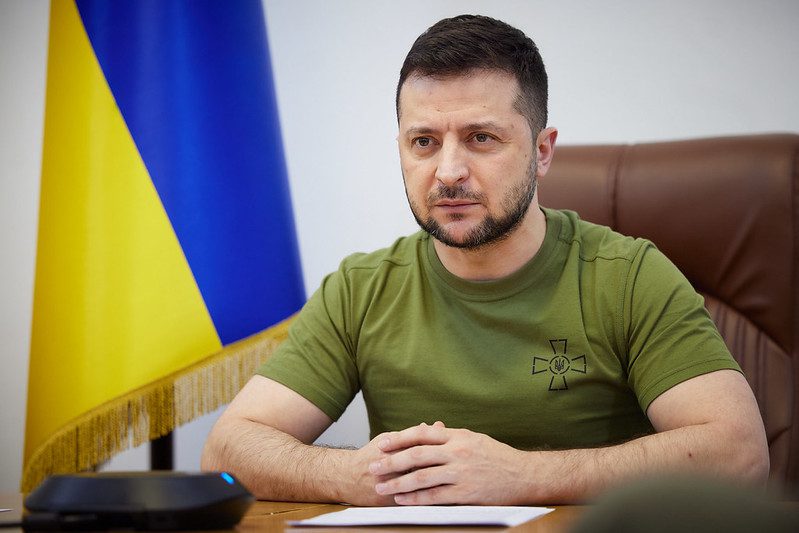
Image: President Zelenskyy addresses the Israeli Knesset amid the conflict with Russia – President of Ukraine
A major turning point in this regard was the tragic discovery of mass graves in several Ukrainian towns (most notably Bucha, Irpin, Izyum, Lyman, Kherson, and Mariupol) as early as April 2022. Not only are these graves suggestive of massacres having taken place nationwide, but also a violation of both international humanitarian law and the Geneva conventions’ Additional Protocol I.
Evidence of “filtration camps” has also been presented, where Ukrainian civilians and soldiers are interrogated illegal methods (such as sexual violence, abduction, forced relocation, starvation, and torture). Over 91 per cent of civilian detainees held by the Russian Federation have described themselves as being treated in this way. The desired outcome of these method appears to be in order to remove those believed to pose a threat to Russian control.
Similar experiences are also reported by both Russian and Ukrainian prisoners of war, with the most significant controversy regarding prisoner of war camp housing remaining the death of an estimated figure of 50 Ukrainian prisoners taken during their defence of Mariupol. While Russian forces have claimed that this tragedy was the result of a Ukrainian missile strike, many observers have suggested that the disaster was most likely caused by Russian authorities.
As of 17 March 2023, the International Criminal Court has issued an arrest warrant for Russian President Putin.
NATO reaction
Since 2014, following Russia’s annexation of Crimea, NATO has remained in full support of both Ukraine’s territorial integrity and national sovereignty, “condemn(ing) Russia’s brutal and unprovoked war of aggression against Ukraine in the strongest possible terms.”
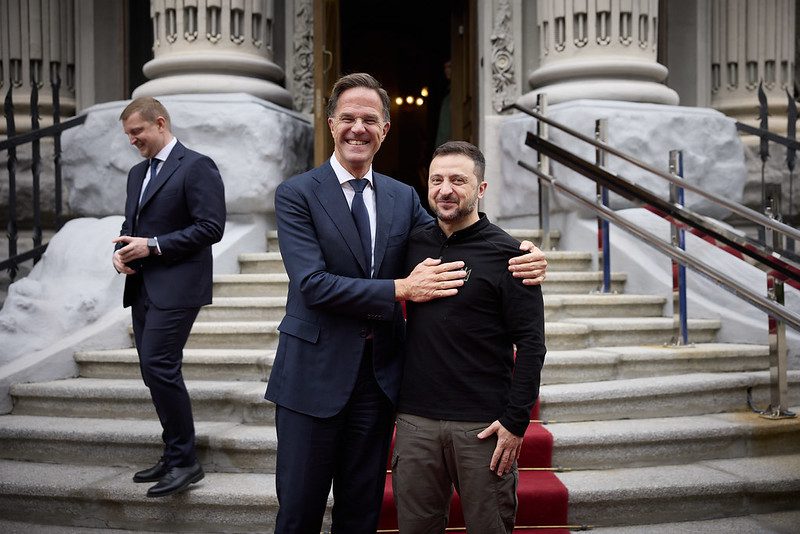
Image: President Zelenskyy and NATO Secretary-General Mark Rutte meet at the NATO Washington Summit – The President of Ukraine
In response to this policy, allies of the Organisation have consistently provided the nation with military assistance, delivering on billions of Euros worth of supplies, training, and weapons.
Not only has NATO assisted in funding Ukrainian efforts, but the European Union has remained the country’s largest provider of financial and humanitarian support. Offering over €100 billion of aid, as well as €70 billion of military support, and €17 billion in support for refugees.
Global Impact
Soaring food prices across Europe, triggering energy shocks and power outages, accelerating inflation, and forcing major shifts in European energy dependency, the Russian invasion of Ukraine has placed the continent and its alliances under significant economic strain. As well as this, allies of Ukraine have enacted widespread sanctions upon Russian companies, particularly energy providers, which in turn has placed major strain on the continent (as well as straining Russia’s own war economy).
Aside from the financial impact of the conflict, over 3.7 million people continue to be displaced across Ukraine. While 4.4 million people have returned from their displacement since 2022, the intensifying nature of campaigns in winter months (particularly those closer to the Eastern border) have disrupted efforts.
Recent Developments
On 19 November 2025, a 28-point peace plan was revealed, drafted in peace talks between the United States and Russia. January 2026 saw the three nations (Ukraine, Russia, and the United States) hold trilateral peace talks for the first time since 2022, further signifying a diplomatic effort between all three nations to end the war.
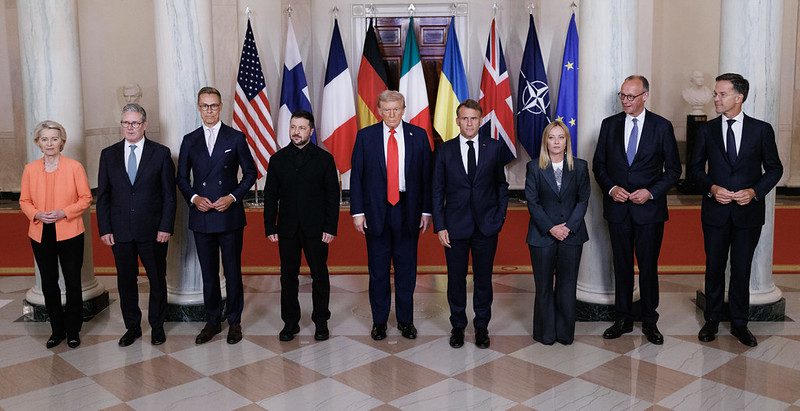
Image: Prime Minister Keir Starmer meets Ukraine President, Volodymyr Zelenskyy, Italian Prime Minister Giorgia Meloni, Alexander Stubb, President of Finland, Mark Rutte, Secretary General of NATO and Ursula von der Leyen, President of the European Commission ahead of a meeting with US President Donald Trump – No 10 Downing Street / Simon Dawson
However, while these peace talks have occurred between the nations’ respective correspondents in both Geneva and Abu Dhabi, ‘total war’ remains ongoing in Ukraine, raising concerns regarding the progress made in these meetings.
Where we stand now
As of February 2026, data is beginning to suggest that Russia is hardly maintaining an upper hand, with a struggling army and a war economy that is grinding to a halt. The early failings of Blitzkrieg tactics have left Russia fighting a war of attrition which it is unable to maintain, and this can be seen in the slowing of Russian advancement alone. Gaining less than 1.5 per cent of further Ukrainian territory since the start of 2024, the lack of an adequate war economy is clearly the factor which is slowing progress.
Not only has Russia failed to generate any breakthroughs in the Ukrainian front line within any of its last two years of offensives, but a major decline in popular support within Russia itself can be blamed at least in part for the fatigue the country appears to be facing (with a majority of 55 per cent of Russians believing that at least one person in their social circle opposes the war).
While terms of national security for Ukraine are beginning to be finalised, territorial distribution remains the heart of debate between the two parties, remaining unsolved despite the numerous meetings held to date. Despite two rounds of trilateral talks between American, Ukrainian, and Russian representatives, there still is yet to appear a resolution to this ongoing debate.
Until territorial gains are agreed, it is likely that a peace deal will remain unsigned, leaving the Russian invasion of Ukraine a distinct lack of a timeline for its resolution, and keeping both nations under a state of duress for the foreseeable future.
Featured Image via President of Ukraine