


Henry Snowdon
Politics UK – Polling and Data EditorThere are few political principles quite as sincerely held as the ones that happen to be electorally convenient.
That is especially true of electoral reform. But is it true of the new Proportional Representation Amendment?
Under our current first-past-the-post system, winning parties will often receive a larger share of seats in Parliament than their share of the national vote. Proportional representation seeks to make each party’s share of seats reflect its share of the vote more closely.
It should therefore come as no surprise that parties disadvantaged by our existing voting system tend to discover that it represents an intolerable affront to democracy, while parties benefiting from it generally conclude that it provides strong and stable government. Occasionally, electoral circumstances change and, through what must be a remarkable coincidence, their constitutional principles change with them.
The ascension of Andy Burnham to Prime Minister has brought the question of electoral reform back to Westminster. Burnham has supported proportional representation since at least 2021, repeatedly calling for Labour to put the proposal in a general election manifesto. His position today is broadly unchanged. While still a supporter of PR, he maintains that he will not change the voting system without first securing an electoral mandate through a firm manifesto commitment. To his credit, that is a fairly honourable and democratic position. Nevertheless, a large group of his own MPs have decided that waiting patiently is overrated.
Labour MP Alex Sobel has tabled an amendment requiring the government to report on the feasibility of establishing an independent National Commission on Electoral Reform. If established, the commission would review the system used for Commons elections and could recommend reforms before the next general election. At the time of writing, the amendment is backed by 176 MPs, including 87 MPs elected for Labour in 2024.
The pattern of supporting PR out of electoral self-interest is already well established at party level. Sobel’s amendment gave me an opportunity to examine whether the same pattern extends to individual MPs. Before turning to the numbers, two examples show just how familiar it is.
A Proud History
1979-1997 saw eighteen straight years of Conservative Party rule with each Tory victory during this period built on parliamentary majorities produced from minorities of the popular vote. Unsurprisingly, calls for electoral reform within the Labour Party began to grow during this period. After all, such disproportionate outcomes were continually blighting British democracy. Labour therefore entered the 1997 election promising a referendum on the system used to elect the Commons and an independent commission to find an appropriate voting system. After Labour won that election with a massive majority, the promised commission duly arrived, produced its report and was rewarded with the traditional fate of inconvenient commission proposals: being ignored. The promised referendum never happened.
Reform offers a more recent example. UKIP, the Brexit Party and Reform, all led by Nigel Farage, have spent years supporting proportional representation while winning millions of votes and almost no seats. Reform’s 2024 manifesto again promised a referendum on replacing first-past-the-post. Since then, its polling position has improved to the point where the same system could conceivably deliver the party a parliamentary majority. References to PR have disappeared from Reform’s current policy platform, and its chairman, Zia Yusuf, has declared that the party is now “firmly in favour of first-past-the-post.”
The parties occupy very different parts of the political spectrum. Their constitutional principles have shown a remarkably similar sensitivity to electoral arithmetic.
So the question is, are Labour MPs with small majorities, i.e. those that are most at risk from first-past-the-post and most likely to improve their careers after a change in electoral system, more likely to support a change than those in safe seats who are enjoying the unearned safety with which the current system rewards them?
Testing The Theory
To test the relationship between electoral self-interest and support for PR among Labour MPs, I looked at all 411 MPs elected for Labour in 2024 and compared those who signed Sobel’s amendment with those who did not. Electoral security was measured by the percentage-point gap between each MP and the second-placed candidate.
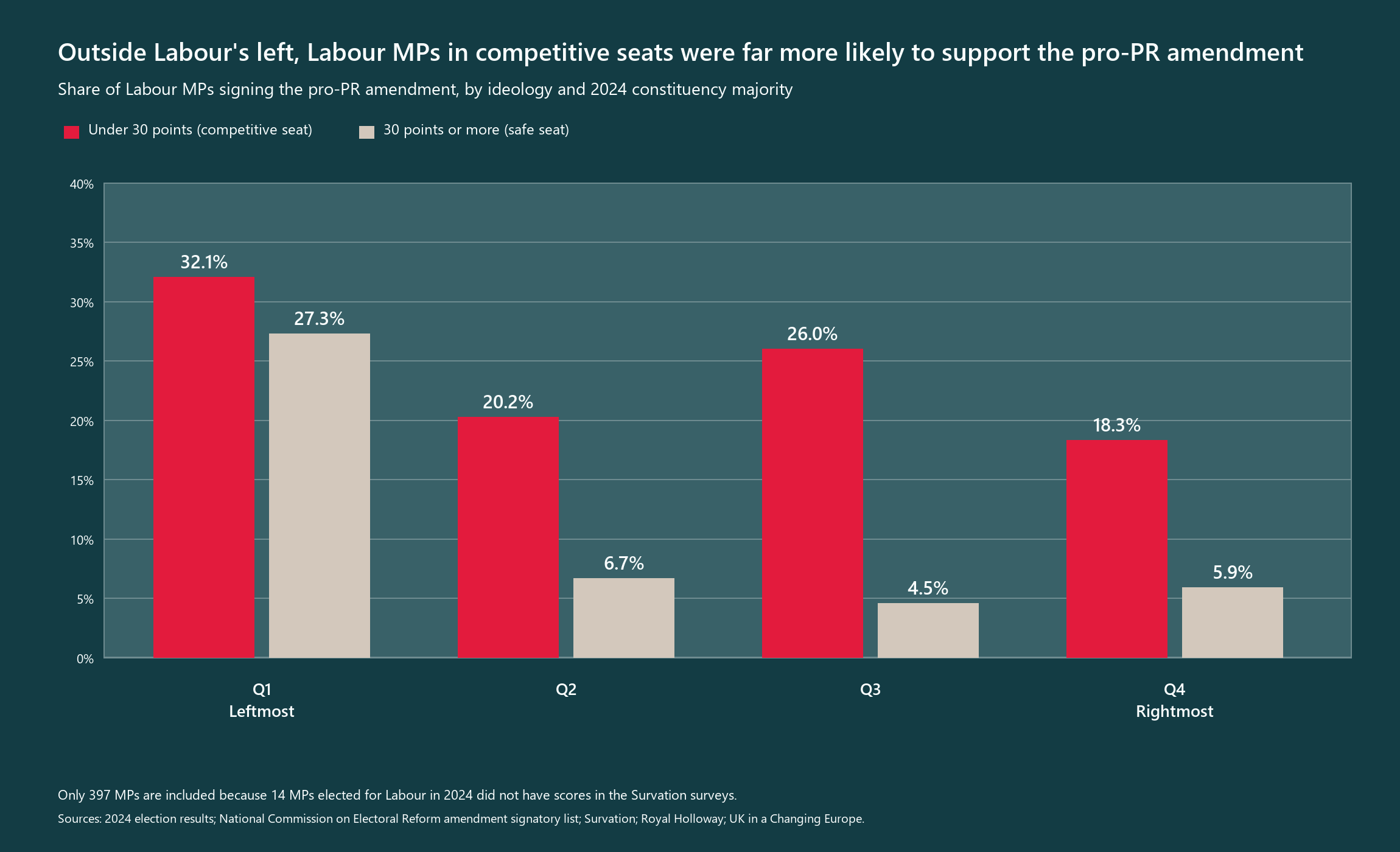
The initial results point in the expected direction. Signatories had an average majority of 16.5 percentage points, compared with 19.4 points among non-signatories. There was a small but statistically significant linear relationship between majority size and signing, with support becoming less likely as majorities increased.
The difference becomes clearer when a 30-point majority is used as the benchmark for a very safe seat. This broadly separates MPs who might reasonably worry about losing their seats at the next election from those who can afford to sleep rather more soundly. Among Labour MPs below that threshold, 78 out of 333 signed the amendment, or 23.4 per cent. Among those with majorities of 30 points or more, only nine out of 78 signed, or 11.5 per cent. Labour MPs outside the safest seats were therefore roughly twice as likely to support the amendment.
Proportional Representation Amendment – Accounting For Ideology
Electoral insecurity appears an even stronger influence on support for PR once ideology is taken into account. In modern Labour politics, support for PR has generally been stronger on the party’s left. When I divided the signatories by ideological position, left-wing MPs were heavily overrepresented among those signing from seats with majorities above 30 points. The same imbalance was not present to anything like the same degree among signers below the threshold. This made me wonder whether the effect of electoral security differed according to an MP’s ideology.
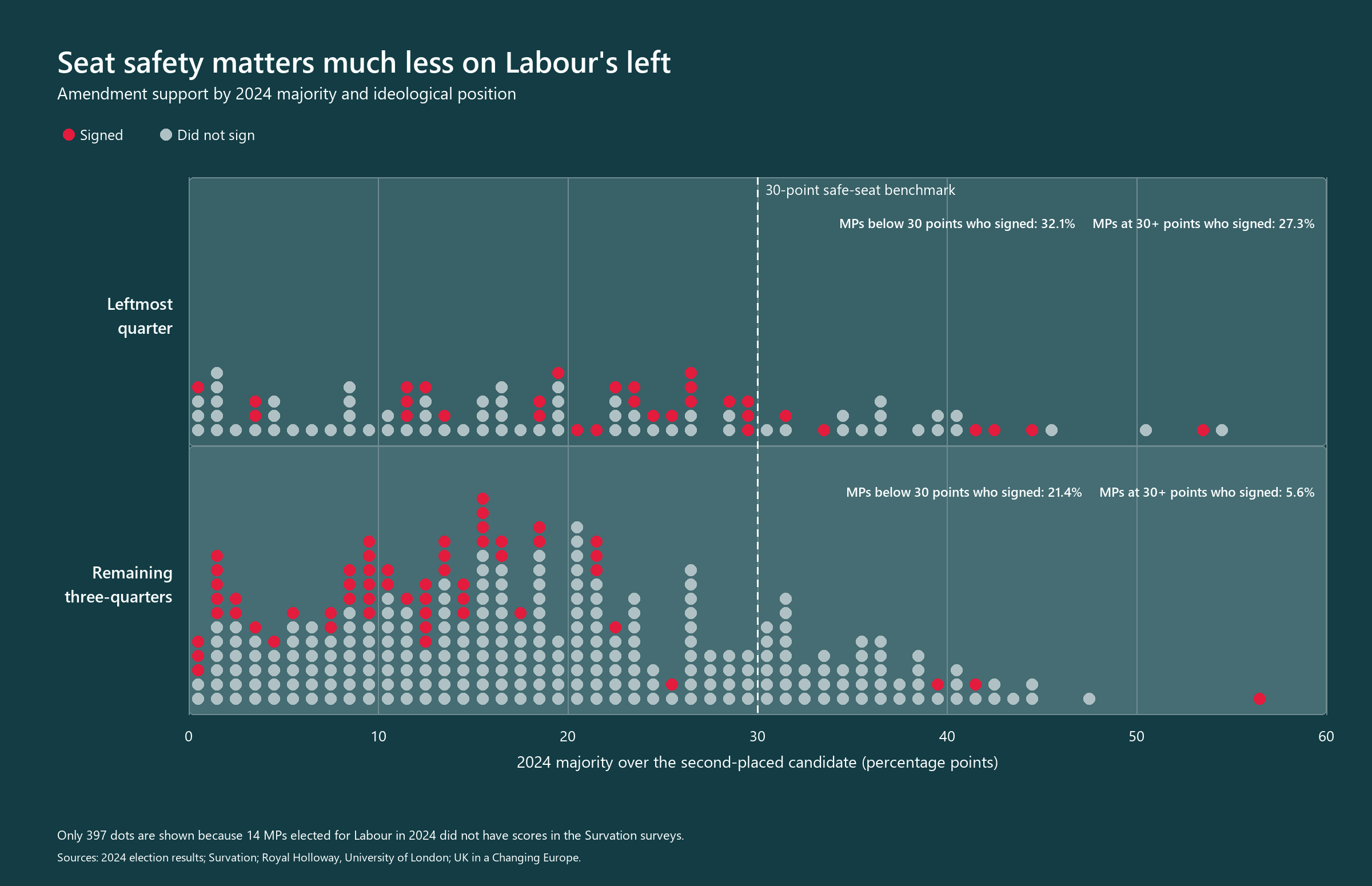
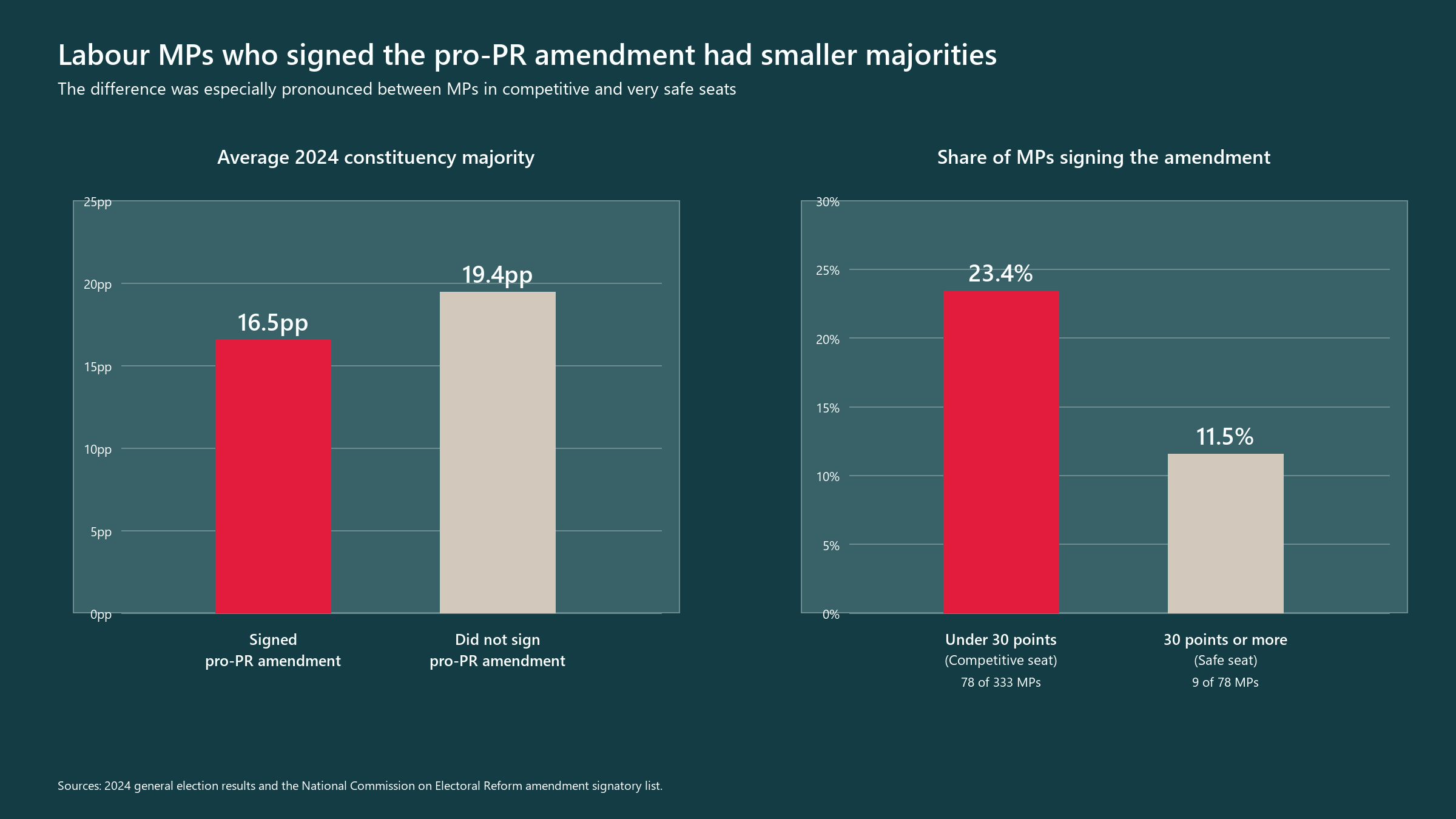
To test this, I matched 397 Labour MPs with left-right estimates produced from two Survation surveys of local councillors for Royal Holloway, University of London and UK in a Changing Europe. Councillors were asked to compare MPs’ ideological positions in pairs, with the results used to place them on a scale from zero for the most left-wing to 100 for the most right-wing. I then used these scores to divide Labour MPs into ideological quartiles, from the leftmost 25 per cent to the rightmost 25 per cent, and found a striking difference in how electoral security affected different ideological segments of the Labour Party.
Among the leftmost quarter of Labour MPs, 32.1 per cent of those below the 30-point threshold signed the pro-PR amendment, compared with 27.3 per cent of those above it. Among the remaining three-quarters of the party, the corresponding figures were 21.4 per cent and just 5.6 per cent. This suggests that, for the left of the Labour Party, electoral self-interest, by and large, really isn’t a driving factor behind support for PR, while elsewhere in the party, enthusiasm for reform is considerably easier to find among MPs with something to fear from first-past-the-post.
What The Results Show
While nothing in this data proves with absolute certainty that most of the MPs who publicly support PR have only done so after receiving deeply upsetting polling data, the wider pattern of Labour MPs in competitive seats publicly supporting electoral reform at much higher rates is difficult to dismiss.
Electoral self-interest is not the only plausible explanation. MPs in marginal seats may differ in their willingness to openly support PR for a myriad of different reasons, and this analysis did not test the many alternative explanations. Likewise, it is not the case that the signatories to the amendment were the only MPs within the party who support electoral reform, as polling data reported by LabourList shows that an electoral reform commission is supported by most of the PLP. Nevertheless, there is an obvious logic to politicians supporting policies that serve their electoral interests, and the pattern of signatures appears to support that logic.
Conclusion
Finally, I want to end on the moral implications of these results. While I have my own views on proportional representation, I don’t believe that debate is relevant to this analysis. My concern here is the process by which politicians seek to change the rules under which they themselves compete.
I care deeply about democracy, and when support for changing electoral rules varies according to how safely politicians are treated by the existing ones, scepticism is justified. Political principles are always more convincing when they survive electoral convenience.