
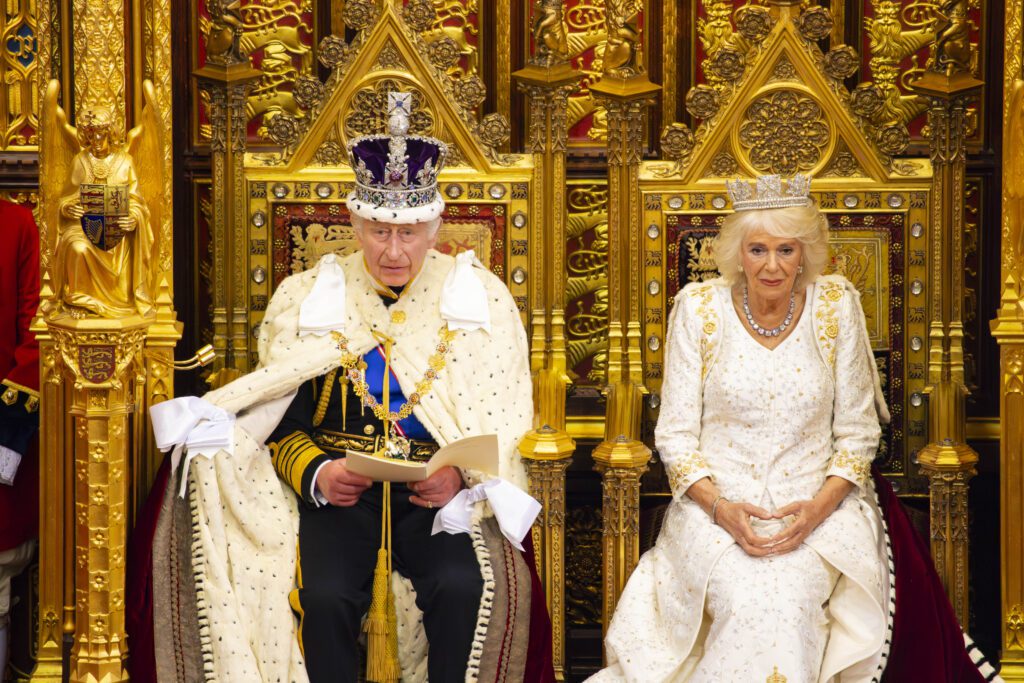
Sir Keir Starmer’s second King’s Speech was an attempt to impose order on a moment of acute political instability.
Opening against the backdrop of conflict in the Middle East, war in Ukraine and wider global volatility, the speech placed security at the heart of the Government’s next phase. Energy security, defence security, economic security, border security, cyber security, housing security, and institutional security were all woven into one larger argument: that Britain needs a more active, capable and interventionist state.
That framing matters because Starmer is under pressure on several fronts. Labour’s recent election setbacks have sharpened internal unease, while Reform UK, the Greens and the Liberal Democrats are all applying pressure to Labour’s electoral coalition.
Starmer now faces calls from around 90 Labour MPs and several junior ministers to resign following poor local election results, even as he insisted the Government must continue with its reform agenda.
Polling has added to the pressure. YouGov’s latest Westminster voting intention poll, conducted on 10 and 11 May, put Reform UK on 28%, the Conservatives on 17%, the Greens on 16%, Labour on 16% and the Liberal Democrats on 13%. The Institute for Government has also argued that the 2026 elections underline the continued fracturing of British politics, describing it as a phenomenon that is “here to stay”.
That is the political context in which this King’s Speech lands. It is both a governing programme and a rescue operation: a bid to show that Labour still has direction, purpose, and the ability to deliver visible change.
Security becomes the organising idea
The most important feature of the speech was the strength of its security framing.
The King opened by warning that an “increasingly dangerous and volatile world” threatens the United Kingdom, with every element of the nation’s energy, defence, and economic security set to be tested. The speech then returned to this theme repeatedly, using security as the thread connecting foreign policy, infrastructure, borders, energy, steel, housing, cyber threats, and public services.
This was clearly deliberate. Starmer is trying to move beyond a narrow domestic policy agenda and present Labour as the party of national resilience. Economic growth, public service reform, stronger borders, energy independence, and technological capability were presented not as separate missions, but as parts of one national security project.
Politically, this gives Labour a clearer answer to Reform UK’s attack line on control and decline. Starmer’s argument is that the answer to instability is not disruption, but a stronger state working with business, communities, and public institutions.
The risk is that voters may not wait patiently for long-term reform. Security is ultimately judged by experience: whether bills fall, whether wages rise, whether public services improve, whether borders feel controlled and whether communities feel safer.
The active state returns
The speech also made explicit what has often been implicit in Starmer’s political project: this is a government that wants to use the state to shape markets, not merely regulate them from the sidelines.
The King said ministers would use public investment to shape markets, attract private investment, and deploy the power of an active state in partnership with business. That is one of the most important lines in the speech for Chamber UK readers.
It signals a governing approach that is neither old-style nationalisation by default nor a return to laissez-faire. Instead, the Government is trying to build a model in which public investment, regulation, infrastructure, and industrial policy are used to crowd in private capital.
That approach runs through several announcements: legislation to tackle late payments, reduce unnecessary regulation through innovation, improve trading relations with the European Union, unlock airport expansion, accelerate roads including the Lower Thames Crossing, deliver Northern Powerhouse Rail and safeguard domestic steel production.
For business, if the Government can provide regulatory certainty, speed up infrastructure and create stronger investment conditions, The King’s Speech could support growth. But the challenge is equally clear: businesses will judge the programme not by ambition, but by whether the state becomes easier to navigate.
Infrastructure, energy, and industrial resilience
The speech gave infrastructure a much more prominent role than the initial press release suggested. Airport expansion, road building, the Lower Thames Crossing and Northern Powerhouse Rail were all named directly.
That matters because infrastructure is one of the clearest tests of whether the Government can turn its growth mission into practical delivery. Britain’s long-standing problems with planning, grid connections, transport capacity, and regional connectivity have acted as a brake on investment.
The commitment to Northern Powerhouse Rail is also politically significant. Labour needs to rebuild credibility in parts of the North where Reform UK is now competing aggressively. Delivering a “fair deal for the North of England” is therefore not just a transport pledge; it is part of Labour’s attempt to hold together its electoral map.
The Energy Independence Bill sits within the same frame. The speech links clean, homegrown energy directly to national security, arguing that energy independence is essential if Britain is to protect living standards and reduce exposure to hostile actors and volatile international markets.
For Labour, this is an attempt to reframe Net Zero. Rather than presenting clean energy only as a climate policy, the Government is making it an affordability, sovereignty, and resilience policy.
That could be politically powerful. But delivery will depend on whether ministers can overcome the practical obstacles that repeatedly slow energy projects: planning delays, grid capacity, community consent, supply chains, skills, and financing.
Digital ID, AI, and the technology state
The speech also confirmed that the Government will proceed with digital ID, presented as a way to modernise how citizens interact with public services.
This is important because digital ID sits at the intersection of public service reform, productivity, trust, and technology adoption. Done well, it could make government simpler, faster, and more accessible. Done badly, it could deepen public concern about privacy, exclusion, and state overreach.
This is also where the wider artificial intelligence (AI) agenda becomes relevant. The King’s Speech did not make AI the headline issue, but its focus on productivity, digital government, cyber security, public service reform, and national capability creates a clear opening for AI adoption.
Tim Flagg, Chief Executive of UKAI, said:
“Today’s King’s Speech rightly recognises that economic security, national resilience, and technological capability are now deeply connected. If the UK is serious about growth, public service reform and national security, AI must be treated as core infrastructure, not a side issue.
The Government now needs to move from ambition to implementation by creating the conditions for responsible AI adoption across the economy, supporting businesses to scale, and ensuring the UK has the compute, skills and regulatory confidence needed to lead internationally.”
That is the central technology test for the Government. Digital ID, cyber resilience, and public service productivity cannot be treated as isolated reforms. They are part of the same question: whether Britain can build a modern state capable of using technology safely, responsibly and at scale.
NHS reform and the adoption challenge
Public service reform was another major theme. The speech referred to significant reforms in the police, the NHS, and the criminal justice system, with legislation expected to reduce bureaucracy, improve patient care, and support earlier intervention.
This is politically essential for Starmer. The NHS remains one of the most visible tests of whether Labour can deliver. Waiting lists, workforce pressure, access to primary care and delayed adoption of innovation are all felt directly by voters.
Jo Bekis, Chief Executive of UK Healthcare and Life Sciences Innovation, said:
“The Government’s focus on NHS reform, early intervention and reducing bureaucracy is welcome, but the test will be whether this legislative programme helps innovation reach patients faster. Across the health and life sciences sector, we see outstanding technologies, diagnostics and care models that could improve outcomes and ease pressure on services, and improve patients’ lives, but too many still struggle to move beyond pilots. If ministers want a more preventative, productive NHS, they must make adoption, procurement, and pathway redesign central to reform.”
That point goes to the heart of the NHS challenge. Reform cannot only mean structural change inside Whitehall or NHS England. It must mean changing how innovation reaches patients, how procurement works, how evidence is assessed and how new models of care are adopted across integrated care systems.
Schools, trust, and housing security
The speech also placed education reform within the wider security agenda. The Government promised a Bill to raise school standards and introduce generational reforms to the special educational needs system.
This is one of the areas where political ambition will meet severe delivery constraints. Special educational needs and disabilities provision is under major pressure, with families often facing long waits, inconsistent support, and adversarial processes. Reforming the system will require more than legislation. It will require funding, workforce capacity, local authority stability, school support and better coordination across health, education, and care.
The speech also linked public trust to collective security. The Government will introduce the Hillsborough Law, creating a new duty of candour for public servants, alongside legislation to enable peerages to be removed and proposals to strengthen delivery, accountability, innovation, and productivity in the civil service.
That is politically important. Starmer’s original appeal was built around competence, seriousness, and integrity after years of turbulence in Westminster. By linking public trust to national resilience, the Government is trying to show that standards in public life are not a side issue, but a foundation of effective government.
Housing also received a stronger place than in the initial briefing. The King described housing as a source of insecurity and confirmed legislation to increase long-term investment in social housing, reform the leasehold system and cap ground rents. The speech also included a Bill to speed up remediation for people living in homes with unsafe cladding.
This widens the Government’s security argument into everyday life. For households, security is not only about borders or defence. It is about whether people have a safe, affordable, and stable home.
What was missing – and where the opposition will attack
For all the breadth of The King’s Speech, the omissions are politically important too.
The most obvious is the absence of a dedicated Welfare Reform Bill. The speech does refer to the Government responding to the Milburn Review and the Timms Review and says ministers will continue to reform the welfare system so that young and disabled people can flourish in work. But that is not the same as bringing forward a flagship piece of welfare legislation.
That creates a political vulnerability for Starmer. Welfare sits at the centre of several pressures facing the Government including rising economic inactivity, sickness and disability benefit spending, Labour backbench concern about cuts, and opposition demands for tougher action.
The Conservatives have already identified this as an attack line. Their alternative King’s Speech included a Welfare Reform Bill, alongside measures on tax, bureaucracy, energy, borders, crime, and defence. The Conservative welfare proposals included reinstating the two-child benefit cap in full and restricting some Personal Independence Payment eligibility.
There is also a wider Conservative critique that Starmer’s programme is too cautious on borders, energy and law and order. Reports of the Conservative alternative programme included leaving the European Convention on Human Rights, repealing the Human Rights Act, expanding stop and search, and resuming North Sea drilling.
From the Liberal Democrats, the pressure comes from a different direction. Sir Ed Davey has argued that Starmer cannot address the cost of living without dropping Labour’s red lines on Europe, saying voters had sent a message that Britain needed a “bold new direction” but that the Prime Minister was offering “the same old speech”.
There are also gaps that matter for business and public service reform. The speech contains digital ID, cyber security, and civil service productivity, but no dedicated AI Bill.
It commits to NHS reform, but the harder questions around social care, workforce capacity and adoption of innovation remain only partly answered. It promises infrastructure delivery, but businesses will want to see whether planning, procurement, regulation, and grid delays are actually reduced.
The opposition critique will not simply be that the Government lacks legislation. It will be that The King’s Speech is broad but selective: strong on framing, weaker on some of the most difficult trade-offs.
The political test
The King’s Speech is broad, serious, and strategically framed. It gives the Government a clearer story than it has had for months: Britain faces a volatile world, and Labour will respond through security, renewal, active government, and reform.
But it also exposes Starmer’s central problem. Many of the reforms are long term. Energy infrastructure, NHS reform, special educational needs reform, digital ID, civil service productivity, rail reform, and housing remediation will all take time. The political pressure on the Prime Minister is immediate.
That mismatch is the danger. Starmer is asking voters, businesses, and his own party to believe in a programme whose results may not be visible quickly. His opponents will argue that the Government is offering legislation where people want delivery.
The King’s Speech should be understood as a statement of intent from a government that wants to use the state more actively, work with business more strategically and rebuild public services around security, productivity, and trust.
Now the question is whether Starmer has enough political time, public patience, and administrative grip to deliver it.
(Photo: House of Lords/Roger Harris)