
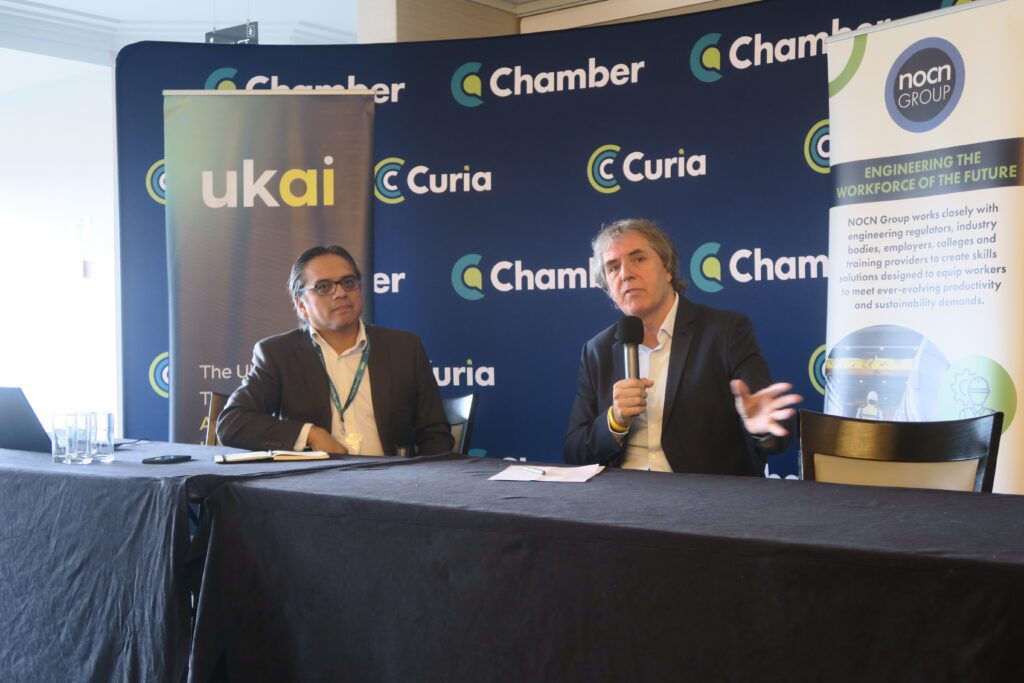
Image: CEO of UKAI, Tim Flagg speaks to Mayor of the Liverpool City Region, Steve Rotheram
The North West has long been recognised as one of the UK’s most promising regions for the development of the artificial intelligence (AI) economy. It is home to globally respected universities, internationally recognised research centres, and a fast-growing community of start-ups and scale-ups applying AI across health, manufacturing, energy, and transport.
Yet despite these strengths, the region has struggled to convert research excellence and entrepreneurial energy into widespread economic impact. According to a new report published by policy institute Curia, in partnership with AI trade association, UKAI, that gap is not a failure of ambition, but the result of structural barriers that prevent AI adoption from scaling across the real economy.
The Get Britain Growing: North West Conference AI Sprint Report brings together findings from a policy sprint workshop held in Liverpool last year, which convened parliamentarians, metro mayors, investors, academics, technology firms, and public sector leaders.
The central question the sprint was designed to ask: how can AI be used to drive long-term, inclusive growth in the North West?
Skills Remain the Biggest Constraint on AI Adoption
The report identifies the skills gap as the most immediate and widespread barrier to AI-driven growth. While the national debate often focuses on shortages of highly specialised machine learning engineers, participants in the sprint argued that the bigger challenge lies elsewhere.
Most near-term productivity gains from AI depend on everyday adoption by managers, frontline workers, and public servants who are confident working with data, understand the limits of AI tools and can apply those tools to real operational problems. Across sectors, employers reported difficulty recruiting and training staff with this applied capability.
This important report highlights systemic misalignment between education providers and employer demand. School curricula do not sufficiently prepare students with the mathematical and data literacy needed to engage with AI tools. Universities often prioritise narrow technical expertise over broader, sector-specific skills. Meanwhile, businesses struggle to navigate a fragmented training landscape, with little clarity on which courses deliver practical value.
To address this, the report calls for a regional AI skills strategy spanning schools, apprenticeships, universities, and mid-career retraining. This would embed AI literacy as a core competence, rather than treating AI as a specialist or abstract subject, and would incentivise education providers to align more closely with employer needs.
There are obvious opportunities to deliver such a strategy in regions across the UK.
Infrastructure, Energy, and Planning are Holding Back Growth
Beyond skills, the report states that AI adoption cannot scale without coordinated investment in infrastructure – particularly energy, compute, and digital connectivity.
Participants highlighted the high cost of energy, limited grid capacity, and slow planning processes as major deterrents to investment. While the UK has world-class AI research, it risks falling behind competitors in Europe, the US, and the Middle East when it comes to attracting data-intensive activity and data centre investment.
The report argues that regions that can offer predictable, affordable, and sustainable energy will have a clear competitive advantage. In the North West, this means upgrading grid capacity, investing in renewable energy storage, and making better use of brownfield sites for innovation-led development.
Crucially, infrastructure planning must be joined up. Rather than treating energy, transport, housing, and digital networks separately, the report proposes integrated “AI corridors” that combine these elements and support clustering around universities and innovation districts.

Investment is Fragmented – and the ‘Missing Middle’ Persists
Despite growing interest in AI, investment pathways in the UK remain fragmented and risk-averse, particularly outside London and the South East. The report highlights a persistent ‘missing middle’ in AI finance: companies that have secured seed funding but struggle to access the capital needed to scale.
Public procurement, which could provide early revenue for innovative AI firms, is often slow and complex, with compliance costs disproportionate to contract size. Even when pilots succeed, there is no clear route to wider adoption.
To address this, the report recommends the creation of a unified North West AI Investment Fund, coordinated at regional level and aligned with national priorities. This would not replace existing schemes, but act as a single front door for investors and businesses, matching projects with appropriate sources of public and private capital.
A regularly updated regional investment prospectus would set out opportunities across the North West, helping investors navigate what is currently an opaque and fragmented landscape.
A North West AI Hub and Pilot Scheme
At the centre of the report’s recommendations is the proposal for a North West AI Pilot Scheme, coordinated through a new North West AI Hub based in Liverpool.
The Hub would act as a regional convenor, bringing together universities, local and combined authorities, the NHS, industry, and investors. It would host training facilities, start-up incubation space, and access to high-performance compute, while also aligning skills planning, infrastructure development, and investment strategy.
Importantly, the report positions the North West as a potential national testbed for AI policy. With strong mayoral leadership and devolved powers, the region could work with central government to trial more flexible, innovation-friendly approaches to regulation, while maintaining national oversight and public trust.
From Aspiration to Delivery
The report concludes that the North West already has the foundations needed to become a national exemplar for responsible AI adoption. What has been missing is coordination – between skills and employers, infrastructure and planning, investment, and regulation.
By implementing the recommendations set out in the AI Sprint Report, the region could move beyond isolated success stories towards systemic change, ensuring that AI delivers productivity gains, high-quality jobs, and improved public services.
Policymakers, investors, and business leaders alike can work towards AI-led growth, but it will not happen by accident. It requires deliberate regional strategy, sustained collaboration, and a willingness to test new models of delivery.
To find out more about UKAI’s work convening industry, policymakers, and researchers to support responsible AI adoption across the UK, visit www.ukai.co.