

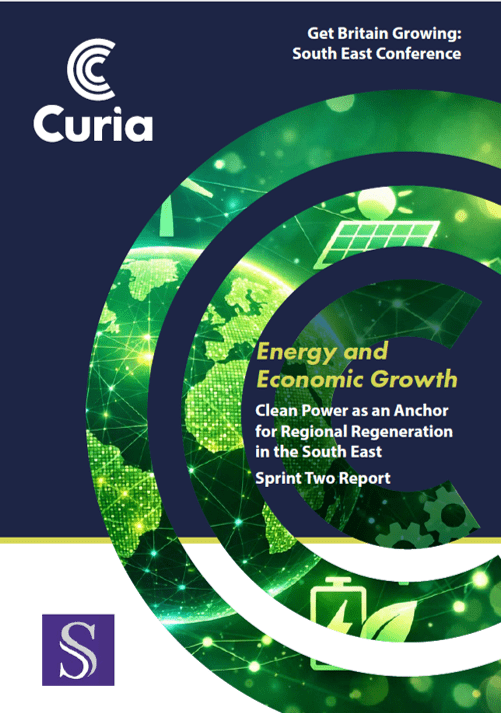
The clean power report from the second sprint facilitated by policy institute Curia at Chamber UK’s Get Britain Conference in partnership with Silverstone Communications on energy and economic growth offers a diagnosis of the South East’s energy challenge. At its core, the report argues that the region’s ability to deliver clean, affordable power will determine not only its decarbonisation trajectory, but its wider economic prospects – from housing and transport to industrial competitiveness and public health.
In policy terms, this is a not a new diagnosis. What distinguishes this report from the multitude of others is the consistency of evidence from across sectors – ports, local authorities, energy providers, and infrastructure specialists – all pointing to the same systemic constraints. The central problem is not a lack of ambition or innovation, but a system that struggles to translate either into delivery.
Grid connection delays of up to a decade, connection costs reaching £1 million per project, and electricity prices that undermine electrification all combine to stall otherwise viable schemes. The result is a region caught in a paradox: high demand for clean energy alongside structural barriers that make supply difficult to deliver.
The limits of national infrastructure thinking
One of the report’s most significant contributions is its challenge to the prevailing model of energy system development. Rather than relying primarily on large-scale national infrastructure, the Sprint participants argue for a shift towards more localised, decentralised generation.
This reflects a growing recognition in policy circles that centralised systems alone cannot meet the pace or scale of demand, particularly in regions like the South East where constraints are acute. The report makes the case that generating power closer to where it is used can reduce transmission costs, improve resilience, and deliver visible local benefits.
However, while the argument is persuasive, the report stops short of fully addressing the trade-offs. Local generation can improve flexibility and community buy-in, but it also raises questions about system integration, market design, and equity across regions.
Without clearer articulation of how decentralised systems interact with national infrastructure, there is a risk that “local solutions” become a policy aspiration rather than a scalable model.

Fragmentation as the central policy failure
For those living and working in the South East the conclusion of system fragmentation will not be a surprise. The report returns to the consistent theme articulated at Get Britain Growing conferences across the UK. There is an evident lack of a coherent, shared energy strategy across the South East, despite the presence of substantial expertise and capacity.
Decision-making is described as siloed across institutions and geographies, with no mechanism to align priorities or share evidence effectively. This results in duplicated effort, stalled projects, and missed opportunities – a familiar critique across UK infrastructure policy.
What is notable here is the emphasis on governance rather than funding as the primary constraint. The report suggests that many projects fail not because of insufficient capital, but because of unclear ownership and weak co-ordination. This aligns with broader debates around “system leadership” in UK regional policy, where institutional design – rather than resource scarcity – is increasingly seen as the limiting factor.
The proposed solution, a South East Energy Co-ordination Forum, is pragmatic but raises questions about delivery. The UK has a long history of creating new co-ordination bodies without resolving underlying accountability issues. The effectiveness of such a forum would depend heavily on its authority, resourcing, and integration with national decision-making structures.

Sector-specific pressures highlight system gaps
The report is particularly strong in illustrating how systemic issues manifest in specific sectors.
Ports, for example, are positioned as both an opportunity for a growth and a constraint on infrastructure. They could serve as hubs for renewable energy and electrification yet face grid limitations and electricity pricing that undermine investment. A case study at Shoreham Port demonstrates how even successful infrastructure deployment can fail to achieve uptake when operating costs remain uncompetitive with fossil fuels.
“The South East does not lack knowledge or ambition – it lacks coherence.” Tom Rutland MP, Member of Parliament for East Worthing and Shoreham
Similarly, the electrification of heavy goods vehicles is identified as a looming challenge, with the South East excluded from key infrastructure planning despite its reliance on road freight. Airports face policy commitments on sustainable aviation fuel without a credible supply chain roadmap.
These examples reinforce a broader point: policy ambition is running ahead of delivery frameworks. Targets exist, but the enabling conditions – infrastructure, pricing, and regulatory clarity – are not yet aligned.
Planning reform: necessary but insufficient
The report’s critique of the planning system is unsurprising but well-evidenced. Participants describe a system that is slow, adversarial, and risk-averse, with high upfront costs and long timelines for projects such as onshore wind.
There was an urgent call for reform that shifts planning from a model of objection to one of co-design and collaboration. This reflects wider government rhetoric, but the report implicitly acknowledges that reform alone will not be enough.
Planning barriers are only one part of a wider system failure. Even where consent is achieved, projects may still be unviable due to grid constraints or electricity pricing. The risk is that planning reform becomes a focal point for policy action while deeper structural issues remain unresolved.
The case for a more evidence-led system
One of the more innovative proposals is the development of a “digital twin” of the South East – a shared modelling platform to test energy scenarios, trade-offs, and cumulative impacts.
This reflects a broader shift towards data-driven policymaking and could help address some of the trust and transparency issues identified in the report. By providing a shared evidence base, such a tool could support more informed decision-making and reduce conflict in planning processes.
However, the success of this approach will depend on governance as much as technology. Data alone does not resolve political disagreement; it must be embedded within decision-making frameworks that can act on the insights generated.
From insight to delivery
The report concludes with a practical implementation plan for local and regional government built around four pillars: regional energy mapping, local pilot projects, strategic co-ordination, and planning and skills reform.
Taken together, these proposals form a credible roadmap. As is traditional with Curia reports, they are grounded in actionable insights and reflect a realistic understanding of the system’s constraints.
“The challenge now is not understanding what needs to be done. It is having the confidence and co-ordination to do it.” Geri Silverstone, Chief Executive, Silverstone Communications
Yet the central challenge remains unchanged. As the report itself acknowledges, the issue is no longer understanding what needs to be done but having the co-ordination and leadership to do it.
For policymakers, the lessons are that the South East does not lack ideas or investment potential. It lacks a system capable of aligning them at pace and scale. Until that changes, clean power will remain an opportunity – rather than an anchor – for regional growth.
Get Involved
Building on the momentum of this Sprint, in 2026 Curia is now taking forward a programme of work focused on translating these energy insights into practical delivery – including their wider work on new towns and place-based development.
This next phase will bring together policymakers, developers, infrastructure providers, and innovators to explore how clean power can be embedded from the outset in new communities, rather than retrofitted into constrained systems. Those interested can get involved through Curia’s Clean Energy and Environment Research Group, upcoming roundtables, and targeted working sessions, with Mayors and local government leaders from across the UK.
These sessions will shape policy recommendations, pilot projects, and future reports. By participating, stakeholders have the opportunity to directly inform how regional energy systems and new settlements are designed, ensuring that growth is both sustainable and deliverable in practice.
To find out more about this programme, contact Partnerships Director, Ben McDermott at ben.mcdermott@chamberuk.com.
Save the Date:
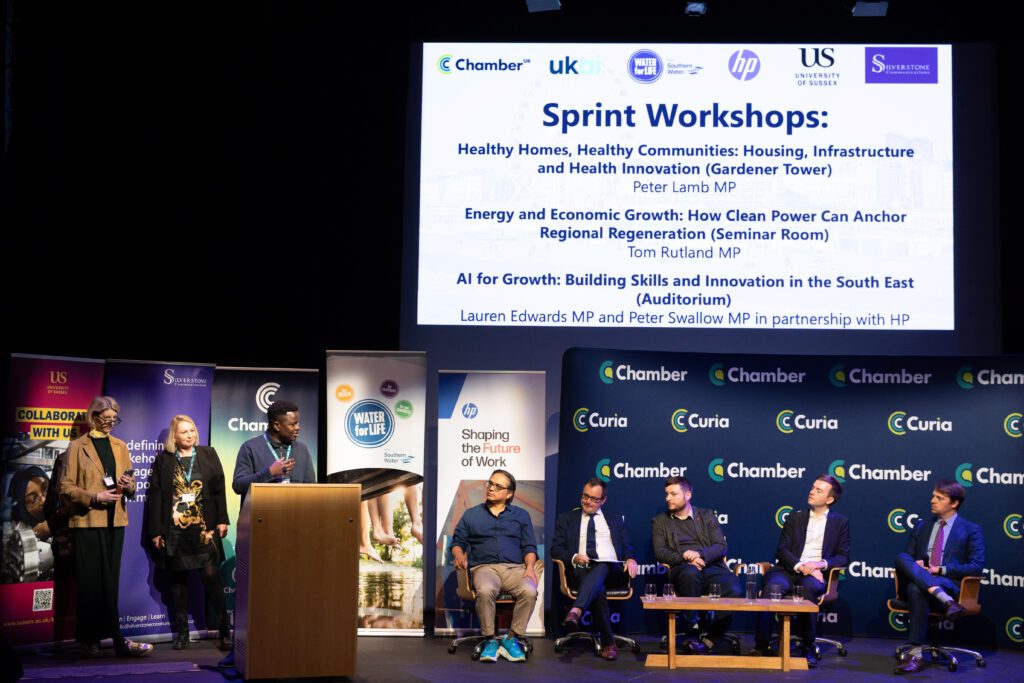
The Get Britain Growing: South East conference returns to Brighton in 2026. To find out more about the sessions and get more involved, please contact Partnerships Director, Ben McDermott at ben.mcdermott@chamberuk.com.
Save the date 6th November 2026.