
Partner Content: AI won’t replace human skills – the real challenge is building an education system that makes them more valuable than ever. HP in Conversation With Peter Swallow MP (Fireside Chat on AI, Skills, and Education)
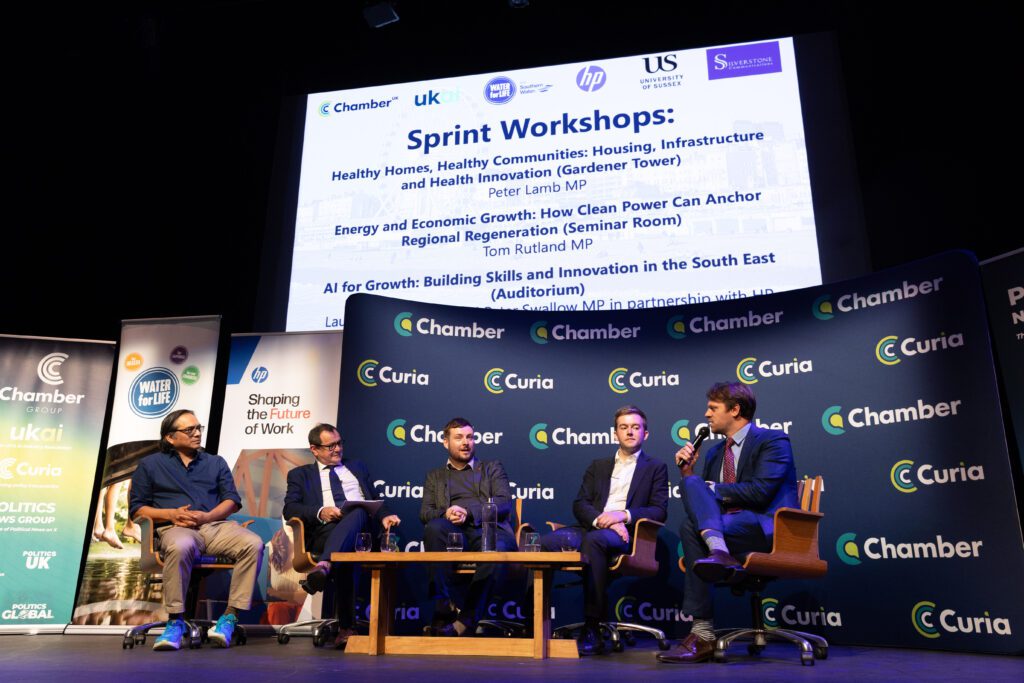
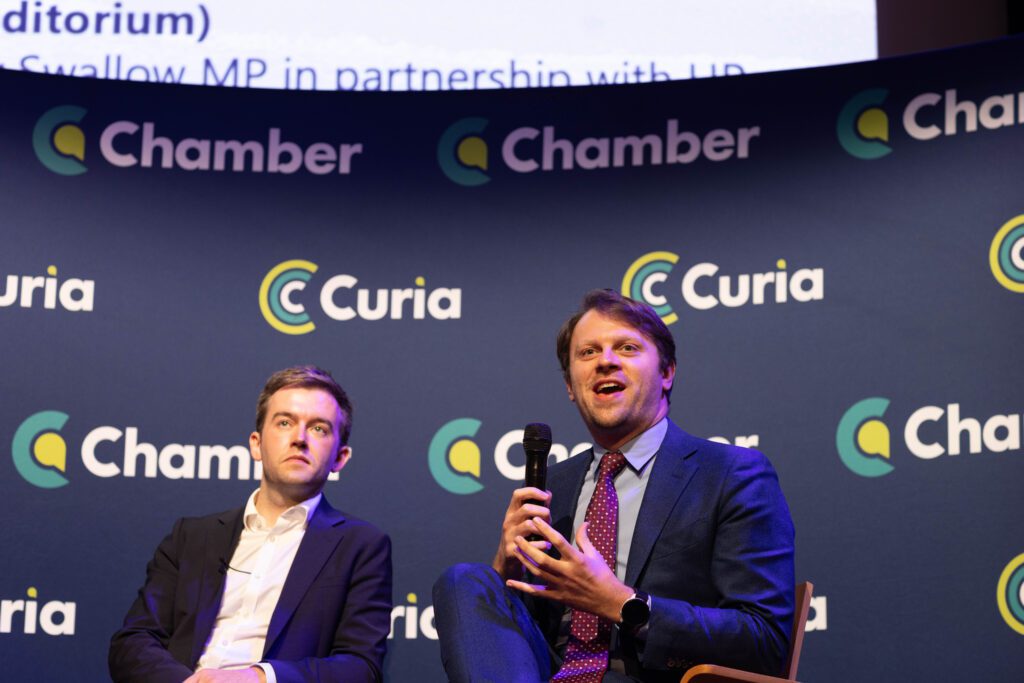
Photo: (Left to Right) Chief Executive, UKAI, Tim Flagg, CEO, Silverstone Communications, Geri Silverstone, Member of Parliament for Bracknell, Peter Swallow MP, Member of Parliament for East Worthing and Shoreham, Tom Rutland MP, Advanced Compute Specialist, HP, James Quigley. (Silverstone Communications)
In conversation with advanced compute specialist at HP, James Quigley, at the recent Get Britain Growing South East conference, Member of Parliament for Bracknell and Education Select Committee member, Peter Swallow MP, set out a vision for a broad, human-centred education system that balances AI and STEM capability with communication, empathy, and adaptability, arguing that the real opportunity lies not in fearing AI but in equipping people to use it well.
Preparing People, Not Just Systems, for an AI Future
James Quigley
Perhaps we can start by grounding this in something tangible. There’s a lot of excitement, and a fair amount of anxiety, about what artificial intelligence (AI) means for education and skills. From your perspective, how should we be thinking about preparing people for a future shaped by AI?
Peter Swallow MP
I think we all know that in a future that will be dominated by AI, the skills to function in the future workforce – and, of course, a lot of that is skills needed to work with AI – are essential. That feels uncontroversial. But I also think it’s really important, actually, that when AI is going to be taking a lot of the weight in lots of roles, we don’t lose sight of the human-centred skills.
AI is never going to be able to replicate the ability to have a conversation, or the ability to have empathy with another person. If anything, I think those things are going to be more important than ever. So, when we’re thinking about the skills we need in an AI future, yes, technology- and science-centred skills absolutely matter, but so too do communication, collaboration, and problem-solving skills – the things that a narrow curriculum can sometimes sideline.
Education as Adaptability, Not Memorisation
James Quigley
That balance between technical capability and human skills feels critical. Does AI pose a threat to more traditional forms of education? Is that something you wanted to pick up here? Do you think the advent of AI is concerning for those more historic forms of education?
Peter Swallow MP
Not really, no – or at least not in the way people sometimes frame it. There’s so much history out there that you can learn now. It’s even easier than just going to Wikipedia and googling it. You can have a whole conversation about something, in much more depth, than was ever possible before.
But that actually reinforces my point. The purpose of education has never been – and should never have been – about teaching people facts alone. It’s not about how much you can tell me about the Battle of 1066 or Thermopylae. The point of education, broadly defined, has always been to give people the skills they need to take on the next problem, apply those skills and solve it.
A Broader Curriculum for an AI Age
James Quigley
So do you see opportunity there, rather than something to be fearful of?
Peter Swallow MP
Very much so. That purpose of education is more important in the age of AI, not less important. I fundamentally believe that government, through the curriculum and assessment review, is looking at a wider curriculum – one that puts more arts and humanities front and centre, alongside much more emphasis on AI and STEM subjects.

People sometimes argue that those things are at odds with each other, but I fundamentally think that’s wrong. The way we make sure we are ready for the next stage is by having that broad curriculum, which allows us to develop the broad set of skills that will be needed in tomorrow’s world.
Adapting Fastest, Not Inventing First
James Quigley
That’s helpful, particularly in the context of what we’ve been hearing today [at the Get Britain Growing South East Conference] about skills pipelines and workforce readiness. From an industry point of view, one concern is whether education systems can adapt quickly enough. How optimistic are you that policy can keep pace?
Peter Swallow MP
I think it has to. If we accept that AI will be embedded across the economy – and I don’t think there’s any serious argument that it won’t be – then the question isn’t whether education changes, but how well and how quickly it does so.
What gives me some optimism is that there is now a much broader recognition that education can’t just be about memorisation or narrow specialism. It has to be about adaptability. And AI, if used properly, can support that rather than undermine it.
Used well, it allows people to explore subjects in more depth, ask better questions and make connections across disciplines. That’s true in schools, universities, and workplaces. The risk isn’t AI itself; the risk is using it badly or not equipping people to use it thoughtfully.
James Quigley
If you connect that back to the wider economic picture, what does this mean for how regions like the South East position themselves?
Peter Swallow MP
On AI, it’s not necessarily the country that invents the technology that wins. It’s the country – or the region – that adapts its economy best to use it. Through skills, training, and employer adoption, the UK is well placed to seize that opportunity.
But that does require leadership. It requires policymakers, employers, and educators to be aligned, and it requires us to think about infrastructure, skills, and community building together, rather than in silos.
James Quigley
That’s a strong note to end on. Thank you.
Final Thought
What emerges most clearly from this conversation is a shared rejection of the idea that AI diminishes the purpose of education. Instead, it sharpens it. Peter Swallow framed AI not as a substitute for human capability, but as a force that makes human judgment, communication, and adaptability more valuable. The discussion moves beyond familiar binaries – technical versus creative, STEM versus humanities – and lands on a more pragmatic viewpoint: the systems and regions that succeed will be those that combine technological fluency with broad, transferable skills.
There is also a notable emphasis on pace and alignment. The question is not whether education and skills systems will change, but whether they can do so quickly and coherently enough to match how AI is embedding itself across the economy. The conversation points to adaptability as the organising principle for the next phase of education and workforce development, with AI acting as an enabler rather than a threat. Taken together, the exchange offers a grounded, policy-relevant case for why skills, leadership, and regional co-ordination – rather than technological novelty alone – will determine who benefits most from the AI.
This conference was sponsored by HP.