



Miles Bennington
Editor – Chamber UKAfter an inspiring, hopeful speech from Andy Burnham this week, you may be tempted to live in the afterglow for a while. Sit back and imagine a self-confident Britain, where competent leaders of functioning political parties tackle longstanding problems to set us up for long-term success.
Alas, they may be in Government, they may have a huge majority and they may be inching their way up in the polls, but the Labour Party is not where you find the action in British politics. No, to really understand where Britain is going, you must cast your eye rightwards.
Will Reform replace the Conservatives as the default option to kick Labour out? Will the Conservatives halt their slide towards the extreme and become electable again? Will the wets ever do anything? Will Restore undermine Reform’s ability to win Parliamentary seats? What role will science denial, conspiracy theories and racial animus exert on the runners and riders? Will corruption be a political liability or a useful source of funds? Who will win the social media race? Who will win the donation race? Who will win the polling race? All this and more to follow.
In this monthly newsletter, I will analyse the fight on the right.
My Credentials
I joined the Conservative Party in 2002. I was 15. The Tories were profoundly ensconced in opposition and, under the less-than-stellar leadership of Ian Duncan Smith (IDS), were going nowhere fast.
My worldview was basically that the UK had it pretty good: we were rich, safe and stable. My hope was that over the next few decades we could maintain that situation, make marginal improvements and, most important of all, bring prosperous democratic capitalism to the rest of the world.
I was (and remain) appalled by the regional inequality in the world and the bitter injustice that life chances vary so hugely depending on the country of your birth. The Conservative Party was my vehicle to ensure that the UK continued on a stable course, acting as an example to the rest of the world.
I volunteered for years. I worked hard to get Conservatives elected in Hastings, Lancaster and Watford. I stood for council three times (twice as a paper candidate and once the Lib Dems thumped me). Then, in 2009, got a job at CCHQ working on campaign data,a dream come true. After a few years and the election victory I’d been working on for almost half my young life, I moved on. I kept volunteering and working indirectly for the party.
After Brexit, I was disillusioned.
Why prioritise some inexplicable form of “sovereignty” over the economy? I didn’t love the EU but saw no urgent reason to leave.
I stuck it out in the hopes of a wet revival (wet, meaning a soft-hearted, squishy Conservative, coined by Mrs Thatcher) but those hopes were dashed in 2019 when Boris removed the whip from 21 Conservative MPs. I figured if Kenneth Clarke, Nicholas Soames and even Phillip Hammond were not Conservative enough, then what the hell was I? I never renewed my membership.
Electoral Elastic
So, while no longer a Conservative, I maintain a morbid interest in what is happening in my old party. We all should, because as official opposition, there’s a good chance that in a few years the memories of Partygate and the mini-budget, austerity and Brexit will have faded and they will be back in power.
Being the official opposition in Britain is bad. It is not power. All the donors, money and interesting people leave and, for years, people ignore you.
But it’s a million times better than being the third party.
In the early 2000s, while commentators were writing the inevitable Strange Death of Tory England articles, the seeds of the next Government were being planted. IDS and Oliver Letwin were presenting their ideas for a Universal Credit, David Cameron and George Osborne were entering Parliament and Lord Ashcroft was ramping up his support. Being in opposition was bad, but it was also safe. The Lib Dems were not a realistic threat and, despite his epic competence, eventually Tony Blair and Labour would make mistakes.
It’s different now. Reform UK are an existential threat to the Conservatives. It’s not inevitable, but it’s now not unimaginable that the most successful political party in history has only a few months to live. If they are eclipsed, that would be a very strange death indeed.
Life-Dinner Question
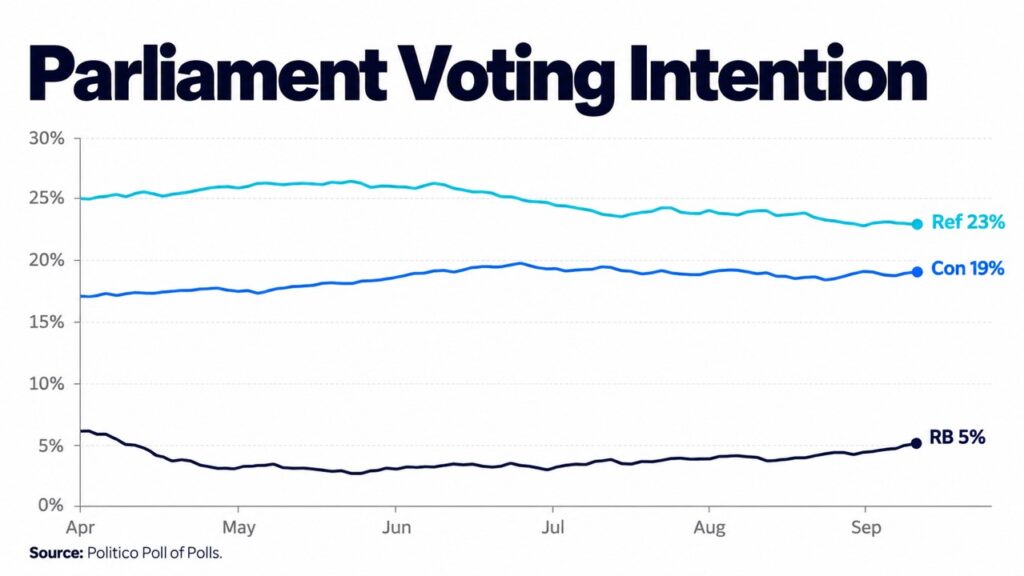
Despite his torrid summer, Reform are still ahead of the Conservatives in most polls and, while a four-point lead is not unassailable, what you must understand is that the stakes are grossly unequal for the two right-wing parties.
Reform UK is the latest in a series of Nigel Farage vehicles, sustained by his celebrity and subordinated to his ego. If they come third or even fourth with over 25 seats at the next general election, they may be disappointed, but they will still have achieved remarkable progress.
Even if Reform stagnate and win only a dozen seats, it would not be existential for them. Nigel would still enjoy the limelight, still enjoy the donations and still enjoy his position as an MP and party leader, with all the authority that grants him.
For the Conservatives, on the other hand, if they lose their position as official opposition, it is over.
The Conservative Party is not an ideological party; it’s not a personality cult. It is a vehicle for obtaining power… and nothing else.
If they lose their position as the most likely right-wing party to form a Government, then it is over for them. They will have nothing left. The donors, careerists, candidates and think tanks will all switch sides. They will show all the loyalty of Tory MPs voting in a leadership election.
The Fight On The Right
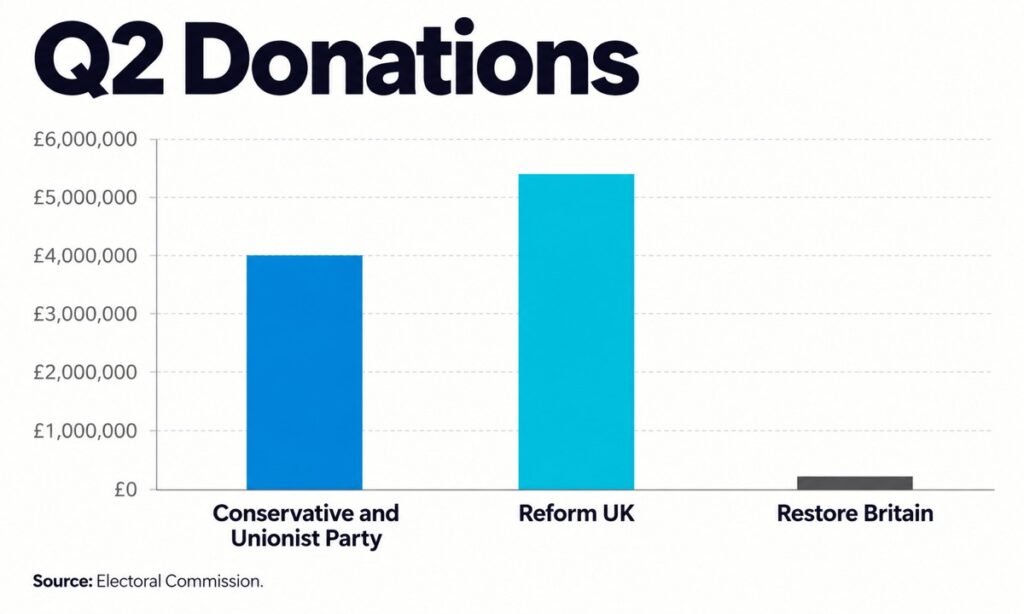
So this is the shape of the battle to be waged. Reform are fighting to keep momentum, the Conservatives to stay alive, Restore to be credible new disruptors.
This is the most important battle in British politics right now. To be a successful, stable, growing country, Britain needs a party system with the diversity to represent the views of the public, integrity to filter out leaders that are out-of-touch with reality or morality, and vibrancy to bring new ideas to the table.
As Andy Burnham has set out this week, the left is moving on from the neoliberal era and testing new ideas and policies to fix Britain’s relationship with the state. The fight is on the right.
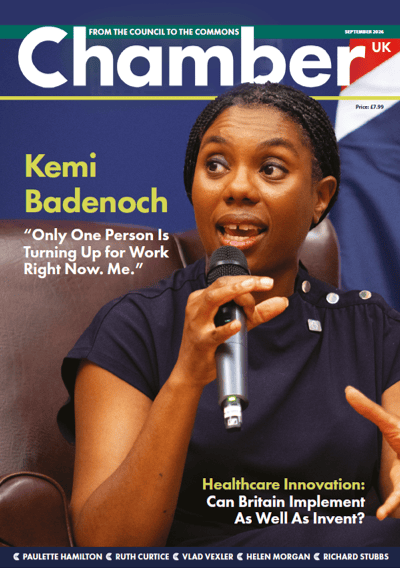
You can still get a copy of our new edition of ChamberUK. Our parliamentary journal.
Photo Credit: Edward Massey / CCHQ