


Ben Howlett
Group CEO, Chamber GroupAndy Street’s pitch for rebuilding the centre right is based on difficult choices, political moderation and resisting the pull of Reform UK. But an evening with Prosper UK at the former home of Ted Heath revealed the scale of the challenge, as even a seemingly receptive audience pushed back on pensions, Europe, public ownership, and the future direction of the Conservative Party.
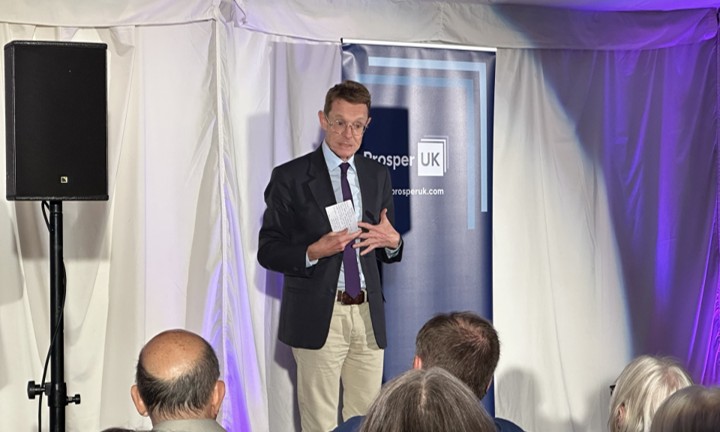
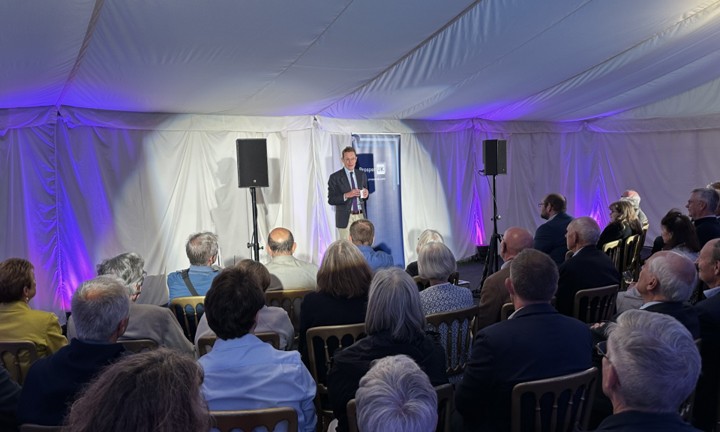
I rarely go to political rallies these days, but en route to the South West I thought I would stop in at Prosper UK’s ‘In Conversation’ with Andy Street.
I’ve always thought highly of Andy, particularly from his time as Mayor of the West Midlands. In a political world where many of us who were elected under David Cameron have felt that the Conservative Party has lost its way, Andy has continued to fly the flag for centre-ground, One Nation, moderate, ‘wet’ conservatism, or whatever cliché you prefer for those of us who have traditionally occupied the middle of the Conservative spectrum.
That does not mean I am completely on board with the Prosper pitch. In fact, as one of the owners of Politics UK, I am pretty happy being a ‘floater’…
In particular, I remain unconvinced by what feels like a slightly confused strategy: challenging the party leadership and its policy direction while apparently stopping short of confronting how the party is organised and influenced at local level.
As I have argued before, candidate selection matters. Anyone who watched the tactics employed by UKIP and Farage-aligned activists from the 2017 election onwards will understand how relatively small numbers of organised members can exert significant influence over the political direction of a party.
But what struck me most last night was the reception.
Having travelled to Arundells, the former home of Ted Heath in Salisbury Cathedral Close, I assumed Andy’s argument would receive a politically warm hearing. If there was anywhere you might expect an audience to be receptive to a One Nation case for rebuilding the centre right, surely this was it.
Yet even here, some of Prosper’s central arguments were challenged from the floor, from reform of the triple lock to privatisation and the role of public ownership.
The discussion was thoughtful rather than hostile, but perhaps that is the point.
The fight to rebuild the centre right may be considerably harder than Andy Street thinks.
What is Prosper?
Good question, and one that “slightly surprised” Andy.
A quintessentially conservative women in the audience awkwardly asked why more people have not heard of it?
She wasn’t politically ill informed, earlier in the evening I had overheard her conversation about something the Prime Minister had been discussing on migration in the Times.
Street acknowledged the problem himself, accepting that the organisation had not yet done enough to break through nationally.
Launched in January 2026 and co-chaired by Street and former Scottish Conservative leader Ruth Davidson, Prosper describes itself as neither a political party nor a traditional think tank, but a centre-right political movement. Its stated purpose is to develop policy, commission research and build a nationwide network capable of influencing the direction of centre-right politics.
Its leadership also includes former centre right politicians such as Sir David Gauke, Amber Rudd, Gavin Barwell, Sir David Lidington, and Margot James, placing it firmly within the moderate and One Nation tradition of Conservative politics.
From polling commissioned from More in Common – the new pollsters led by former Special Advisor to Conservative Education and Equalities Secretary, Nicky Morgan, Luke Tryl – organisation argues that there are around seven million voters in Britain who sit broadly in the centre or centre right but currently feel politically “homeless”. Its central proposition is that the Conservatives cannot rebuild simply by chasing Reform voters, and instead need a broader pro-business, pro-growth and outward-looking political offer.
In his speech, Street demonstrated that Prosper is not merely interested in publishing policy papers. He spoke about building local branches, encouraging supporters to become involved in the Conservative Party and, over time, helping people sympathetic to Prosper’s politics become council and parliamentary candidates.
Prosper may have ambitions to influence the future direction of the Conservative Party, but as one audience member effectively pointed out, it first has to ensure that voters, and perhaps Conservatives themselves, know it exists.
The Triple Lock Test
Perhaps it should be obvious that plans to reform the Triple Lock may go down like a cup of cold… with an average age well above the pension threshold.
For someone that thinks the political trap should never have been set, good on Prosper for making the argument – even if the mainstream political parties have their fingers in their ears for fear of losing the grey vote.
For Prosper this issue shows just how difficult it will be to create a movement on ideas (whether right or wrong) that divide people.
Prosper UK has made reform of the triple lock one of its most deliberately difficult policy positions. Its welfare plan proposes replacing the current system with a smoothed earnings link, while protecting pensioners against inflation in weaker years. Prosper argues that doing so would improve intergenerational fairness and could save around £20.6 billion a year by 2050.
Street presented the policy as a test of whether politicians are prepared to tell voters uncomfortable truths. In his argument, rebuilding confidence in mainstream politics means being honest about spending pressures and accepting that government cannot promise every group protection from difficult choices.
But several in the audience did not simply accept his policy plan.
One woman challenged Street over why pensioners should be targeted, pointing out that many older people have limited means to supplement their income and continue to face rising living costs.
This is obviously not their position and Street pushed back against the suggestion that Prosper was “attacking” pensioners. As I have learnt over the years, anyone seeing headline “remove triple lock” will fail to read beyond those three words to “replace it with something else”. He argued that pensioner incomes had performed considerably better than those of younger generations over the period in which the triple lock has operated, and said the question was whether the existing settlement remained fair and sustainable.
It was an interesting exchange precisely because Street had used the triple lock as an example of the sort of political honesty he believes the centre right must rediscover. Prosper describes the policy as a way of demonstrating that politicians are prepared to explain trade-offs rather than offer voters easy answers. Street has previously called the triple lock the clearest test of whether politicians are willing to “level with people”.
Yet even at Arundells, in a room that might have been expected to be relatively receptive to his wider political argument, the consequences of that honesty proved much harder to sell.
That may be the broader lesson for Prosper. Calling for difficult choices is one thing. Persuading the people affected by them that those choices are fair is quite another.
Beyond Pensions
While I love a good chat on pensions reform, luckily for a well triggered over-65 audience the conversation ranged well beyond pensions, and in many ways helped explain the political territory Prosper UK is trying to occupy.
Street was emphatic that Conservatives should not seek a formal accommodation with Reform UK. He rejected the idea of “uniting the right”, arguing that the Conservative Party would lose moderate voters if it tried to merge its electoral offer with Nigel Farage’s. Pointing to polling by Lord Ashcroft showing that the Conservatives have the most to lose from such a deal, his argument was that Conservatives need to fight on their own ground and rebuild confidence among voters who have drifted away from the party altogether, rather than simply competing for those already attracted to Reform.
Street also stressed that this should not mean timid politics. Street repeatedly returned to the idea that the centre has to become more willing to make difficult choices, rather than allowing populists to monopolise the language of radical change. This is something I’ve talked about for years, those in the centre like me are to blame for failing to articulate their radical visions for where the country could go – instead allowing alternative extreme visions to fill that void. This was the most exciting thing Street talked about – it’s now time to put some meat on the bones.
That included immigration, where he argued for controlled migration while accepting that skilled migration remains necessary for economic growth, and energy, where he said Prosper intends to address high prices without abandoning the Climate Change Act. Housing, student finance and the challenge of winning back younger voters were also prominent themes.
With the candidate for Rejoin EU Party at the Holborn and St Pancras by election sitting in the audience (some 150 miles away from her constituency) you will be shocked to know that Europe was indeed the first question.
Europe will be another important test. Street said Prosper has undertaken substantial work on Britain’s future relationship with the EU and acknowledged the economic consequences of Brexit. He stopped short of advocating rejoining, questioning whether that was presently realistic, but suggested there was a serious case for examining how Britain could rebuild closer economic and strategic ties. The audience reaction was meh – hoping for a full fat policy proposition they left receiving some semi…
There was also a significant organisational message. Street said Prosper wants to establish branches around the country, encourage supporters to become involved in the Conservative Party and, eventually, help bring forward council and parliamentary candidates who share its outlook.
Having seen what the ‘Kippers’ did to me and colleagues on selections after Brexit, I asked Street whether Prosper’s growing supporter base could ultimately be used to influence Conservative candidate selections, particularly given how relatively small groups of organised activists have previously been able to shape local associations and parliamentary selections.
Street rejected the idea of “entryism”, but accepted the broader point. He said Prosper wants to establish branches in areas where it has support, encourage people who share its outlook to join the Conservative Party, help select council candidates and, over time, support people with similar views to come forward as parliamentary candidates. His distinction was that Prosper did not want to purge existing Conservative MPs, but did want to ensure the party was increasingly represented by people who reflected its political outlook.
As I left, one of the audience approached me and said – “I think he needs to be more radical”…
Rebuilding the Centre May Be the Hard Part
Street’s central argument is persuasive in several ways – but importantly mainstream politics cannot simply complain about populism while ignoring the failures that helped create an audience for it.
He was unusually candid that Conservatives had failed to deliver sufficiently on issues including immigration, growth and public services, and that populists had moved into the space left behind. His answer is to rebuild trust through credible policies, delivery and a broader, more inclusive form of centre-right politics.
But the evening at Arundells also exposed the difficulty. Is anyone listening?
This was, symbolically at least, friendly territory. The former home of Ted Heath could hardly have offered a more appropriate setting for a defence of One Nation conservatism. Yet Street still faced challenges over pensions, privatisation, public ownership, welfare, Europe, and the direction of the Conservative Party itself.
The exchanges were thoughtful rather than hostile, (though I did feel sorry for the metaphorical lynch mob of the once Tory voter on his views over nationalisation…maybe a conversation for another day) but they demonstrated that there is no automatic consensus waiting to be rediscovered simply by invoking the centre ground.
Prosper may be right that millions of voters feel politically homeless. The harder task will be persuading them that its particular combination of fiscal restraint, economic liberalism, internationalism, and social moderation provides the answer.
For Street, the challenge is therefore bigger than defeating populism – clearly something he and his band of well meaning merry men and women cannot achieve themselves. It is proving that the centre right can once again offer something coherent enough to inspire people, difficult enough to be credible, and broad enough to win.
To find out more about Prosper UK, www.prosperuk.com