

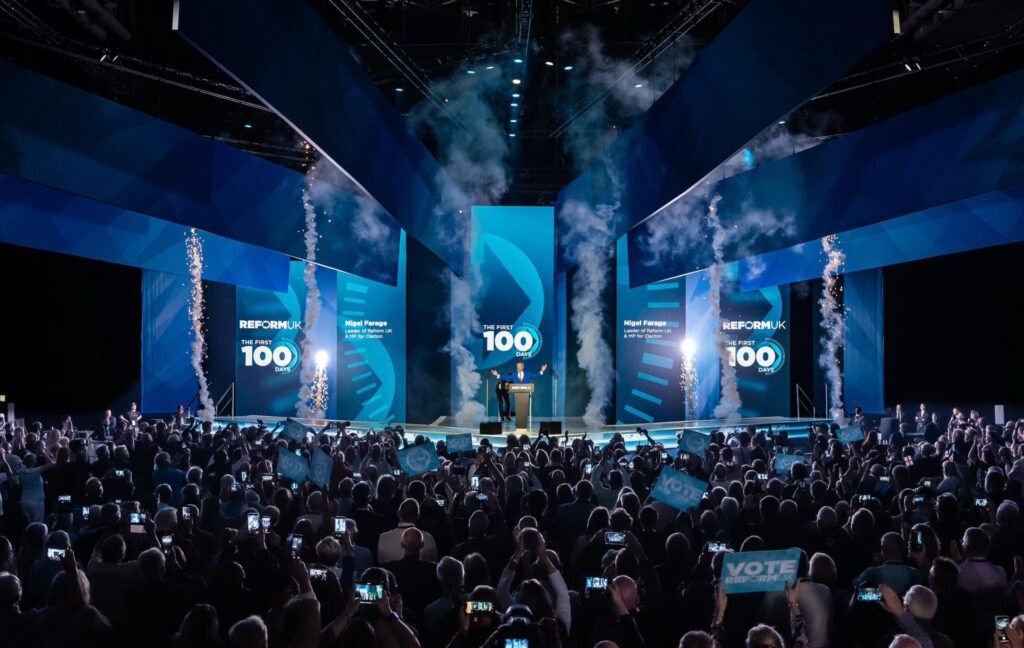
As Nigel Farage arrived on stage accompanied by dramatic music for Reform Party Conference 2026, a light show and a considerable amount of pyrotechnics, it was clear that Reform UK would stop at nothing in copying the Trump playbook for what it now sees as a six-month journey to the next general election.
The Trump parallels emerged before the speech had even begun. A security threat delayed proceedings, leading Farage to resort to dancing cheesily with the crowd, although YMCA was conspicuously absent. Screaming activists were then swiftly ejected to the absolute glee of the audience.
If anyone needed evidence that the UK’s political culture has entered an entirely new era, this conference provided it at almost every turn.
Reform Party Conference 2026: a 100-day roadmap for government
At the forefront of Farage’s speech was Reform’s roadmap for its first 100 days in office, unveiled in preparation for a potential election next spring.
Shrugging off the controversy of the previous 24 hours, Farage attempted to project strength by setting out his plans for a Reform government. He promised to declare a “national emergency” on his first day in office and introduce a barrage of new laws with sweeping consequences for the country, pledging to replace Burnham’s “continuity” government with real change.
Equipped with his coterie of former Conservative ministers, who have now been brought to kowtow at the altar of Nigel, Farage is hoping to convince the public that he is serious about government. JD Vance and Marco Rubio may know how they feel.
To achieve this 100-day transformation, Farage took aim at each branch of government in turn.
Starting with the House of Lords, he threatened to appoint hundreds of new peers or even hold a referendum on its membership if the chamber stood in the way of Reform’s legislation.
Secondly, he attacked the judiciary as an “obstacle”, stating that Reform would “remove the ability of judges to lean on outdated conventions” to block legislation.
Finally, he turned his attention to the Civil Service, suggesting that it could be filled with businesspeople if civil servants refused to co-operate.
This almost methodical attack on Britain’s institutions makes clear where Farage wants to take government: towards power concentrated in the political executive, with the support of big business. Yet, despite this apparent intent to mirror Trump’s second term, Farage’s speech contained relatively little clear policy that could be implemented.
Thatcherism meets economic nationalism
Throughout the day, speakers offered several snippets of Reform’s economic policy.
Rejecting Burnham’s “big government” approach, Farage promised a generational reduction in taxation alongside major cuts to healthcare spending. He also pledged to end deindustrialisation, an objective on which he and Burnham appear to agree.
However, Farage scoffed at Burnham’s mention of the “triple helix” in Parliament. The industrial model, which is based on collaboration between government, academia and industry, has been employed successfully in countries such as Singapore.
Farage dismissed it as “socialist dogma” before asking the room: “Has anyone ever heard of it?”
Having learnt about the triple helix economic model during the first year of my social sciences degree, this amused me, particularly because Farage had earlier mocked a protester for being a sociology student.
The overall impression of Reform’s economic policy was therefore a confusing pastiche of Thatcherite small government and economic nationalism, not unlike the model currently being pursued in the United States.
Earlier in the day, Richard Tice evoked the American president with his “drill Britain, drill” routine. This was coupled with criticism of Sadiq Khan for buying cheap Chinese buses rather than British-made alternatives, a preference that would presumably require greater government intervention to enforce.
The marriage of two economic approaches once considered antithetical, nationalism and neoliberalism, has become a staple of populist movements around the world. Here again, in emulating a Trumpian agenda, Reform appears keen to align corporate and state interests if it enters government.
Farage also strongly emphasised the need for sovereignty in Britain’s security and Armed Forces. He began his criticism of the Government on this basis, focusing on weaknesses in national security allegedly highlighted by the recent conflict in the Middle East and what he described as the “strategic error” of the Chagos Islands agreement.
Farage then referred to recent comments about the Falkland Islands by Argentina’s President Javier Milei. He was quick to attribute those remarks to the weakness of the British state, rather than considering them a by-product of the populist politics pursued by a fellow Trump ally.
“Sovereignty” was mentioned repeatedly in both Farage’s and Tice’s speeches, in relation to the economy as well as national security.
Championed by Trump’s Energy Secretary, Chris Wright, from the beginning of the President’s second term, the concept has become increasingly prominent among MAGA-adjacent parties. These movements advocate national sovereignty in areas such as energy supply and industrial production, both of which remain heavily exposed to global markets.
This shift away from free-market economics and towards greater political control over the levers of the economy is a major indication of where contemporary politics may be heading.
Controversy and the international populist playbook
Finally, Farage addressed the latest controversy surrounding him: a funding sting conducted by the campaign group Verbatim and Channel 4 News, which reportedly recorded senior Farage aides discussing how electoral donation rules might be circumvented.
Farage labelled those behind the sting “far-left activists” and accused the media of participating in a “co-ordinated plot against me”. These were accusations with distinctly familiar echoes.
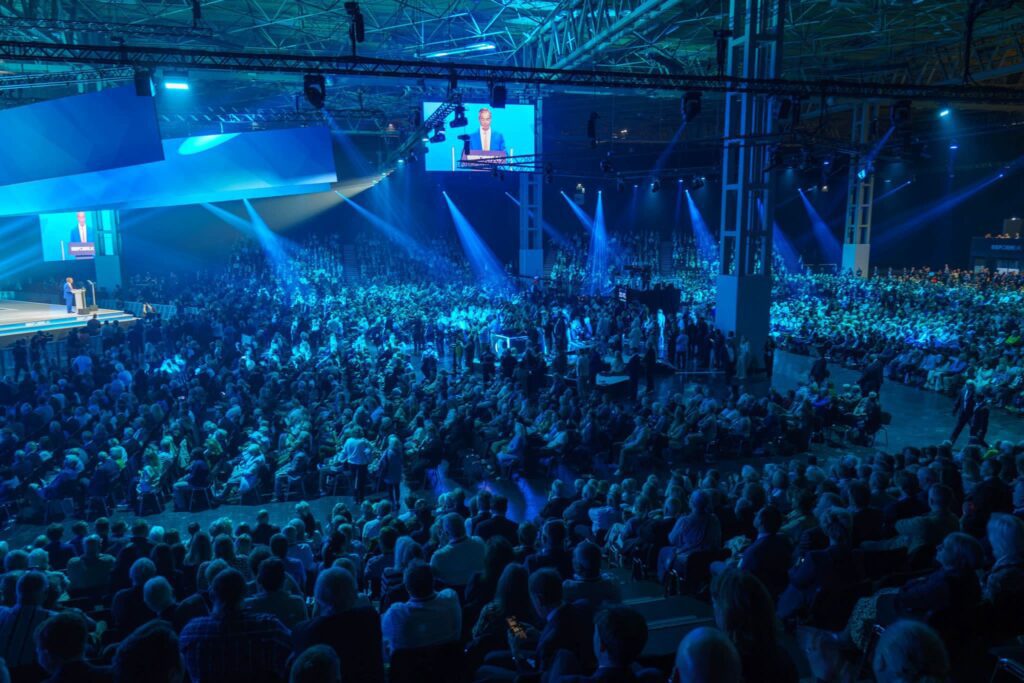
Nevertheless, the conference itself was an impressive media operation. GB News presenters, including Jeremy Kyle, led proceedings, while the event was streamed in high definition on YouTube.
The mobilisation of this alternative media ecosystem in support of the conference demonstrates the extent to which Reform is seeking to reproduce the methods employed by other populist movements.
Although Farage and his deputies may describe Reform as a patriotic movement, the conference bore many of the hallmarks of the international far right.
The appearance of Jordan Bardella, president of France’s National Rally, to sign a comically large memorandum of understanding with Farage made that connection all the more apparent.
Inviting a French politician may not be what one would initially expect from a self-declared patriotic British party. However, the two leaders found much on which to agree, including the need to defend “European civilisation”.
These talking points, repeated almost word for word from Warsaw to Washington, reveal the internationally connected nature of parties such as Reform. Their leaders appear more comfortable whipping up grievances online than engaging intelligently with the real issues affecting their communities.
Devoid of serious thought, Reform’s conference replicated a Trump rally for a British audience, albeit with all the charisma and virality of rotting wood.
(Image: Reform Party UK)