
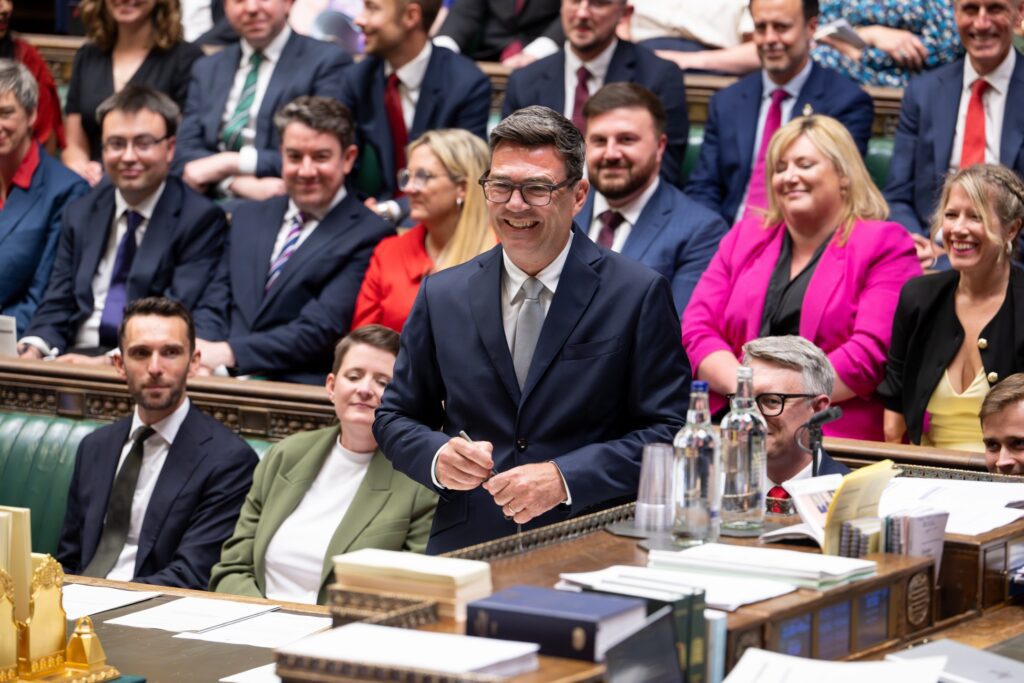
Andy Burnham’s first major intervention on foreign policy reframes what foreign policy is for. In his argument, as set out in the Times on Thursday, security is more than a matter of military capability, diplomacy, or deterrence. It is also about whether local economies can withstand global shocks, whether British workers benefit from public investment, and whether communities feel protected in a world that is becoming more unstable.
After several high-profile figures in Labour have called on the likely Prime Minister to set out his foreign policy stance, Burnham makes clear that national security would be his first priority if he becomes prime minister. The world he describes is one of Russian aggression, conflict in the Middle East, climate and energy insecurity, cyberattacks, and rapid technological change. His central claim is that these pressures are no longer distant events. They are felt in household bills, hospital systems, energy prices, supply chains, and jobs.
This is where Burnham’s position begins to differ from a more traditional foreign policy statement. Rather than treating defence, economics, and social cohesion as separate policy areas, he presents them as part of the same national resilience agenda. The closure of the Strait of Hormuz, the war in Ukraine, attacks on NHS systems, and disruption at Jaguar Land Rover are used to show how international instability can quickly become a domestic crisis.
Hard power, but with a domestic dividend
Burnham’s clearest commitment is to rebuilding Britain’s “hard power”. He backs the UK’s pledge to increase defence spending to 3.5 per cent of GDP by 2035, while arguing that the public must be levelled with about what this will cost and why it matters.
However, the political significance lies in where he wants that money to go. Burnham argues that increased defence investment should not simply purchase equipment from overseas suppliers. Instead, it should regenerate British industry, support apprenticeships, and create jobs in communities that have seen economic opportunity decline.
This is a foreign policy with an industrial strategy at its centre. Burnham wants Britain to strengthen sovereign capability in areas such as shipbuilding, energetics, AI and quantum technologies. The argument is that defence investment should improve military readiness while also rebuilding domestic productive capacity.
That approach is likely to appeal to parts of the country where traditional industry has declined and where globalisation has often been experienced as insecurity rather than opportunity. Burnham is presenting defence not just as a national obligation, but as a route to reindustrialisation.

Continuity on NATO, Ukraine and the US
Despite the domestic emphasis, Burnham is careful to reassure allies that his approach would not weaken Britain’s existing commitments. He describes the UK’s commitment to NATO and the nuclear deterrent as absolute and says the United States would remain Britain’s most important defence and security ally.
His support for Ukraine is also firm. Burnham argues that British security and Euro-Atlantic security are inseparable from Ukraine’s struggle against Russian aggression. By referencing his engagement with Ukrainian mayors, including Andriy Sadovyi and Vitali Klitschko, he places his support for Ukraine in both strategic and civic terms.
This matters because Burnham is not attempting to sound isolationist. His emphasis on British workers and domestic resilience could easily be read as a turn inward, but his argument is more nuanced. He is saying that Britain can only be credible abroad if it is stronger at home.
A stronger European pillar
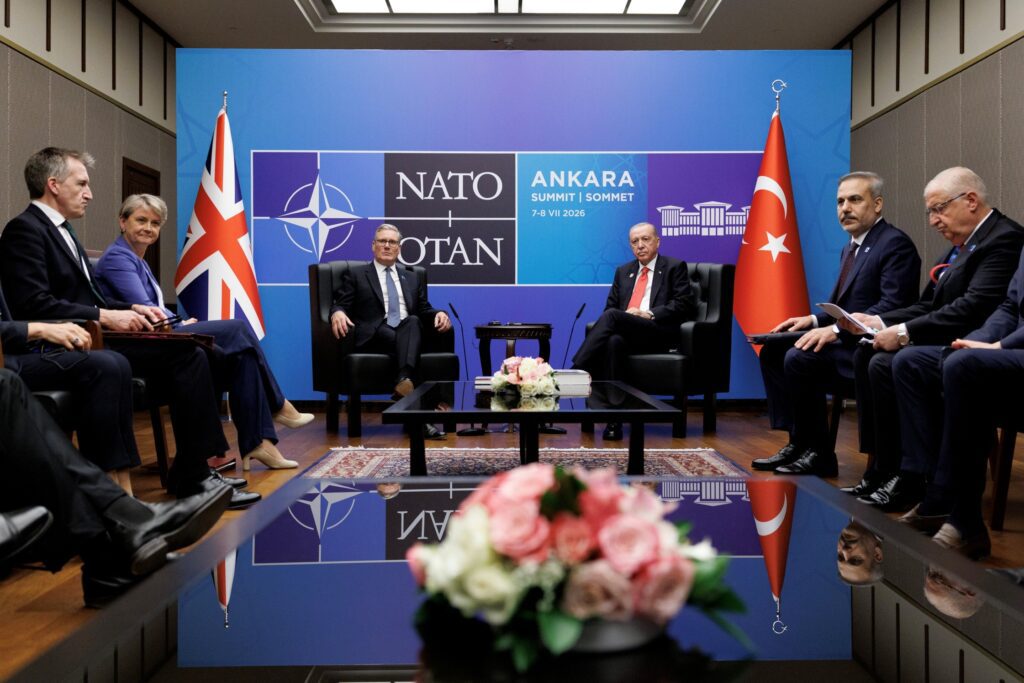
Burnham also signals a desire for closer European co-operation, particularly through the E3 grouping of the UK, France, and Germany. He wants to strengthen the European pillar within NATO and remove barriers to defence industrial co-operation.
This is one of the most important elements of his foreign policy positioning. It suggests a pragmatic post-Brexit approach that avoids reopening old arguments while seeking closer co-operation where British interests are clearly aligned with European partners.
He also links this to wider UK-EU negotiations, including illegal migration, economic security and resilience against terrorism and AI-driven disinformation. The message is that Europe is not simply a trading relationship or a diplomatic forum. It is a shared security space.
Defence, technology, migration, cyber resilience, and economic security are increasingly interconnected. Burnham appears to be arguing that Britain needs a more joined-up state to respond.
Values, institutions and international law
Burnham’s intervention also contains a values-based argument. He says Britain’s alliances must be built on interests and values, and that support for international law and institutions such as the UN extends UK influence.
This is a deliberate contrast with a world in which major powers are increasingly willing to ignore international norms. Burnham is positioning Britain as a country that should remain principled while also becoming more capable and resilient.
His argument is that values alone are not enough, and that military power alone will not secure Britain’s interests. In continuity with his predecessor, he is attempting to combine deterrence, industrial strength, alliance-building, and international legitimacy.
Transparency and public consent
Burnham also calls for greater public scrutiny of defence spending. He wants more detailed progress updates on major defence and infrastructure projects, with stronger accountability to prevent delays and cost overruns.
This reflects a wider theme in his political brand: the idea that government should be more open, more place-based and more accountable. Defence spending is often treated as distant from everyday politics, but Burnham argues that it must deliver social value as well as security.
That may become a major test of his position. Asking the public to support higher defence spending at a time of pressure on public services will require a clear explanation of trade-offs. Burnham’s answer is that defence investment can also support jobs, skills and economic renewal.
Foreign policy through No 10 North
Perhaps the most distinctive part of Burnham’s argument is his insistence that Britain’s strength at home and abroad are indivisible. Through No 10 North and further devolution, he says Britain should regenerate and reindustrialise all parts of the country as part of a broader security strategy.
This is foreign policy seen through the lens of place. Burnham is arguing that national resilience starts locally: in industrial towns, energy systems, hospitals, ports, supply chains, digital infrastructure and skilled workforces.
The result is a foreign policy doctrine that blends Labour’s traditional concern for workers and communities with a more hard-headed view of global threats. It accepts that Britain faces a more dangerous world but insists that the response cannot be left to defence policy alone.
Burnham’s message is therefore both international and domestic. Britain must remain committed to NATO, Ukraine, the US alliance, European co-operation, international law and the UN. But it must also use the demands of this new security era to rebuild its own industrial base and restore confidence in the state’s ability to protect people.
Whether that can be delivered is another question. Defence procurement is complex, industrial renewal takes time, and closer European co-operation will require careful diplomacy. But as a statement of direction, Burnham’s foreign policy pitch is clear: Britain should face a darker world by becoming more resilient, more productive, more allied and more rooted in the strength of its own communities.

You can still get a copy of our new edition of ChamberUK. Our parliamentary journal.
Photo: House of Commons