




Dr Rosie Godeseth
Medical Director, Genomics LtdSpeaking at the UKAI and Curia Healthcare and Life Sciences Parliamentary Showcase, Dr Rosie Godeseth highlighted how polygenic risk scores, artificial intelligence and large-scale health data could help the NHS identify disease risk earlier.
Dr Rosie Godeseth, Medical Director at Genomics Ltd, a UK-headquartered TechBio company founded in 2014, used her remarks at the UKAI and Curia Healthcare and Life Sciences Parliamentary Showcase in Parliament to set out how innovation in genomics could support one of the central ambitions of the NHS 10 Year Health Plan: moving from sickness to prevention.
A clinician by background, with higher specialist training in cardiology, Dr Godeseth explained how Genomics uses large-scale genetic and health data, artificial intelligence (AI) and proprietary analytics to accelerate drug discovery and support disease prevention. Her presentation focused on the potential of polygenic risk scores to identify people at higher risk of common diseases years before symptoms appear.
Genomics Ltd has built the world’s largest harmonised genotype-phenotype data resource, with over 40,000 genome-wide association studies, and is the exclusive polygenic risk score provider for Our Future Health, calculating scores for up to five million volunteers. Its Health Insights product is the first UKCA-marked, MHRA-registered PRS product of its kind.

Predicting risk before disease develops
Dr Godeseth began by explaining that common diseases are not usually caused by one single genetic mutation. Instead, polygenic risk reflects the combined effect of millions of small variations in a person’s DNA, which together can increase or decrease their likelihood of developing disease.
She used cardiovascular disease as a central example. Heart disease remains a major cause of morbidity and mortality in the UK, and Dr Godeseth highlighted the significant financial burden it places on both the NHS and the wider economy. Modelling based on UK Biobank data suggests that PRS could identify 1.9 million additional individuals as high-risk for cardiovascular disease beyond those currently found through standard tools, preventing approximately 45,300 cardiovascular events over ten years and saving the NHS over £235 million. She argued that polygenic risk scores can help identify people with a hidden high genetic risk of cardiovascular disease, including individuals who may not otherwise know they are at greater risk.
For example, she explained that a 45-year-old man with a high polygenic risk score for coronary artery disease shares the same risk level as a typical 65-year-old but 15 to 20 years ahead of his actual age. The implication is significant: identifying this risk early allows for timely, evidence-based interventions like statins, shifting the focus from treating developed disease to preventing it entirely.
Improving existing clinical tools
Dr Godeseth was clear that polygenic risk scores are not intended to replace existing clinical judgement or tools. Instead, they can strengthen them.
She said that adding genetics and polygenic risk scores to established clinical tools such as QRISK or PREVENT can improve identification of people at risk. This has been validated prospectively: the GENVASC study, a real-world NHS Health Check cohort followed for nearly eight years, found that adding PRS to QRISK2 increased detection sensitivity in 40–54-year-olds by 47.7%. Both the European Society of Cardiology (2025) and the American Heart Association (2022) have endorsed the clinical utility of PRS in cardiovascular risk prediction. Dr Godeseth also highlighted that PRS does more than identify risk, it guides treatment. According to the ESC Scientific Statement, statins are substantially more effective in high-PRS individuals, delivering approximately 44% relative cardiovascular risk reduction in the top PRS decile compared with approximately 24% in lower strata.
Genomics has tested this approach through the HEART clinical trial in NHS primary care in the North East of England, examining the clinical utility and feasibility of adding polygenic risk scores. Dr Godeseth said the work was useful for both clinicians and patients. It led GPs to make a different clinical decision in 13% of cases with 5.2% of participants were reclassified upward across the NICE 10% statin eligibility threshold. Patients responded positively: 98.8% found the test personally useful, 96.4% found it easy to understand, and no additional genetic counselling was required.
From evidence to scale
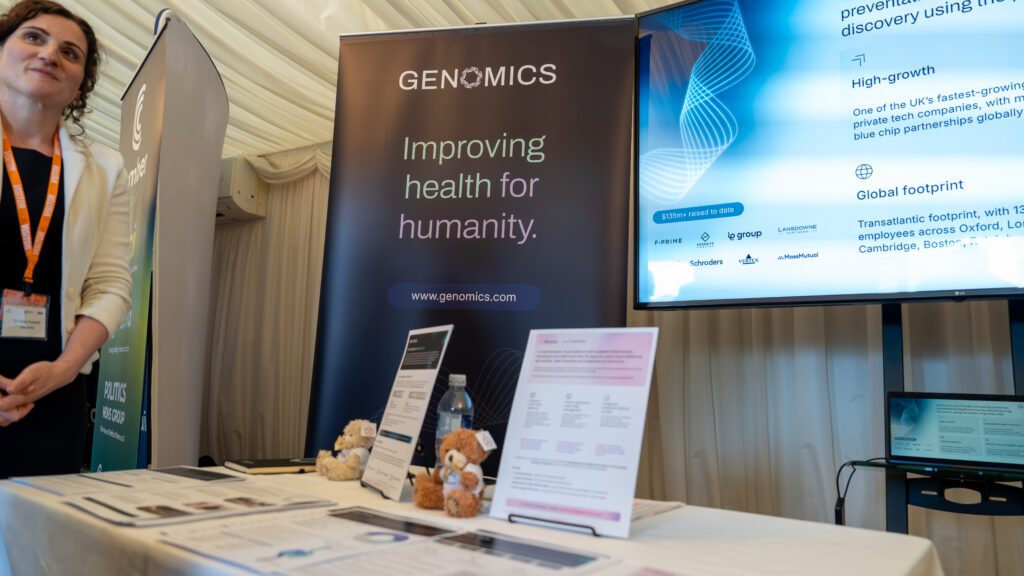
Dr Godeseth also explained that Genomics’ Health Insights product has been through regulation as a medical device and is the first UKCA-marked, MHRA-registered PRS product of its kind, approved for four disease areas: cardiovascular disease, prostate cancer, breast cancer and type 2 diabetes. Genomics is already active in the private sector, is the exclusive PRS provider for Our Future Health, partners to leading UK healthcare providers Bupa and Spire Healthcare and is in discussions with the NHS about supporting the 10 Year Health Plan’s prevention agenda. The NHS Plan itself commits to rolling out PRS universally and creating a new Genomics Population Health Service.
However, her central challenge was not whether the science exists. It was why technologies with regulatory approval; evidence of earlier prediction and clear potential actions are still difficult to scale.
Three barriers to preventive healthcare
Dr Godeseth identified three major barriers.
The first was financial. Prevention and prediction are often expected to compete with budgets designed to treat people who are already unwell. In practice, this means preventive innovation may be competing against immediate sickness and acute pressures, even when earlier intervention could reduce future demand.
The second barrier was evaluation. Many healthcare evidence frameworks are designed around diagnostic tools, where the result is often binary: disease is present or it is not. Prediction is different. It deals in probability and future risk. Dr Godeseth argued that if evaluation models remain built around diagnostics, they may struggle to capture the value of predictive technologies.
The third barrier was infrastructure. Genetic data is different from many other forms of health data because it is static. It can be collected once and used throughout a person’s life, not only for prevention but for multiple points in an individual’s lifetime, for example for treatment selection during disease, or pharmacogenomics to guide medication choice. Yet healthcare infrastructure is still largely designed around episodic care, not lifelong use of genomic information.

Building a preventive NHS
Dr Godeseth’s message was that genomics is ready to play a much larger role in healthcare, but the system around it must change. If the NHS is to move from reactive treatment to prevention, it will need funding models that reward earlier intervention, evaluation frameworks suited to prediction, and infrastructure capable of using genetic information safely across a person’s lifetime.
Across seven common diseases, research published in Nature Communications has shown that PRS-guided screening could reduce premature deaths in high-risk groups by 23.3%. Yet there is a risk that proven, deployable technology is held back while the system waits for next-generation AI and multi-omic tools that remain years from clinical readiness. Deploying what works today builds the infrastructure on which future innovations will depend.
Her remarks reinforced a wider theme of the showcase: innovation is already here. The challenge now is to reform the structures that determine whether it can reach patients at scale. Patients who could be identified and helped today should not continue to be missed while the system debates what comes next.