


Rt Hon Andrew Stephenson CBE
Former Minister of State for Health, Department of Health and Social CareChair, University Hospitals of Morecambe Bay NHS Foundation Trust
Chair, Curia, Health, Care, and Life Sciences Research Group
Writing on the forthcoming NHS strikes, resident doctors are set to strike again in June. Unless government and unions rebuild trust, industrial action risks becoming a recurring feature of NHS life rather than an exceptional moment of dispute.
Resident doctors will strike again from 15 to 19 June. As the Department of Health and Care Minister responsible for workforce between 2023 and 2024, I spent a great deal of time trying to resolve the industrial disputes that have become all too regular within the NHS.
Unless something radical happens, the question is less about whether further strikes will happen and more about how sustained and disruptive they are likely to be. For NHS leaders, the situation demands a clear-eyed assessment rather than political positioning.
A Dispute That Has Become More Entrenched
Recent history provides important context. Industrial disputes in the NHS are not new, but the scale and persistence of the current wave are unusual. The junior doctors’ contract dispute in 2015 and 2016 was, at the time, a significant escalation, marking the first full walkout in a generation. What has happened since 2022 is different.
Strike action has spread across multiple staff groups and, crucially, has been repeated over long periods rather than resolved quickly. By early 2026, resident doctors in England had already taken part in numerous rounds of industrial action since 2023, with fresh mandates extending that action further.
At the centre of the dispute is pay, but it would be a mistake to treat this as a short-term disagreement over percentages. The British Medical Association (BMA) has consistently argued that doctors’ pay has fallen substantially in real terms since 2008, often citing figures in the range of 20 to 25 per cent.
The Government, on the other hand, points to recent pay awards that it says represent significant increases and argues that meeting union demands in full would place an unsustainable burden on public finances.
These are not positions that can easily be reconciled through a compromise at the margins. They reflect fundamentally different views about what is fair and what is affordable.
Trust Between Ministers and Unions Has Eroded
This gap has fed into a more strained relationship between medical unions and ministers. The tone on both sides has hardened. Government figures have increasingly framed union demands as unrealistic, while union leaders have questioned the credibility of government offers and the independence of the pay review process.
That matters because the NHS has traditionally relied on a degree of partnership working, even during disputes. Once that trust erodes, negotiations become more about leverage than resolution.
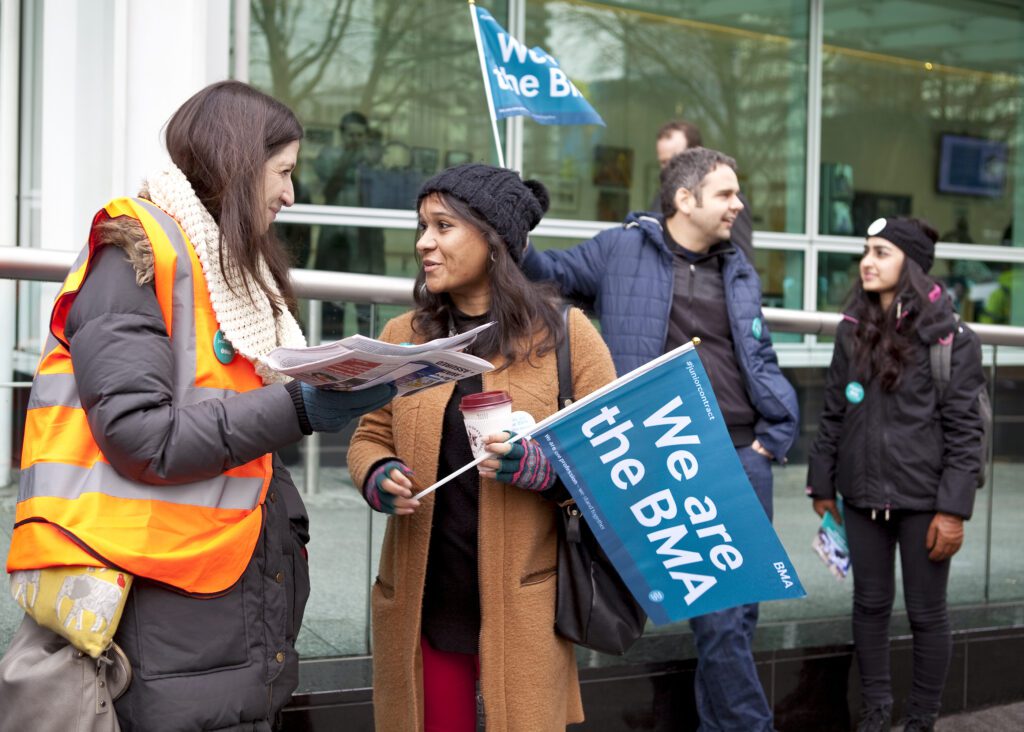
There has also been a shift within the unions themselves. In the case of the BMA, internal changes over recent years have led to a more assertive approach, backed by members who have repeatedly voted in favour of continued strike action.
That suggests this is not simply leadership driven militancy, but a broader reflection of workforce sentiment. At the same time, there are signs of disagreement within the profession about how effective or sustainable ongoing strikes are, particularly as disruption accumulates.

The NHS Is Managing Strikes, But at a Cost
From the perspective of NHS organisations, one notable development is that the system has become more adept at managing strike periods. During recent rounds of industrial action, a large proportion of planned care has still gone ahead, albeit with considerable effort, cost and reliance on goodwill from non-striking staff.
This resilience is important, but it creates a complicated dynamic. If strikes do not lead to visible system failure, they may exert less immediate pressure on government. Yet the cumulative financial and operational strain is significant and cannot continue indefinitely without consequences for service quality and staff morale.
Public opinion is another factor that cannot be ignored. Early in the current wave of strikes, there was relatively strong public sympathy for NHS staff. Over time, that support appears to have become more mixed, particularly as waiting lists remain high and patients experience repeated disruption.
A prolonged dispute risks eroding that support further, which in turn may influence the strategies of both unions and ministers.
Further Industrial Action Remains Likely
So, what does this mean for the likelihood of further industrial action after the latest dates announced today? On balance, it remains high. The core drivers of the dispute are still in place: a long running disagreement over pay, a breakdown in trust between key actors, and a workforce that has shown it is willing to continue taking action.
There is no clear sign yet of a settlement that addresses these issues in a way that both sides can accept.
That said, the pattern of action may evolve. Rather than continuous escalation, it is more likely that we will see intermittent and targeted strikes, designed to maintain pressure while limiting the risk of losing public support.
The new Secretary of State may continue to pursue incremental pay offers, potentially linked to wider workforce reforms, while unions may adjust their tactics in response to both internal pressures and public sentiment.
Ministers Must Address the Underlying Workforce Challenge
For NHS leaders, the immediate priority remains maintaining patient care and supporting staff through a difficult period. But there is also a broader point. The current cycle of industrial action reflects deeper structural issues in how the NHS manages workforce planning, pay progression and industrial relations.
Without addressing those underlying problems, there is a real risk that disputes of this kind become the norm rather than the exception.