
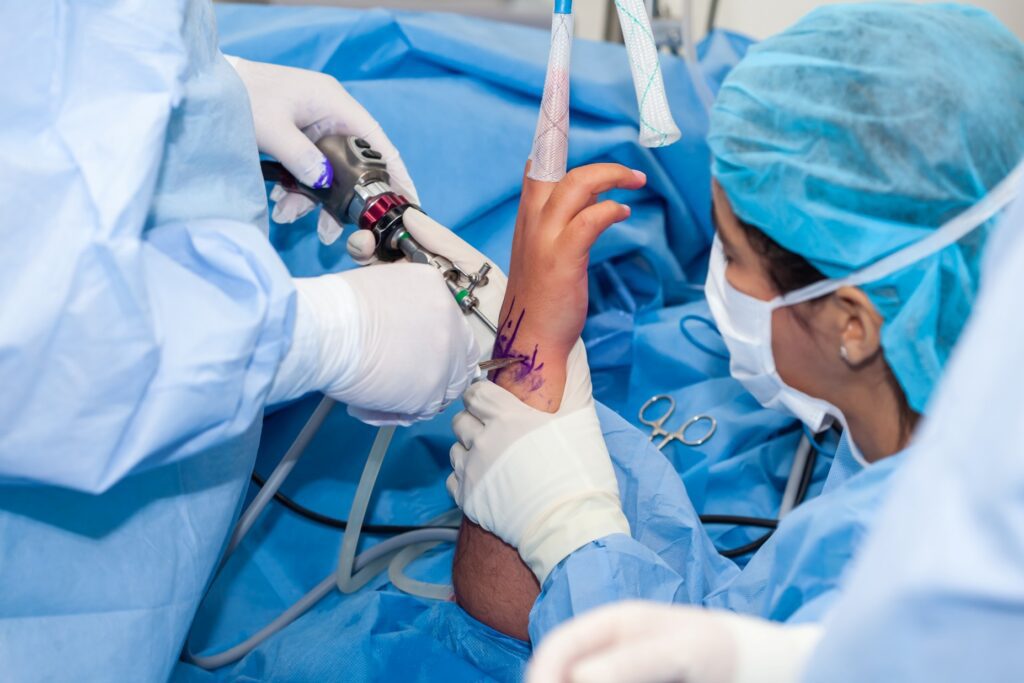
Thousands of NHS patients awaiting hip and knee replacements face potential delays after a major disruption to the supply of surgical bone cement – a material essential to securing artificial joints.
The issue follows a production halt at Heraeus Medical, the German firm that supplies roughly three-quarters of the bone cement used across the NHS. The company has paused production at its main site for at least two months after a critical machine failure during upgrades to its manufacturing process.
The product is used in around 1,000 NHS operations every week – primarily knee replacements, but also some hip and shoulder procedures. With such heavy reliance on a single supplier, the disruption has immediate national consequences.
Hospitals are understood to hold approximately two weeks’ supply in stock. Beyond that, systems may need to rely on alternative manufacturers or begin rescheduling planned procedures.
What Bone Cement Does – And Why It Matters
Bone cement is central to many joint replacement operations. During surgery, it acts as a fast-hardening binding agent between the implant and the patient’s existing bone, stabilising the joint and enabling mobility.
Some formulations are infused with antibiotics. These are used in cases where infection risk is higher or in complex revision surgeries, where a previous joint replacement has failed or become infected. In two-stage procedures, antibiotic cement can also be used to create temporary spacers while infection is treated before a new implant is fitted.
The shortage therefore affects not only routine elective surgery but also certain urgent and revision cases where specialist cement products are clinically required.
While products already in circulation remain safe and compliant, the interruption to new supply places significant pressure on surgical scheduling.
Prioritising Trauma Over Elective Care
Guidance from NHS England instructs hospitals to prioritise trauma and urgent care over routine elective procedures during the disruption.
In practice, this means older patients who have suffered fractures – often following falls – and those requiring emergency orthopaedic surgery are likely to take precedence over patients awaiting planned joint replacement.
Systems are being asked to focus on those in the greatest pain or with the most complex conditions. Meanwhile, efforts are underway to increase supply from four alternative manufacturers.
An NHS spokesperson confirmed the disruption is affecting supply globally and said immediate guidance has been issued to ensure trauma care can continue safely, alternative suppliers can be used where possible, and waiting lists are prioritised according to clinical need.
A Specialty Already Under Pressure
The timing could scarcely be worse.
Orthopaedics represents the largest waiting list of any specialty in England. Around 850,000 patients are currently awaiting treatment for joint-related conditions. More than 31,000 people are waiting for a hip replacement and nearly 50,000 for a knee replacement, with average waits stretching beyond six months in many areas.
Across 2023/24, the NHS carried out approximately 120,000 hip replacements and 96,000 knee replacements. Even a short disruption in supply could affect thousands of scheduled procedures.
More broadly, the elective backlog remains formidable, with over 7.3 million treatments in the queue across England. Around 190,000 patients have already been waiting at least a year for hospital care.
Joint replacement surgery is rarely cosmetic or optional. For many, it marks the difference between immobility and independence.
A “Crushing Blow” for Patients
Deborah Alsina, Chief Executive of Arthritis UK, described the shortage as “a crushing blow” for patients who have already endured prolonged waits.
“This is a crushing blow for those individuals who have finally made it to the front of the orthopaedic surgery queue after a long time waiting,” she said.
She urged hospitals to communicate quickly and clearly with those affected to minimise additional anxiety.
“We urge hospitals to communicate quickly with those affected to avoid additional worry and uncertainty.
“Aside from the personal toll on people with arthritis, the stakes are high for government who have an uphill challenge to bring down waiting lists to meet ambitious targets.”
Her remarks underline the dual pressure on ministers: protecting patients’ wellbeing while also meeting politically sensitive elective recovery targets.
Ben Howlett, Chief Executive of policy institute, Curia, said:
“This is a stark reminder that elective recovery is not just about workforce and theatre space – it depends on resilient supply chains. When a single manufacturing fault can disrupt thousands of operations, we need to ask serious questions about procurement concentration and contingency planning. Patients who have already waited months in pain should not bear the consequences of supply fragility. Have we learnt anything from the pandemic?”
Surgeons Seek to Mitigate Impact
Fergal Monsell of the British Orthopaedic Association said the organisation is working with NHS leaders to limit the impact on patients.
Hospitals may pivot towards procedures that do not require bone cement where clinically appropriate, using available theatre capacity and surgical teams for alternative orthopaedic work while supply remains constrained.
“The BOA will update surgeons with developments so they can treat their patients as the situation develops,” he said.
Such mitigation may soften the blow, but it cannot fully offset disruption in a system already stretched.
A Test of Procurement Resilience
Beyond the immediate clinical consequences, the episode exposes structural vulnerabilities in NHS supply chains.
Under national procurement frameworks, Heraeus Medical holds a substantial share of the orthopaedic cement market. Concentrated purchasing arrangements can deliver economies of scale and cost efficiencies. Yet heavy reliance on a dominant supplier creates systemic risk when production falters.
The disruption echoes wider lessons from pandemic-era shortages, when global manufacturing shocks rippled through domestic healthcare provision.
As ministers pursue ambitious targets to cut waiting lists and restore routine care, supply chain resilience may move higher up the political agenda. Reducing backlogs depends not only on workforce and funding, but also on reliable access to surgical consumables.
What Happens Next?
Heraeus Medical has indicated it aims to restart production as quickly as possible, though the manufacturing cycle means shortages could persist for at least two months.
In the meantime, the NHS is co-ordinating nationally to protect urgent care, expand alternative supply routes and minimise delays wherever possible.
For the hundreds of thousands awaiting joint treatment, the hope is that the disruption proves short-lived.
For policymakers, the episode is a reminder that elective recovery rests on more than capacity alone. It also depends on resilient procurement, diversified manufacturing and transparent communication with patients whose lives remain, quite literally, on hold.