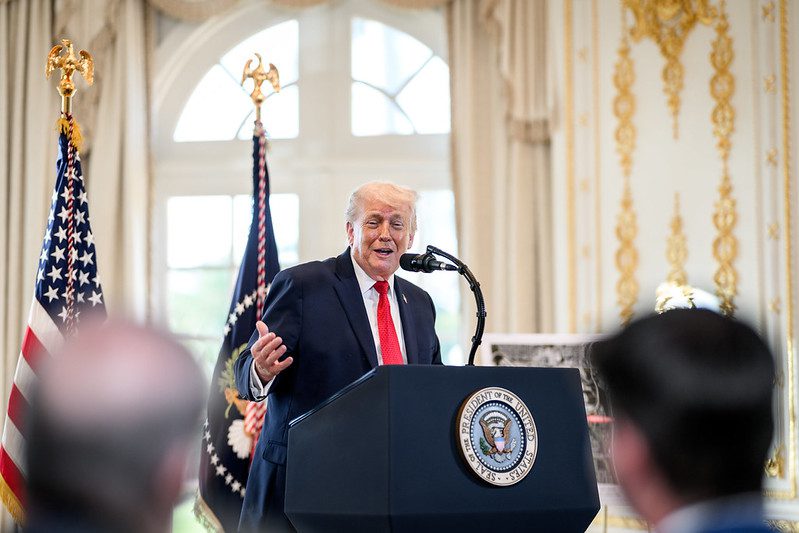

It is well known that New Year’s resolutions are often broken, but this year Donald Trump might have set the record for the fastest yet. Days after declaring that his 2026 resolution was “peace on earth,” the US President invaded a sovereign country and captured its president, threatened to annex an autonomous territory, and invited 60 nations to join a US-led private members’ club seeking power in the Middle East. 2026 is already promising to be a more dramatic year than 2025.
Yet Trump is just the latest in a long line of American presidents who, since the nation’s founding, have employed the tactics of gunboat diplomacy and economic intimidation to further US interests while bulldozing over anyone who stood in their way. Although Trump’s style of imperialism may not be new, what we are experiencing now is the fracturing of an international order that has shaped global relations since WWII, and with it, the sense of security that has been taken for granted by too many of us for too long.
Following WWII, principles of self-determination, human rights, and collective accountability were enshrined in global politics through international structures including the United Nations (1945), the Universal Declaration of Human Rights (1948), and NATO (1949). Yet Trump’s declaration that “I don’t need international law,” only “my own morality, my own mind,” indicates that these institutions are no longer enough to constrain the ambitions of world leaders.
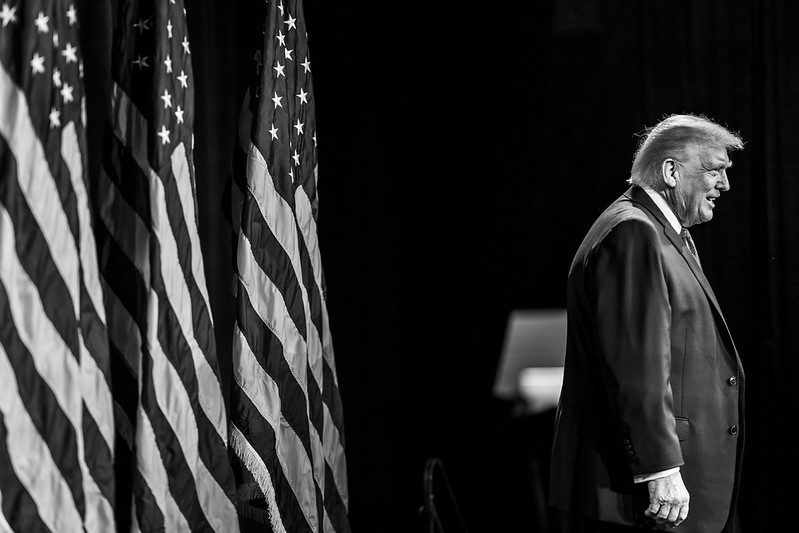
Image: President Donald Trump delivers remarks at the Donald J. Trump – The White House / Daniel Torok
It is no secret that the US empire never disappeared, surviving the era of anti-colonialism in the form of global military bases and five permanently inhabited territories: Puerto Rico, Guam, the US Virgin Islands, American Samoa, and the Northern Mariana Islands. Yet we are now seeing the most explicit re-embracing of the US’s role as an imperial power since the drive for decolonization and anti-imperialism following WWII.
On January 5, 2026, US Homeland Security Advisor and deputy chief of staff for policy Stephen Miller posted: “Not long after World War II the West dissolved its empires and colonies, sending colossal sums of taxpayer-funded aid to those former territories (despite having already made them far wealthier and more successful).” He described this as “a kind of reverse colonization,” declaring that “the neoliberal experiment, at its core, has been a long self-punishment of the places and peoples that built the modern world.”
It seems that empire is no longer a dirty word in international politics, a fact made stark by the return of rhetoric lifted from the 1823 Monroe Doctrine. In the November National Security Strategy, the administration promised to “reassert and enforce” the doctrine “to restore American pre-eminence in the Western Hemisphere.”
The Monroe Doctrine was a staple of nineteenth-century US imperialism, warning European powers to refrain from intervening in the Western Hemisphere. It delineated the region as the exclusive sphere of US influence and was strengthened by the 1904 “Roosevelt Corollary,” which explicitly justified interventions across Latin America. The new “Trump Corollary” announced in the National Security Strategy signaled Trump’s return to an aggressive style of foreign policy and his intention to ramp up regional intervention.
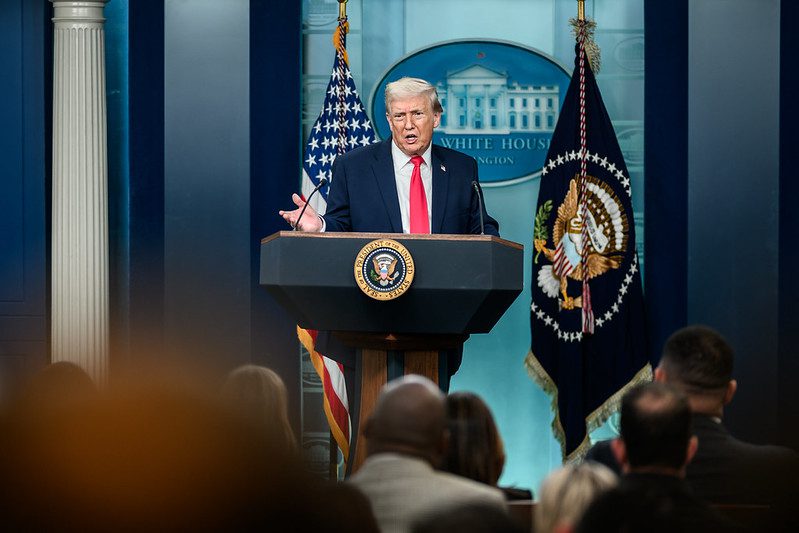
Image: President Donald Trump addresses members of the media in the James S. Brady Press Briefing Room – The White House / Daniel Torok
Trump stayed true to his word when, on January 3, 2026, he launched a military strike in Venezuela and captured its leader, Nicolás Maduro. It seemed as if his New Year’s resolution of three days prior was all but forgotten. Trump blamed Maduro for the arrival of hundreds of thousands of Venezuelan migrants in the US and, without evidence, accused the Venezuelan leader of “emptying his prisons and insane asylums.” Trump labelled two Venezuelan criminal groups as Foreign Terrorist Organizations and accused Maduro of leading one himself. The Venezuelan leader was then indicted in the US on charges relating to “narco-terrorism” and conspiracy to import cocaine, which he denies.
In a press conference on the day of the attack, Trump announced that President Monroe’s 1823 principles were now being referred to as the “Donroe Doctrine.” A post on X by the Department of State on January 5 declared: “This is OUR Hemisphere, and President Trump will not allow our security to be threatened.”
Yet Trump’s imperial ambitions did not end with Latin America. He has repeatedly insisted that the US will annex Greenland, an autonomous territory of the Kingdom of Denmark, to protect it from perceived threats from Russia and China. Although backing down from threats to acquire the territory by force and impose 10% import taxes on eight countries that had opposed his plans, he insisted that a “framework of a future deal with respect to Greenland and, in fact, the entire Arctic Region” is in place.
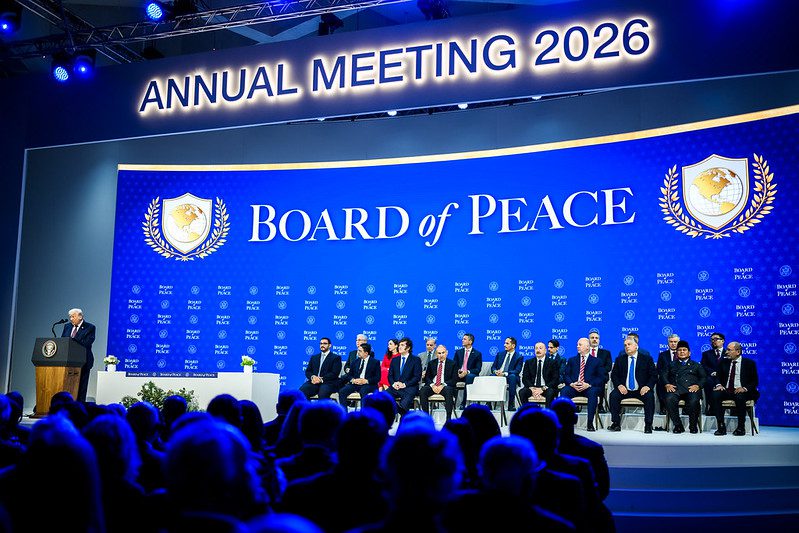
Image: President Trump participates in the Board of Peace Charter Announcement and Signing ceremony during the World Economic Forum – The White House / Daniel Torok
Turning to the Middle East, Trump is also growing his “Board of Peace” that was established to oversee the ceasefire in Gaza but has transitioned into something far more concerning. There is not a single mention of Gaza in the board’s charter, a text that seems to be an attempt to replace the UN Charter of 1945. Rather than promote self-determination and human rights, Trump’s charter bolsters him as an omnipotent chairman with complete control over meetings and discussions.
A life membership on the board stands at $1 billion in “cash funds,” effectively making it a private members’ club with no representation for the people it will govern. It is an alarming exercise of Trump’s megalomania and a palpable threat to the existing structures that govern international politics.
Of course, Trump is not entirely beyond restraint. His ambitions are subject to market pressures and political relationships, but we must not underestimate the threat he represents to the established world order. There is no doubt that we are entering a new era of global politics, and it is one in which international law is becoming increasingly discardable.
Featured Image via The White House / Daniel Torok