

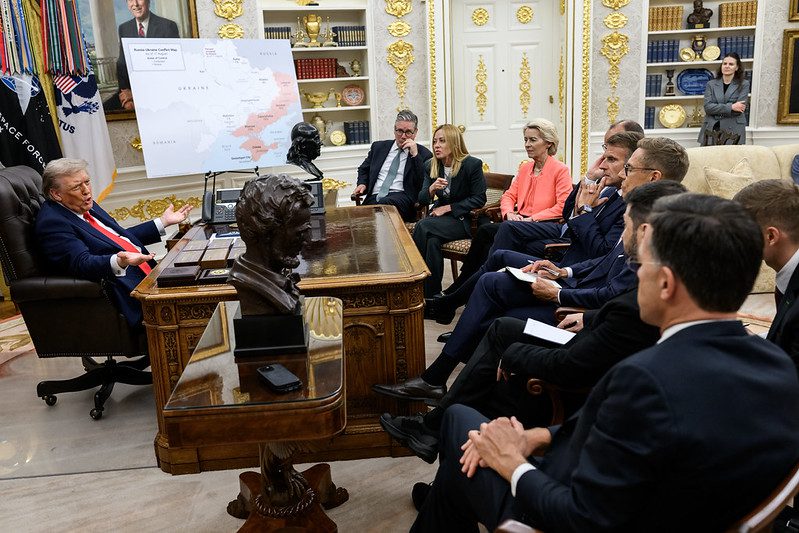
It would certainly be apt to assert that international relations imploded during 2025. To arraign Trump’s administration as solely responsible for such a dangerous breakdown in global cohesion wouldn’t be truly fair, however, over the last year, American foreign policy has undeniably caused considerable damage to relations with the rest of the world, whilst also intensifying regional tensions within the Middle East and Eastern Europe alike.
The Megalomaniacal Turn in Diplomacy
American foreign policy has always been somewhat contentious, from Cold War tensions to Bush’s ill-fated War on Terror. Yet, during Trump’s second administration, it has become increasingly controversial and potentially self-destructive, perhaps due to the fact a megalomaniacal narcissist has come to occupy the highest office in America.
Trump’s rhetoric from the beginning of his presidency has been subversive, suggesting that the US has funded NATO and other allied countries far too long, getting little in return. Although Trump isn’t completely inaccurate in his assessment of the stark disparities in international defence contributions, his assertion could not have come at a worse time. Deciding to review major foreign aid commitments, at a time in which war continues to ravage Ukraine, is not just politically insane, it is cruelly inhumane.
The Ukrainian Conflict and Performative Self-Praise
Arguably, the Ukrainian issue has defined Trump’s attempt to navigate foreign policy. From the very outset, Trump declared he would end the Russo-Ukrainian conflict quickly to undermine Biden and his relative failings. This promise has turned out to be impossible to fulfill. In fact, to refer to the preliminary stages of negotiation as an attempt to restore peace would be absolutely ludicrous, considering the events of Trump and Zelenskyy’s televised meeting at the Oval Office in February.
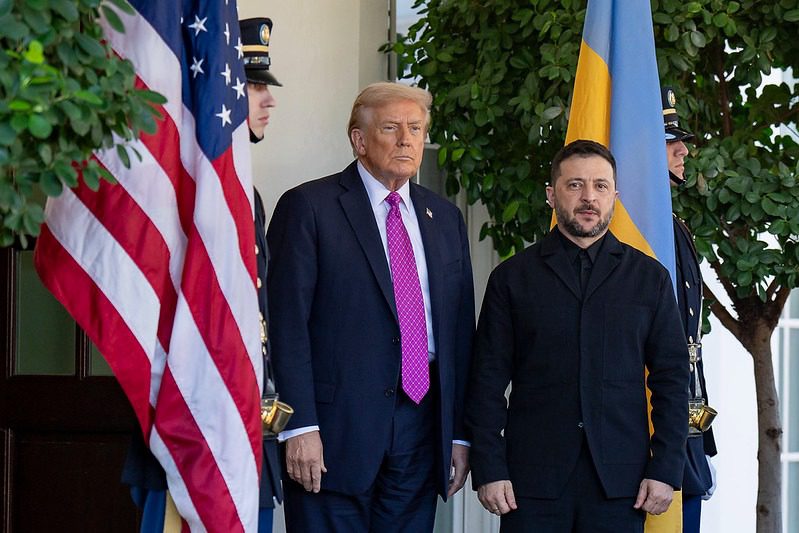
Image: President Trump greets Ukrainian President Volodymyr Zelenskyy at the West Wing Lobby entrance of the White House – The White House / Juliana Luz
Not only did Trump refer to Zelenskyyy as a dictator for attempting to guarantee Ukrainian security, but notably both Trump and VP J.D. Vance demeaned Zelenskyy for over ten minutes, resulting in international condemnation. Trump’s attempts at peace-making should not be seen as altruistic. Instead, they are simply performative, poised to ensure Trump’s legacy is as impressive as possible.
Courting the “Beast in the East”
It would be impossible to consider American relations with Ukraine without considering Russia, or rather, the Beast in the East, whom Trump seems eager to please. Trump’s relationship with Putin implies a new age of super-power co-operation under a masterplan to transform global politics. After all, Putin has managed to do what Trump and his followers dream of: maintaining power long enough to assert complete control over the country and the manner in which state control is ensured.
Trump’s actions aren’t completely nonsensical in theory; if America was to improve relations with Russia, Trump may be able to reduce the risk of direct NATO-Russian confrontation. However, modern technology means the concept of mutually assured destruction is completely useless, implying Putin could still be pushed toward his nuclear arsenal. Increasingly, the USA is becoming less significant in world affairs, losing influence to China. It seems Trump’s attempts to prostrate himself at the feet of Russian supremacy are in vain.
Transactional Peace: From South Asia to the Congo
Trump’s desire to be viewed as the “greatest President of all time” led to a series of performative interventions across the globe. He claimed credit for halting an air war between India and Pakistan in May, a move that prompted the Pakistani government to endorse him for the Nobel Prize even as India remained sceptical of his “diplomatic and trade crisis” tactics.
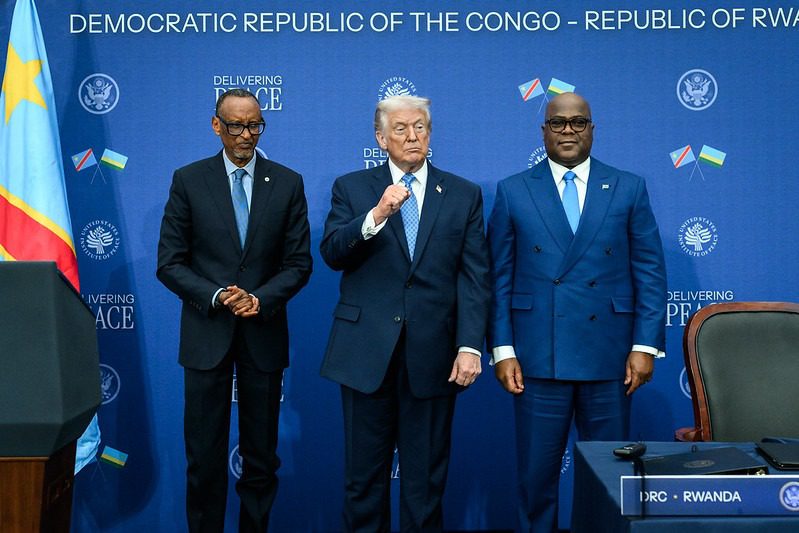
Image: President Trump, President Paul Kagame of the Republic of Rwanda and President Felix Tshisekedi of the Democratic Republic of Congo, following the signing of the Washington Peace Accords – The White House / Daniel Torok
Similarly, he mediated the Kuala Lumpur Peace Accord in October to briefly halt border clashes between Thailand and Cambodia, and the Washington Accords in June to end conflict between the DRC and Rwanda. While these were celebrated as milestones, they were often transparently transactional; the DRC deal, for example, was heavily tied to securing American access to critical minerals, proving that Trump’s “peace” is often a byproduct of American economic interests. The Thailand and Cambodia deal has since collapsed in December, however, recent efforts have eased fighting whilst the DRC and Rwanda have also blamed each other for carrying out military operations.
The Israel-Palestine Failure and the Nobel Pursuit
Trump’s peace proposal for the Israel-Palestine conflict further proves his pursuit of the Nobel Peace Prize. Remaining firmly on the side of Netanyahu, his proposals have been questionable, most notably the scrapped decision to place Tony Blair in charge of governing a neutral Gaza. Blair is despised in the Middle East for his actions during the War on Terror, proving Trump has very little grasp on how to ensure actual peace.
FIFA: The Consolidation of the “Peace President”
Perhaps the most surreal moment of the year occurred on December 5th, during the draw for the 2026 FIFA World Cup. After being overlooked for the Nobel Peace Prize, which was awarded to Venezuelan opposition leader María Corina Machado, Trump was presented with the inaugural FIFA Peace Prize by Gianni Infantino.
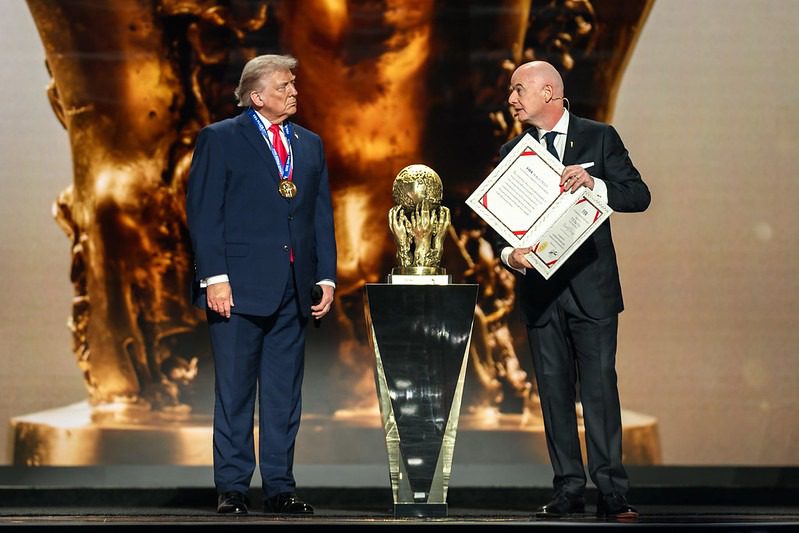
Image: President Trump accepts the inaugural FIFA Peace Prize from FIFA President Gianni Infantino – The White House / Daniel Torok
The award, a golden trophy of hands holding the world, was widely viewed as a consolation prize. Accepting it at the Kennedy Center, Trump claimed he had “saved millions and millions of lives” in places like the Congo and South Asia. This bizarre fusion of sport and statecraft served as the ultimate validation of Trump’s manufactured cohesion, positioning him as a global unifier even as his policies continued to alienate traditional allies.
Throughout 2025, Trump’s attempts at foreign policy have been controversial and ineffective. In attempting to portray himself as a global peace-broker, Trump has prevented actual progress in major conflicts, ensuring that fighting will continue into 2026. The world shall have to wait with bated breath to determine whether Trump can truly bring in a new age of peace or if he has merely accelerated global instability.
Featured Image via The White House / Daniel Torok